Showing posts with label philosophy. Show all posts

Tuesday, 13 July 2010

London Calling?


I came back from San Francisco and I hated London.  I've never had that feeling about London before, but where it had always been exciting and vibrant, it was suddenly closed in and narrow and full of hollow people.  I'm sure that in large part the reason for this was what I'd left behind in San Francisco.  Who.  But more than that.  I loved how, at least in the parts I was hanging out in, I could really feel that it was a city for everyone, from all walks of life and all backgrounds.  The London I know is a homogeneous place of well educated well off people - often monotonous and at worst stagnant.

I fully admit that this is a mere impression, limited as much by my own background and what I have so far found in London.  There's a lot more to the place than the people on the train and the people in the offices in the City, but they are the ones I see all the time.  And they all have more to them I would hope than the commute, the job and an expensive bed they hardly see.  I'm just worried that many of them don't.  I love my friends, and I know them well enough to know that they have dreams that go further than what they happen to be doing right now.  That the job isn't the be all and end all.  We are all of us in that circle the middle class products of a middle class upbringing and a thorough education.  Factory made, almost.  There hasn't been a lot of space for mutation or variation to appear.  I guess I'm concerned that where such things do appear they are either ignored or papered over, rather than grown and developed and encouraged and valued.  

[Ha.  Picking something more or less at random to listen to while writing, I hit The Clash and find myself listening to London Calling, all about the other bits of London - which definitely exist even if I don't see them so much for myself.]


It's comforting and reassuring and impervious and safe, that fairly moneyed, fairly engaging existence.  That's good as far as it goes.  I'm very lucky indeed to have been born when I was to who I was, I know that.  I'm allowed to be a free independent modern woman, able to make my own living.  But it's a well-worn path - exactly what each of us was expected to do when our parents sent us all off at good schools at the age of 4.  The people who start out as the children of one earnings bracket step up to take their parents' places.  They even do the very same jobs their parents do.  Both of my close lawyer friends are the children of lawyers. Of course there are logical reasons for this to happen even though we all might rather it was rather less rigid than it seems to be.  Elaine (who is Irish) said to me a few months ago that she was always amazed at how class ridden British* society is, how little social mobility there is.  I am intrigued to find that it is less so in other countries, though relieved that it isn't the same everywhere - perhaps Britain can change.

Tom put it the best - 'people are following life, not chasing it'.  It's very easy to keep putting one foot in front of the other along the clear course and never to look to right or left.  I don't want to be that person.  I want to take in the view at the very least and wonder all the time about whether it would be better to drop out of the race and try out the path I can see over there.  It's not the path itself that is wrong, it is the blind choosing of it.  The passivity of never imagining anything different.  I should say that I haven't had this conversation with any of these people - it may very well be that everybody I know has thought long and hard about what else they could be doing and is well aware of what else is out there and how other people live, for them to choose if they want to.  It's what I'm doing, after all, or will be if my civil service job ever materialises. I am not in any way indicting or judging my friends for following it.  Just hoping that they are active in choice.

But it is awkward to keep looking around you.  I remember a conversation I had with my dad when I was 14 or so, when I said I believed that there was always hope, whatever happened.  He said that that was an uncomfortable way to live because it meant that one would never be content with what one actually had.  Maybe the day-dreaming about life as a chef or a gardener, both of which are well outside the ordered 9am to 1am city job spec, is the same - never content with the good of what is in front of me, not quite grateful for what I have.  I'm trying to avoid that too, without numbing myself.  Perhaps what I'm really saying is something I've talked about before, about ringing everything out of every experience and being aware of what experiences are available - not letting them roll on by without a glance.


*Yes, British.  I think this certainly still happens in Scotland and Northern Ireland and Wales, too.  The Irish Republic is different.

Sunday, 20 June 2010

Somebody pressed the accelerator.


And time disappeared.  San Francisco is a fantastic place.  It's like falling down the rabbit hole - it never pays to assume anything about anybody, no matter how ordinary they might seem at first.  Everyone has a story and an idea.  Everybody is involved in a cause.  Everybody makes and does.  Everyone is determinedly and unselfconsciously individual.  Everybody (*everybody*) does yoga.  I've never come across anywhere where it was so difficult to buy food that wasn't organic.  Nobody runs with a crowd.  Where is the crowd?


It couldn't exist in England.  We are too cynical, too into bathos, too proud.  Too concerned with the neighbours and keeping up with the Joneses.  I guess that is true in a large number of places in this country too, but not, I have the impression, in urban California.  I kind of miss the self-deprecating British humour, I think in the right dosage it can generate humility and hence tolerance (we often get it wrong and use it to support arrogance or discourage ambition, both of which damage our society).  Not that San Francisco is in any way intolerant.  We could do with a bit of optimism back home; we lack it.  A really big bit.


Things I have learned in San Francisco, so far, with 10 days left to go:
 - How to smile at strangers.
 - Most people, really, are friendly if you talk to them right.
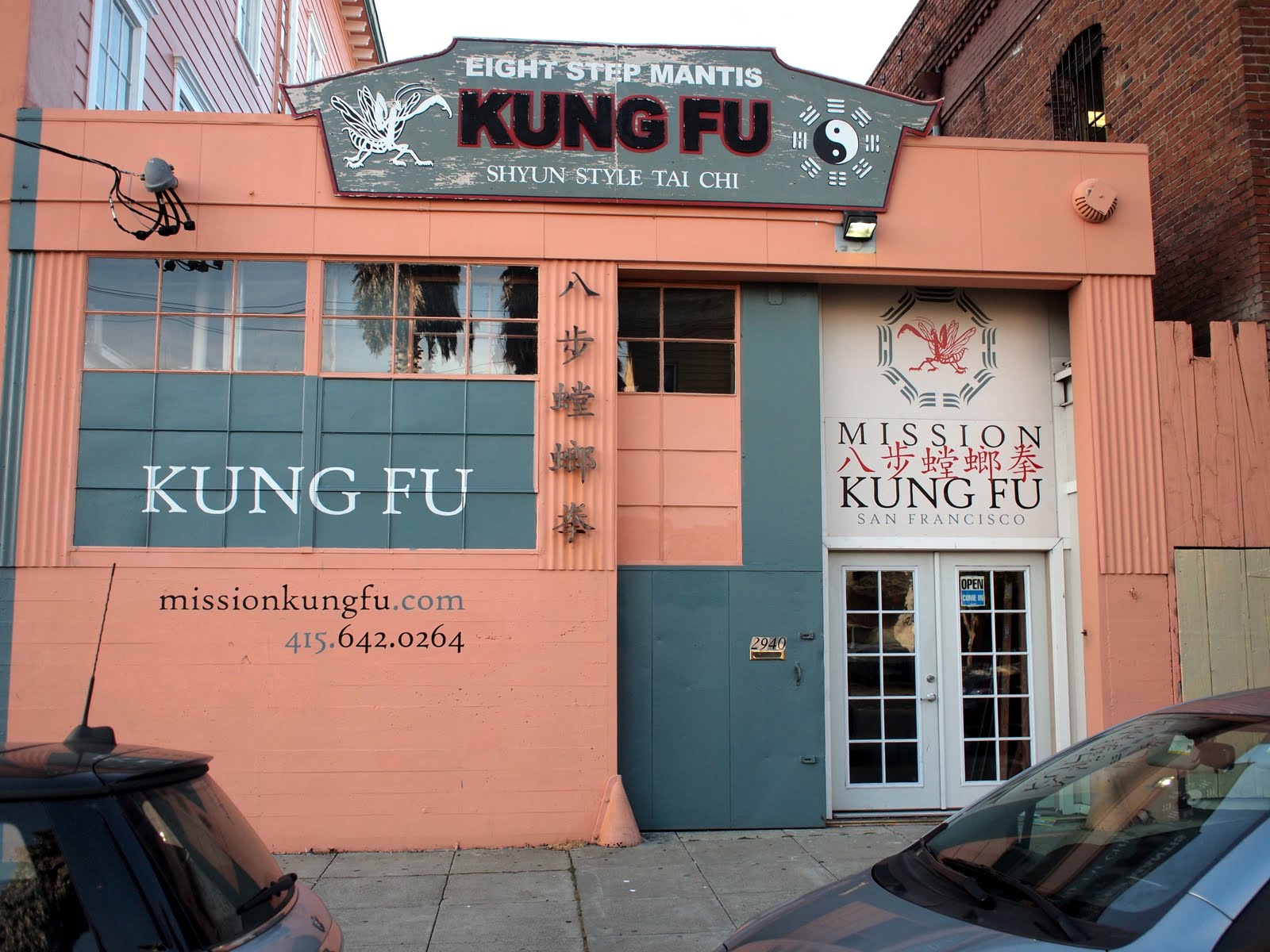
 - Kung Fu.

     - How to paint a wall (they're different to stages).


     - Quirky people are most people, if you find the right space for them.
     - What hemlock looks like.


     - How to change a bike tyre.
     - How to fit new brake blocks.


     - That however tired you are, the view from the top is worth the effort of the harder path.


     - What a beaver* looks like!


     - Constant searching for betterment prevents enjoyment of the now.
     - It is possible to conform to being a non-conformist.

    More things.

    *Behave.

    Sunday, 7 March 2010

    Adventures.

     (here)

    Well.  On the 29th of January Charissa and Tedd arrived from Florida.  On the 31st of January we went for a drive of 2,500 miles and got back on Valentine's Day.  And then we all went to Cambridge and picked up some other People We Know - and a few we didn't until that day.  Over the next three weeks there were always people sleeping on floors, in Cambridge or St Albans or London.  Often they were me.  Rarely just me.  There were folk songs and whiskey at 3am.  There was charades in a room with 6 nationalities, 12 or so people and around 30 degrees of various sorts.  The kind of game where C19th literature of any of 5 at least cultures would be guessed instantly and references to popular culture led to 10 minutes of head scratching and incredulous cries of 'that's a FILM?'.  There has been poetry and cellos and theatre and home made bread.  And photographs and home developing.  And concerts and gigs and alwaysmusic, written or sung or chosen with purpose always by people I know.  There have been black tie parties and rainy walks around London for art galleries and cake.  There was a WEDDING.  There have been strangers who became friends never to be forgotten. Old friends and new friends and new places and thinking and the watching of the spring.

    And today is the first evening I'm spending alone in my house since the 28th January. 

    Goodness.

    I'm not done yet.  This is a lull between Trips.  There are more friends here this week, and there are Plans for Dublin in a few weeks.  The prospect of spending time with yet more of the best people in the world makes everything wonderful.

    I'm feeling peaceful.  I've had a crazy month or two - in a different way from the ones before.  There have been adventures of all the best kinds, in contrast to angst and aching and a freezing of the limbs that characterised the time before.  I feel spring cleaned and awoken.  There's a whole world full of things to see and do.  I have been trapped in this house; it has been awkward and cold and dark and confused, and now it is full of possibilities again.  There might be Paris (three months, to learn) and San Francisco (three or six weeks, to know).  But those aren't the point really.  The new beginning that I have needed for half a year or more feels like it might be here, despite the fact that I still have no prospect of a job in the nearest future.  2010 is finally here.  I finally feel that I can look at 2009 with objectivity, and see its pure highs and lows without feeling them all at once.

    Monday, 18 January 2010

    Truancy...


    ...I've been posting some very long and moderately complicated thoughts about agnosticism over on Philip's blog.  Which is my excuse for not having had anything serious to put here for a little while.  There are a lot of words in those comments, but the whole conversation is one that I feel coalesces some old thoughts quite neatly.  It addresses why, for me, agnostic is all that I can be, despite leanings towards atheism.  I will always sit on the fence.  I will never say never.  It might be a little uncomfortable, but you get a good view from every angle.

    "There are more things in heaven and earth, Horatio,
    Than are dreamt of in your philosophy."
    (Hamlet 1:5:166-7) 


     It's been a long time since I read any Hume - he's an interesting member of the C18th British Empiricists that I could never muster much enthusiasm for at university.  They make some very interesting points as a group, but for the most part I wish they would say it in one tenth or less of the volume of Latinate prose.


    I've also been playing with a film scanner lent me by the inimitable Graham.  I'm pleased with the results, and I'm learning masses about processing quality, film speeds and their effects and what difference a camera makes.  See some of my favourites scattered through this post from the last month or so, posted purely for self-gratification plskthanxbi...


    P.S. Tomorrow, I intend to make crumpets and start making bacon.  And read some more of some of the many decent books sitting on top of my wardrobe to read...  Usual blog fodder again :-).


    Monday, 21 December 2009

    'The tempter or the tempted, who sins most?'

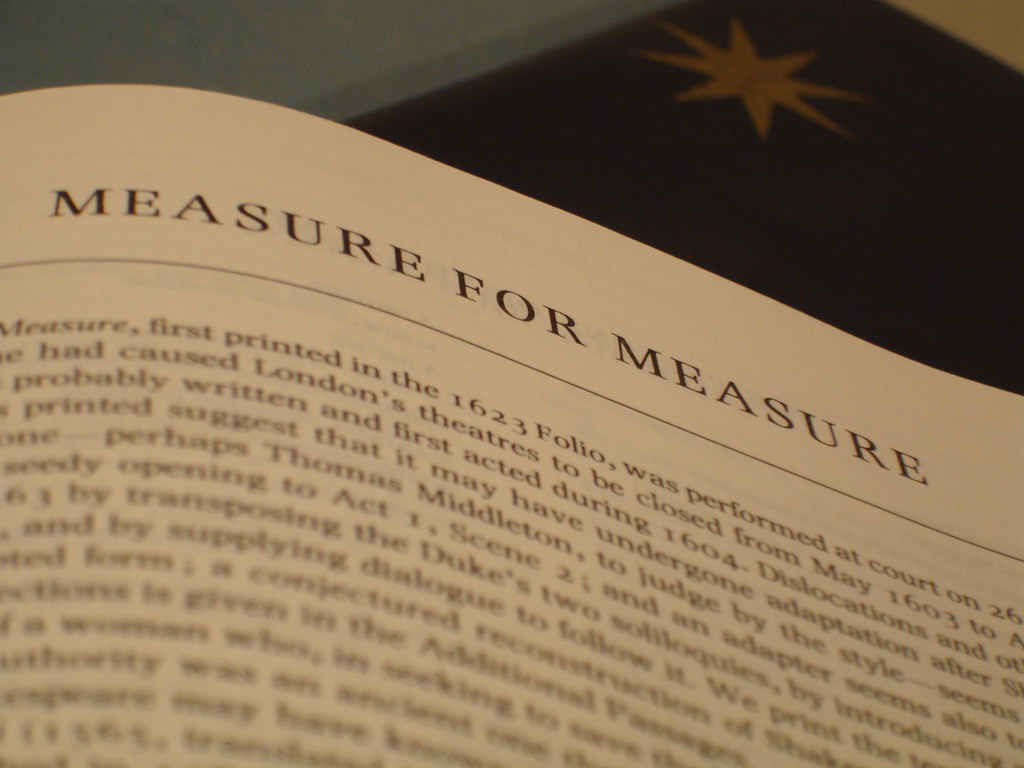
    From Measure for Measure, 2.2.169


    This quotation occurs just after Isabella has been pleading for her brother's life with Angelo, the Duke's draconian deputy.  It's a very difficult question to answer, either in the context of marriage (M4M is all about marriage, or if you re-write it like we did, it can be all about the acceptance of homosexual or otherwise queer relationships in a conservative society) or more generally. It depends a lot on what your feelings about marriage are in the first place, I suppose. How seriously do we take the 'til death do us part' stuff these days, really? Is the bond of marriage as much of a big deal as that, really? Should two people stay together even beyond the point when the relationship makes either of them happy purely because they are married?*

    There's a chunk of me that doesn't feel allowed to talk about this – I've never been married. I've never, finally, made the decision that yes, this person is forever. All I need or want, always. I might have felt that a time or two, but that's not the same as standing up in front of somebody legal and signing to that effect. That's a big, big deal, that declaration. The very fact that I feel like that, despite the way that marriages are contracted and dissolved in secular Western societies, says that it's still an important institution – to use myself as litmus for Everyone, anyway. If you're going to get up there and have all of those people watching you, you owe it to yourself and everyone else, let alone to your partner, to really mean it, aside from any legalities. It demands that you trust the other person enough, too, to be making the same enormous commitment that you are. You both have to know all the way through yourselves that This Is It. It can't be a time that you hide behind yourself and allow the bullish part of yourself to chivvy the undecided and probably more rational part of you to go through with it. The whole thing is about complete and total trust – for oneself and one's own feelings as well as for the fact that the other person is interrogating themselves just as deeply...which is the scary part.

    Is that a fanciful ideal, to believe that people should and do really, truly feel to the bottom of themselves and line up every layer of their minds to check that they aren't fooling themselves, and really can and do trust other people to do the same? Personal integrity and everything. Some people probably know instinctively what they're thinking, I'm probably the odd one out there. But I'm sure there are hundreds of people who drift towards marriage because it's The Next Thing and then live happily ever after - but then there are hundreds of people who never live their lives right to their full extent. The people who just skim their own feelings and understanding, who are content with the surface of life. I'm not sure whether it shows that I'm a cynic to believe that there are many of such people or that I'm an optimist to believe more and more that those people might be the minority...at least of the people that I know. Those skimmers might be 'content', but are they ever happy? I've said before that I'll cope with the lows of a life lived as fully as I personally can, without actually imagining extra drama in the name of 'living', to gain the highs at least for a few more years, but that's another story.

    But why do relationships where that commitment has been made honestly eventually shatter? Where there hasn't been total honesty with the self and then one another, things are a bit different. I suppose one often feels that one has been honest to in the first place and then finds that one hasn't? But also, how much do people change? If you've been happy with someone for three years is it reasonable to believe that you will always be happy with them? [I'm applying scientific terms to emotions again. I wonder if that's a bad habit or a sane thing to do?] CAN you just outgrow someone, like you might in a short-term relationship of some sort? Why shouldn't you be able to? Is it more that you always outgrow people but then re-learn the loving them part, and that's what keeps a relationship going? Could that be the point in a way of such a tight institution as marriage? I suspect it has to be that.

    But it all depends on the sort of the 'outgrowing' I guess. If it's just a question of finding that in your mutual life you have arrived at incompatible points then that is surely where you might re-learn the original loving in the new context. The trouble is that I don't think usually people can see that sort of drifting apart until it's too late. It's perfectly possible for the first realisation that something was wrong before to come from the revelation of somebody's infidelity. The point then is surely not the affair itself but what it means for the original relationship. The person who is 'cheating', to use the most judging synonym out there, might be so horrified by the fact of what they've done that their original relationship will actually be better off...something about realising the value of what you have. But the other side is that one realises what is missing from the prior relationship...which might on some level be a good thing for the individuals involved too. Either way, it ought to lead, admittedly through fire, to the possibility of a better future. Having seen some of that, though, I think that logic glosses far too much of the pain in all of this. Which doesn't invalidate the conclusions, but it does colour them.

    [Ok. I still hate the language I'm using in this discussion...but if I don't make it sound clinical, it will sound insincere. As it is, I sound too definite in my wandering attempt to understand some of this, even with the volume of question marks I've used...]

    All of which is a long way back around to asking – 'the tempter or the tempted, who sins most?' How much blame can be attached to the 'other (wo)man'? Is it their fault that someone else was tempted? Is it their responsibility to safeguard the relationship of the 'tempted' party? In modern times we only have a generally accepted societal framework for such moral questions, but to take the Shakespearean quotation in context is to require us to address the deeply Christian setting of the period in which it was written. The 'tempter' then is always the Satan and the snake in the Garden, and hence ought inherently to be the evil one; Eve is the 'tempted', and while she is clearly regarded as a sinner throughout the Bible, she is also the mother of the race and the reason for the existence of Christ and so on and thus is an ambiguous figure. With that simplistic rationalisation, we seem invited to make the tempter the greater sinner. However, the snake in the Garden was deliberate in the temptation of Eve; he was all out for her downfall. Shakespeare underlines the ambiguity – clear in his question is the fact that both parties sin and the only query is around which one is more sinful. The question brings us up a little short. Is the 'tempter' really such a Satanic character? Is the 'tempted' really as innocent as Eve was when the snake came to her? How many affairees are really likely to be setting out to break up a home? I'm sure there are people who do go out to sleep with someone married or not, but I find it hard to believe that most people looking for love and happiness (surely 90% of world) would set their sights on something so sure to generate heartbreak and recriminations somewhere along the line. In real life, the ordinary affairee might be guilty of not caring rather than active sin. But a sin by omission is still a sin in most religions. In our society, is it? Well, yes, but I don't think it's such a big thing as it might be to the religious. Perhaps they could be blamed for not stepping back quickly enough, not pro-actively defending the relationship in which they are the intruder. But 'intruder' too suggests action and intention which may well not be there. Is it ever our responsibility to save people from themselves? UK old-style socialist (nanny-state) politics would suggest that sometimes it is The Socially Acceptable Right Thing To Do. But that doesn't reduce the fact that Sometimes Things Happen. Don't They?

    It's too circumstantial. Who is the seducer? IS there a seducer? Does ANYTHING Just Happen? How often is there equal blame? Won't it usually be uneven, but be random as to who? Is there a general skew? Is there some sort non-relational standard against which all of these things should be set? The very fact that Shakespeare poses the question in such a way in a deeply religious age again underlines the fact that religion doesn't have an easy and satisfying answer...why should our much more woolly modern consensus-morality be any clearer?

    *At no point in this am I thinking about how this applies to couples with children. That's a totally different kettle of fish. It's not just about two independent grown ups then; the obligations have much more to owe to the innocent kids than they do to anyone else.

    Saturday, 12 December 2009

    Books.


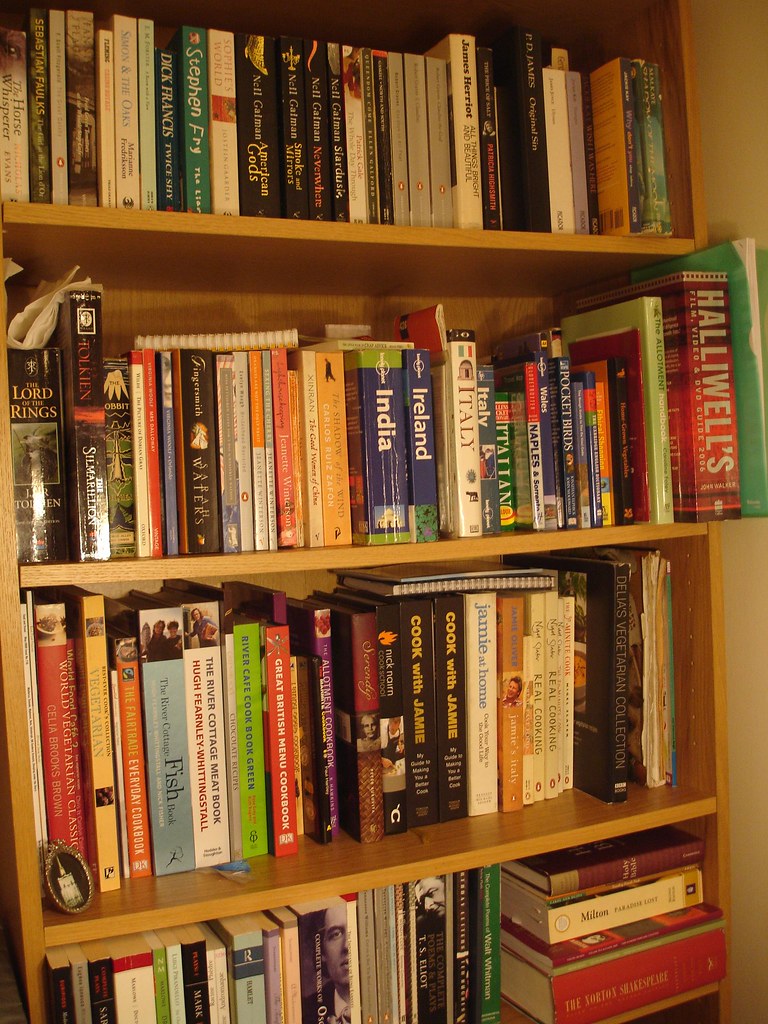
    I adore books.  Today, I finally got around to sorting the ones in this flat out.  It's a strange place, this, because it contains stuff belonging to all members of my family which, with the exception of myself, they aren't currently using.  It's things they haven't got rid of but only need intermittently or not at all.  There's a lot of un-thrown-away rubbish, or things left here like a very elderly pair of slippers belonging to my dad or the largest pans we own as a family, 'because I need something when I'm there'.  When I got here, there were 6 loaves of bread in the freezer some of which have been there for months and months (becoming breadcrumbs by degrees).  And around the same number of 2-pint containers of milk, half used and frozen 'for next time'.  I have forbidden anyone buying either of those staples until the freezer is under control...


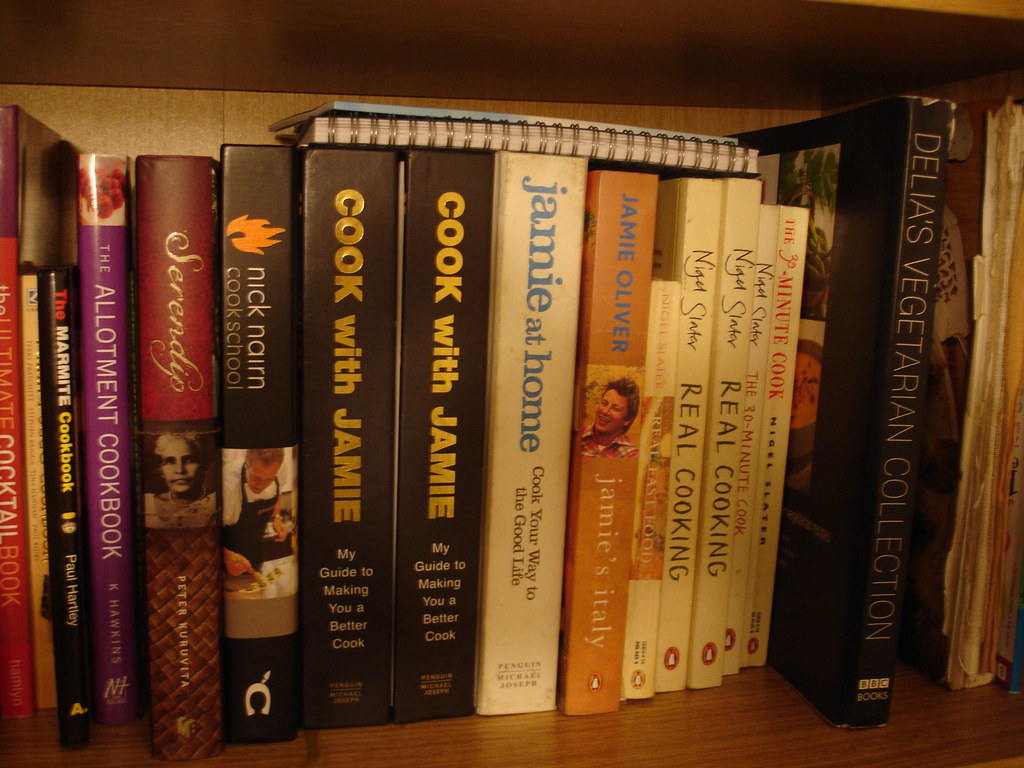
    The books aren't that different.  I found a heap of Dorothy L Sayers, Agatha Christie and P. D. James that belong to my mum and her crime obsession.  I organised the cookery books that belong mostly to my next brother and me to discover quite how many duplicates we have between us.  He's living in college at the moment so all his cooking stuff is here.  Still.

    There isn't really excuse for the following, though.

    That's *three* copies of The Riddle of the Sands by Erskine Childers, first published in 1903.  It's a relatively little-read early spy novel written at a period that was (rightfully) fearful of German imperial ambitions westward over the North Sea.  It's actually a wonderful read, if you like an action story.  That is no reason to have copies from re-issues in, respectively, each of 1955, 1978 and 1998.  And I first met it as an audiobook, too, which means we have it FOUR times.  I suspect the older two belong to my dad and my mum, and the newest one is mine.  Still.  Not really an excuse.  For Harry Potter we have three copies of each of the last two novels.  That's one for each child, though I suppose that makes sense - we were all living in different counties when those two were published.  I also have the first book in Latin, but that's beside the point.

    The duplication is hindering my ability to file things.  I always have this problem.  I suppose I have around two thirds of my books here, and the rest on shelves in Cornwall.  Down there, where I have room for them, they're orderly - divided by genre and then alphabetised.  Here, I've done my best.  Adult fiction is downstairs, along with maps and travel, reference, drama, biography, interesting non-fiction ('coffee table') and most poetry.  Up here beside me is the complete Discworld, 'young adult' fiction (that's the aforementioned Harry Potter*, Philip Pullman, Jonathan Stroud and a few other things - there isn't much space after Terry Pratchett), the irrelevant non-fiction and poetry anthologies.  The main issue is that every single shelf is double-stacked, which means that A-E is behind F-K, etc, and hard to get to and hard to re-shelve.  I haven't labelled things.  I'm debating it.  My family might upset things if they don't notice.  I understand librarians and their constant air of irritation.  It's taken me all day to do this and I hate the thought of it being disturbed.  But I suspect that labelling things might be taken amiss, too...they aren't quite all mine.


    I adore books.  It's why I did a degree in English.  I love them for escapism, I love them for learning, I love them for poetry and music and understanding and knowledge and information and discussion and ideas and new thoughts and hope and different moods and people and places to reflect back to myself.  I get totally and utterly lost in stories, I always have.  It's what makes me unbelievably irritating to watch films with - I jump, and gasp and mutter and have to resist shouting encouragement or warnings or advice to on-screen characters even in crowded cinemas.  I usually fail when sitting on a sofa.  That world onscreen is real.  And I feel bereft when I finish a book, or a film, almost without exception.  Putting one down in the middle used to be a very rare occurrence indeed, until my education led to more discerning tastes.  Even now though, I'll probably read the book I've got and then not bother with anything else the author has written unless influenced by some trusted friend.  Once a book is started I feel an obligation to it to finish it.  It's a thing as a whole and never in parts - what comes after modifies what happened to begin with; you can rarely say with any authority that you don't like a book when you've only read half of it, you didn't look at the whole thing.  That irritating foible of style might turn out to be magically transformed later in the tale into something of purpose.  The only exception to this rule is something like a poetry or short story anthology, put together by an independent editor or team.  Any set put together by a single author ought to hold together as a whole, like an album does.  The best of them create something greater than the sum of their parts.  I've never had that feeling about a multi-author collection, there's just too much disparity of style and preoccupation.

    I do read several things at once, though, because what I read needs to reflect my mood or I will fidget and not do whatever doesn't fit justice.  I tend to have a volume of poetry, something new to me - probably loosely-defined as 'literature' - and something familiar (still might be some sort of classic or modern classic) or otherwise simpler on the go all at once and will flit between them.  That's often influenced by which is lightest.  I read a lot of poetry collections on trains because they're so little.  I actually don't get on with bookshops and browsing them, it isn't how I read.  I follow threads, looking for influences on favourite authors or books I've heard reviewed or discussed or which come from the same family as something else I love.  I have never been at a loose end for something to read next, not since I first picked up a book.  I have a very well tended Amazon wishlist, which represents fairly accurately preoccupations of the moment, though with a bias towards to trashy because I let myself buy less of it - the 'worthy' stuff gets bought more often.

    I virtually never read books created for 'art' that were originally published in a foreign language (non-fiction or criticism is different).  Translation is a difficult and valuable skill, granted, but to my mind it will always muddy whatever the original text said.  Some might argue that translated works should be regarded as something in their own right, and maybe they should, but I don't want my closeness to a text mediated by somebody else.  There was a point that I kept making over and over in one paper of my degree, and I can't now find the reference - about the fact that no reader can truly approach a text in total isolation as advocated by the enormously influential New Critics of the early C20th.  How you understand a given word in a given position is always governed by where you have seen that word, that phrase, a similar word, a rhyming phrase, the same idea, a contrary idea, used in what you have read before - which is influenced by your historical moment, your employment, your gender, your education, your class, what you're listening to...right down to what the weather outside is doing and maybe even what colour pants you put on this morning.**  A translation means that someone else's unique position in time is already influencing how the text can be interpreted, and so one individual's unified creation becomes clouded.  At some stage, maybe I'll learn enough of a foreign language to read well in it, but it hasn't happened yet.  It requires total immersion, I think, to get to the point where your mind feels the connections between things instinctively.  Mind you, there are advantages to being an outsider - I, reading American novels for example, will understand them very differently to someone from that nationality, and it is from such oppositions that the most interesting ideas come from, I guess.  What I read won't be what you read, and from what we each comprehend from a text will a more full and more interesting reading, conversation, philosophy come***.  That is a strong reason for the existence of criticism, for me****.  To do with the exchange of ideas is central in really good criticism and the reason that I read essays on texts I'm interested in, still - even if I'm not writing essays any more.
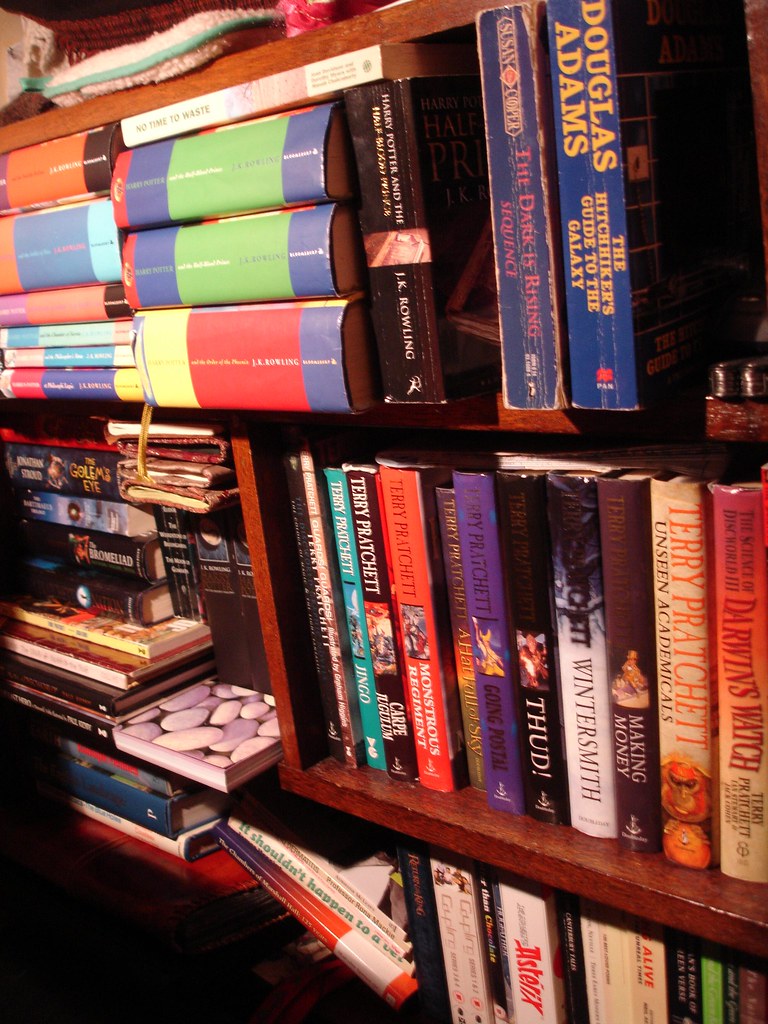


    All of which is a way of justifying the enormously large collection of books I have and will continue to have.  They comfort me and connect me to the world around me and I think they're great.

    More about the function of art, from me. I meant it when I said I was keen.

    *I keep thinking 'that is the type of thing I'd usually find a reference link for'.  But it's Harry Potter.  No.
    **I think this possibly wanders around the edges of Derridan Deconstructionism, should anyone be remotely interested.  Lots of fairly nihilist Post-Structuralist Post-Modernist philosophy about the instability and eventual futility of human endeavour.  Fascinating, but a little dark.
    ***Edward Said definitely discusses the idea that the Critic should always be in opposition to society in order to be of any use.  Which kind of makes sense.  References...  I *think* this will be in The World, The Text, and the Critic but I couldn't swear to it...
    ****There's a very great deal to say about the function of criticism - which really means the function and influence of art and literature...the discussion of the POINT of reading.  Academics have been studying it for centuries, which always seems a little uncomfortable to me.  All those discussions could boil down to a justification for their existence, on one level.  In modern times (as opposed to the Greeks), the conversation comes into its own in the Victorian period with Matthew Arnold's seminal essay 'The Function of Criticism at the Present Time' (1864), particularly 'the idea of a disinterested endeavour to learn and propagate the best that is known and thought in the world, and thus to establish a current of fresh and true ideas.'  I find it absolutely fascinating and wrote my dissertation on the function of art and whether or not it is or even remotely should be regarded as philosophy.  I'm aware that other people wouldn't find it quite so interesting, though...
    Sunday, 6 December 2009

    Withnail & I, with extra Shakespeare


     I have of late - but wherefore I know not - lost all my mirth, forgone all custom of exercises; and indeed it goes so heavily with my disposition that this goodly frame, the earth, seems to me a sterile promontory, this most excellent canopy, the air, look you, this brave o’erhanging firmament, this majestical roof fretted with golden fire, why, it appears no other thing to me but a foul and pestilent congregation of vapours. What piece of work is a man! How noble in reason, how infinite in faculty, in form and moving how express and admirable, in action how like an angel, in apprehension how like a god - the beauty of the world, the paragon of animals! And yet, to me, what is this quintessence of dust? Man delights not me, no, nor woman neither, though by your smiling you seem to say so.

    Hamlet, Act 2, Scene 2

    She should have died hereafter;
    There would have been a time for such a word.
    Tomorrow, and tomorrow, and tomorrow,
    Creeps in this petty pace from day to day
    To the last syllable of recorded time;
    And all our yesterdays have lighted fools
    The way to dusty death. Out, out, brief candle!
    Life’s but a walking shadow, a poor player
    That struts and frets his hour upon the stage,
    And then is heard no more; it is a tale
    Told by an idiot, full of sound and fury,
    Signifying nothing.

    Macbeth, Act 5, Scene 5

    I've been watching Withnail & I. I don't know what to make of it, though I think that's a traditional reaction to that film. I spent most of the film feeling sorry for Monty, and for Marwood ('...& I'), though obviously it's Withnail you watch. It doesn't tell you enough. There's more story. One shouldn't feel sorry for any of the characters - one shouldn't like them, because one can see that there is a lot of less likeable stuff in them that is barely shown. You know that Marwood is junkie enough for paranoia, you know that Monty is predatory - you know that Withnail could be respected as talented man and certainly one with character and courage. In some ways he would have been redeemed had they chosen to finish the film the way I think the book does, with his suicide. His decision to die would have validated him and credited him with some integrity. The film is like a Beckett play, but with more context than one ever gets from those. Absurdist.

    The Hamlet quotation, above, ends the film. I have always remembered the image as 'stellar promontory' rather than 'sterile'. I think the former concept would probably be an impossible one for Shakespeare to come up with - his was still a period that believed in the spheres of the heavens rather than understanding the universe as orbs floating in a void as we do now. For him, the most desolate place imaginable was a spur of headland flung far out into the sea, weather-swept and on which nothing was able to survive. To me, from the vantage point of a new millennium, it seems more appropriate when looking for true sterility to conjure up a rock in space, totally dead, totally barren, totally cold, projected into nowhere, anchorless, helpless, dust among the stars. The feeling is the same, but as the world has become a smaller place since the C17th, so the universe has got larger and our place in it has become infinitely less significant; after all we no longer believe, for the most part, that the world was created by a beneficent entity purely for us.  Shifting from the terrestrial to the universal seems appropriate, with that shift in context.  Anywhere on earth is not remote, not really.  Anywhere in space - is.  I sort of hope that Shakespeare wouldn't mind too much my mis-rememberance of his line, because from my moment of history my image can go some way towards re-investing his with the power that 400 years has leached from it.

    The Macbeth quotation is mostly there because it is probably my favourite piece of Shakespeare to say aloud. It follows almost naturally from the Hamlet speech, though the art in it is greater as might be expected from the one in metre and the other in prose. Both deal with isolation and desolation and the insignificance of man in the face of time and situation. Macbeth is over-dramatic (and over-quoted and almost hackneyed, now) but the image of 'all our yesterdays have lighted fools/ The way to dusty death' is speaking - each of us guides each other, a day at a time, towards each individual's death. Shakespeare expresses both the futility and the camaraderie of the human experience in the space of ten words. We are reminded how hopeless our lives are, but also that we are all in it together and we have little but one another. It's arguably an odd sentiment from the character of Macbeth, but ultimate poetry.


    Thursday, 21 May 2009

    A different sort of post.

    Or one more diary-like than they've been of late. I have new poetry books on order - gushy thoughts on Carol Ann Duffy will resume shortly. And I'll probably re-visit lemonade and get summer-food excited. I'll even try and remember to take photos of it...

    T and I and various assorted others went to the Cambridge Beer Festival yesterday (I drank cider). It was a wonderful evening of random drop-ins - we were the centre of a small group of wanderers from all areas of my Cambridge existence. GSM people came, a few ADC types were about (including some we hadn't planned to see), Matt the director of the the play he stitched me into producing dropped by, Carl was there, and even Linda from the college chapel set. Even a kind of vicarious family element, though that definitely doesn't count. I had to keep double-taking to keep track of it, and drifted around the circle trying to make sure that everyone had someone to talk to, because in a lot of cases they either knew me a lot better than they knew one another or often were only in the same group because of me. Linda spent a long time explaining spider reproduction to Marion (whom she'd never met), and bonding with Matt over the fact that they both have connections to the zoology department. Leave Linda in any situation and she will proceed to gross out everybody with Bugs. I love Linda.* Carl found someone he'd lived with in his second year of uni in a city 200 miles away to chat to. The attractions of a beer festival break down great disparities. It was a little confusing, and a little stressful because of it. We left before it got too late. T had been on breakfast and I had to be on top of a tower wearing a cassock at *7:15* this morning (more later).

    It was a beautiful evening still when we made it home, not too hot or too cold or anything. Hopefully it promises more to come, but I don't gamble when we're talking British weather. We went to sit on the garden wall for a bit. And then there was a hedgehog.

    More or less totally unconcerned that we were there, it came bumbling through the fence and snuffling through the undergrowth. It was full dark by that point, no moon, barely any light seeping around the blinds from Will's film inside. Just glimmer enough that it was possible to follow the creature's progress by means of an occasional glimpse of a waddling body on the grass, but it was quiet enough that we could hear it. Listening to it eat was hilarious - so much relish from the little animal. It was chompchompchomplipsmackpotterslurp for a good ten minutes, getting nearer and nearer to T's foot on the lawn. Both of us were still as stones, craning towards it and straining our eyes in dimness to see what it was up to, wondering if it would actually get close enough to touch Traci's shoe (it didn't). When it began to move up the garden towards a bush at the back, I crept inside to fetch Will to show him, but though we could still hear it, it didn't come back from under the bush and it left our patch via the back fence.

    But a HEDGEHOG. I like hedgehogs. I like the way they move and the expressions on their faces and their attitude. I don't often see them though; in Cornwall I suspect they're either out-competed by the badgers, of which there are many, or just scared of the dogs, or both. And tiredness and tense and awkward social situations melted into our watching of a wild thing enjoying itself. No deadlines, no nothing. Not long awake from a winter sleep and enjoying a spring glut of fat worms and bugs. No concerns beyond dinner.

    I like how even in a city there are still so many bits of things that are natural that hit you if you look. People say that city-dwellers have no idea about the seasons because they never see the plants. But there are hedgehogs and foxes (currently irritating a houseful of London friends of mine) and birds and the odd growing thing and all sorts, and there is the colour of the sky and the weather - it still has an impact.

    I wasn't really a country kid, in that nobody in my family farms or raises food animals or manages forests or anything of that sort, but I did grow up in a village. I can milk a cow, believe it or not, though I wouldn't like to be challenged to. But city kids get taken to farms to do that, now, so they can too. I think they probably don't see much of the fields or what goes into them or comes out of them and how things grow, though. Not in a field-wide sense. Not a whole crop, just a bean at school, unless someone has an allotment or a vegetable patch. My mum did and does have a vegetable patch, and she supplements it with ducks now. The llamas still serve no useful function. But I had a childhood spent climbing on rusting tractor hulks, chasing rabbits with my dog, and picking blackberries - until I was 11 anyway, and I loved it. I then spent years living in a city, and got used to the idea of streets of houses and postage-stamp gardens and shops that weren't an event to go to. I know I'm lucky to have had that upbringing - not many kids do these days. But the thing I like most is that it has left me with the ability to have just a small handle on how things the natural world fits together, and how our and everybody's lives are affected by seasonality in a way that it must be difficult to grasp in quite the same way if you've never been that close to the countryside. And it is that slightly closer bond that makes me want to respect it enough not to eat meat that hasn't at least seen daylight and been able to stretch its legs a bit, and to try my best to make choices that have as little impact as possible. I'm not there yet, but I try, and it's got to be a start...

    I felt that feeling again this morning. The adults were down to sing the Ascension Day service from the top of the GSM tower at Frightening AM today. I think the last time I got up before 6:30 it was winter - so that time actually felt like dawn, with greyness and mists and sunrise. We're edging on to summer here now, so the sun is well and truly awake at 7am, which was when I left the house. I was slightly disappointed not to be privy to that secret dawn...I like that time of day, though definitely not more than sleep. I can see the season changing, though, and that's ace. On top of the tower today it was a little hazy still from spring dampness, but you could see Ely Cathedral on the horizon 15 miles away - 'the ship of the Fens'. Cambridgeshire is SO flat...

    I like that I'm not attached to academic years any more. They create artificial breaks in the progression of the year. Christmas and Easter do that, to a certain extent, too, but they're less intrusive and regimented than the three terms, three holidays arrangement that we use to order our years. I like that I can sink into something more natural, rather than trying all the time to break the year into shorter segments. That just results in feeling like a failure when you miss a deadline that was set with no regard for what the task is and your personal work speed.

    And I don't have to watch the end approaching with the same finality that you do with the end of the term, the end of the year, the end of school, the end of university...and there is life beyond whatever the deadline is because the months and the years keep going and don't stop because you've reached a certain milestone. Dates are only a way of talking about time - in themselves they shouldn't be deadlines on their own account. There shouldn't be exams 'just because it's summer'. A couple of college friends have said to me that they always feel guilty if they're in Cambridge in the summer - they should be revising, that's what May means. No. All that May means is that the sun will be edging its way out a bit and that the peas have sprouted. All. Exams are not seasonal. They have nothing to do with the sun and the weather and the natural order of things. There are still deadlines, because otherwise there is no way of functioning, but they are more fluid and less metallic. They move with not against the flow of the year.

    *She is actually ace. Used to date a housemate of mine, who made his own mead and shoes and spend a lot of time dressed as a Viking and talking in dead languages.

    Tuesday, 31 March 2009

    An excuse, language and gender theory and feminism. Sort of.

    Sometimes work takes over. Not very often at present, I grant you, but sometimes. And things like laundry and cleaning require to be done. And photos, which haven't been attended to for months. They're not done yet - I need to find another evening or two to fiddle with them, but evenings are at a premium and it's not looking that likely, at least for the time being.

    That's my excuses made, anyway.

    Traci and I went to Ely on Sunday, because we had a free afternoon on a lovely day and it was nice to get out of Cambridge for a bit. Went to Evensong at the the Cathedral - now THAT is a fantastic building. The girls and men were doing Howell's Worcester Service, which I didn't know but knew I'd love (and did), the Leighton Responses, which I can still sing by heart and Leighton's Solus ad Victimam* which I've been wanting to hear for ages and which was divine. The building itself is spectacular - one of the oldest and largest Medieval buildings in England if not the world, built in 1109 (that's 900 years old this year). We wandered into the Lady Chapel, where I did a concert in January, to admire the light and the acoustic, and then wandered around the town a bit. It's a pretty place, and the light was nice. I took some pictures I might put up if they're worth it.

    The bit that grated was the sermon. I don't listen much to sermons in general, regarding them as interludes between the singing, unless something grabs me. A really good speaker is worth listening to, almost no matter what they are saying, and the kind of people who preach in Cambridge or in the Cathedrals will say something worth hearing, that might have a Christian basis but will be applicable for nearly everyone. And they say things, usually, in an interesting way using interesting words and with anecdotes to make points. This guy, and I don't know who it was because they don't seem to publish a helpful service sheet with things like the readings or the name of the preacher on it, had an incredible voice, too, and I can always listen to a good voice. (Music list, I can get hold of, but surely that's less liturgically relevant and hence less important to the work of the foundation, and hence shouldn't be easier to find than a sheet of the lessons? This is the second time I've had this problem in an English Cathedral in the last three months; what's going on?!) Anyway. Maybe he was the Precentor, that would explain the voice, though he didn't seem to be acting as cantor.

    The reading was from Romans 5, which is more or less irrelevant to my point, except that it comes from the letters of Paul. He's quite widely regarded as having been fiercely misogynistic, and it's often from his writing that people have taken the excuses for discriminating against women in the Church and hence in more secular areas of life. One of the key parts is 1 Timothy 2 - particularly verse 11 to the end^. There are people who don't believe that Timothy letters were actually written by Paul, but it's like debating the authorship of the plays of Shakespeare in terms of amount of speculation - worse, in fact, given their age. Anyway. Romans 5:14 mentions 'Adam's transgression'. The speaker interrupted the flow of his sermon (which focused on the free gift of the sacrifice of Christ) to point out 'for those who believe that Paul was a misogynist that he describes it as Adam's transgression.'

    Yes, it is described as 'Adam's transgression' - Paul doesn't blame Eve for the Fall of mankind at least at this point. I have no idea about whether he does elsewhere in his oeuvre and now is not the time to trawl. But WHY does he not blame her? Is it about chivalry? About taking responsibility? But it IS Eve's fault. SHE is the one fooled by the serpent and Adam blames her and by implication God, saying in Genesis 3:12, 'The woman whom thou gavest to be with me, she gave me of the tree'. The blame, for Adam's part, is shared between God and the woman. God cannot be blamed, and so it is Eve's fault. God punishes both of them. They are equal in their fault. Paul's claiming of the sin for Adam alone in the passage from Romans makes her a child. His chivalry enfeebles Eve. Her reasoning is felt to be inferior than his and she is regarded as incapable and hence cannot be held accountable for her actions. This is worse than blaming her outright and extending that to the whole of the female species.

    With one word, it emasculates every woman. Not that you can emasculate a woman, really. But it's the right word. Makes them impotent. Another word you can't use about women. Maybe I need to read the theories about gender and language I always sniffed about at college. In fact I probably do - our language is inherently masculine, inherently limits what women can be in our thoughts. Well. Up to a point. Everyone knows what I mean when I use the terms 'emasculate' and 'impotent' about women. I mean 'render powerless' and 'ineffective'. Maybe I should have used those, but they don't contain within them the cut to the self esteem that the words I did use do. Is there an equivalent feeling in women? The inability to have children does have some of the same helplessness to it, I suppose, but it's not the same. Does it create the same 'I am not a woman' feeling that losing essential pieces of anatomy does for a man? I guess it does in many women. But there isn't the same level of competition between women - it's not about prowess. Maybe those words are so masculine because women actually can't feel those things, though they can imagine them well enough from understanding men to comprehend the concepts in the words. So language isn't inherently sexist?

    But the sermon irritated me because this man clearly wanted to score points for Paul and felt that this was the way to do it. In a public space, he expressed these sentiments and didn't see what was wrong with them. It implies that he, too, holds such patronising opinions about women as expressed by the author of the letter to the Romans. And he would deny that he did, and would hold up this sermon as an example. It could be an honest mistake; he could be blinkered by arguments from feminists about Christianity blaming women for the human condition. But I don't think it is.


    *The words to that are amazing, as is the story of Abelard and Heloise. 'Alone to sacrifice thou goest, Lord, giving thyself to Death whom thou hast slain. For us thy wretched folk is any word? Who know that for our sins this is thy pain? For they are ours, O Lord, our deeds, our deeds. Why must thou suffer torture for our sin? Let our hearts suffer in thy Passion, Lord, that very suffering may thy mercy win. This is the night of tears, the three days' space, sorrow abiding of the eventide, Until the day break with the risen Christ, and hearts that sorrowed shall be satisfied. So may our hearts share in thine anguish, Lord, that they may sharers of thy glory be; Heavy with weeping may the three days pass, to win the laughter of thine Easter Day.'
    Peter Abelard (1079-1142), trans. Helen Waddell

    ^'Let the woman learn in silence with all subjection. But I suffer not a woman to teach, nor to usurp authority over the man, but to be in silence. For Adam was first formed, then Eve. And Adam was not deceived, but the woman being deceived was in the transgression. Notwithstanding she shall be saved in childbearing, if they continue in faith and charity and holiness with sobriety.'

    Wednesday, 18 March 2009

    Paris.

    We could speak about the meaning of life vis-a-vis non-consequential/deontological theories, apodictic transformation schemata, the incoherence of exemplification, metaphysical realism, Cartesian interactive dualism, revised non-reactive dualism, postmodernist grammatology and dicey dichotomies. But we would still be left with Nietzsche’s preposterous mustache, which instills great anguish and skepticism in the brain, which leads (as it did in his case) to utter madness. I suggest we go to Paris instead.

    The Principles of Uncertainty
    Nod to Deb, where I found it while digging for dinner...

    Wednesday, 11 March 2009

    How to sin.

    A friend asked me which of the seven deadly sins I'd pick, if it was me, for a costuming project that she's doing as part of a course. Greed, gluttony, lust, sloth, pride, envy, wrath. Which would YOU pick, and why? I found it hard, and did what I usually do when asked to answer a question, which is unpick the semantics of the question in order to establish what it's really about. That led to Wikipedia, which has the following to say:

    "Listed in the same order used by both Pope Gregory the Great in the 6th century, and later by Dante Alighieri in his epic poem The Divine Comedy, the seven deadly sins are as follows: luxuria (extravagance, later lust), gula (gluttony), avaritia (greed), acedia (sloth), ira (wrath), invidia (envy), and superbia (pride). Each of the seven deadly sins has an opposite among the corresponding seven holy virtues (sometimes also referred to as the contrary virtues). In parallel order to the sins they oppose, the seven holy virtues are chastity, temperance, charity, diligence, patience, kindness, and humility."

    I get hung up on the fact that 'greed' and 'gluttony' in ordinary English usage are very similar - gluttony is surely just a specific form of greed, why single it out as a particularly bad thing all its own? But the Latin for 'greed' is 'avaritia', so maybe we're talking about avarice which is much more specific and definitely different from gluttony. But both are to do with acquisitiveness - which is different from miserliness. The desire to spend money as opposed to hoarding it. The sin there is the stop-at-nothing attitude to acquiring possessions, no matter who gets walked over in the process.

    I suppose in times gone past you could link lust in here, since the trading of humanity for sex was much more widespread than I think it is today. (Is that a naive thing for me to say? I don't know any figures on the sex trade over history.) But is the sin the commodification of human flesh, or the desire for corporeal (corporal? I need a dictionary. Or I should just use the word 'physical', but where would the fun be?) pleasure? I think only the first is atually wrong. There is no harm in pleasure or happiness, though I appreciate that those two things are different and that there's an argument that could be had there - about moderation, mostly. But the thing that is wrong is treating a person as a thing - which is different again from enjoying the other person's body. That surely is not a problem provided you treat one another as people and not objects without feelings. There's a Discworld reference there - Vimes I think in Night Watch defines crime as anything which involves treating people as things. It's interesting that 'lust' started off as 'extravagance', really - back to moderation. The Latin 'luxuria' has odd connections - to the word 'uxor' meaning 'wife', for example. I always found that rather uncomfortably telling about the Romans' attitude to women. Objectification or what?! You're only a 'luxury' men can afford to do without??

    In gluttony, what is the sin? Enjoyment of food need not be wrong, nor should making oneself obese be of itself wrong. Is it greed at the expense of others, then? Taking food from the child's mouth? Probably. Or perhaps there's an element of over-eating and wantonly making oneself a burden on family and health systems, that is the sin. That is selfishness, and that is the sin. Gluttony, defined as excessive consumption of food, is not wrong for itself.

    Envy and pride are interelated, too, though I think eparate from the greed family of vices. Pride is difficult - it can be a good thing to take a certain element of pride in what you achieve, it means you value it and will produce better work because of it. It is tempered I suppose by humility or a desire to improve further. Something about the knowledge that nothing is perfect. That's the element of religion, I suppose - nothing is perfect except what God makes. But there's the more human way of putting it which goes, 'You can please all of the people some of the time and some of the people all of the time, but not all of the people all of the time.' It is impossible to make something entirely satisfactory. But it is pride which makes the ordinary mortal try? The desire to prove one's ability, to be better than one's fellows, but balanced by self-knowledge enough to know when something could be improved.

    Envy is probably the sin I can find least excuse for, possibly because it is the one I find in myself most often. It's a difficult one to unpick - not about wanting what someone else has. After all, what's the harm in that? It's what helps to drive us to improve our own lives. It's resenting them for it, or tormenting them for it, or taking it out on them. Decidedly unpleasant. In a society as acquisitive as our own, this is a moderately big deal. It drives people to over-spend, or not assess motivations for desires. One ends up acquiring without working out why, in a sort of competition, which results in owning a lot of tat you don't need and in having no greater quality of life. It is related to pride, I guess, but without any of the redeeming elements that might be found in the other sin.

    Wrath and sloth seem to me to be more independent. Surely there are times when anger is justified? When it is a good thing? Angry against injustice, or angry with someone who lets you down - just enough so that they don't do it again. I guess it's linked to pride like that; in order to be angry with someone or something, you have to believe that your position is faultless, and that could leave you open to pride without self-knowledge, especially if you are blinded by high emotion. And I suppose there are correct ways of being angry, to the right levels. Like, it's never, ever right to kill (I'm talking about individuals not nations; I don't want to start the 'just war' debate just now...), so anger that leads to that kind of violence is definitely wrong. It's back to quantifying people. There is more to someone than their actions, whatever they are.

    And sloth. It took me a long time to learn what the word meant when I was a child - I could only think of the animal. The Latin doesn't help unpick it, either. Is it just laziness? What's wrong with that, so long as you are no burden to other people? Not pulling your weight when part of a team is probably an element. Scrounging. Living off the rest of society. Is that it? It's still objectifying other people, I think - you are making yourself more important than everyone else is. Hypochondria is probably in here, too. It's all about self-knowledge.

    In fact, it's ALL about self-knowledge and an assessment of your placement in society, I guess. Not being a burden on other people and being aware of yourself and how your actions affect those around you. So is there only one sin? I don't think there are seven, certainly. But in my quest to live a life I'm proud of (!), I find myself working to know myself better - to see myself the way other people see me and the way I see other people, so that I can avoid irritating them, or being a burden on them or on society in any way. In the course of that, I hope I'd avoid most of the bad sorts of the 'sins' above. There's nothing religious in that, but the framework of thinking about what's good and what's bad is interesting. Are these universal? Does every society in the world look to the same sort of vices and virtues? Yes and no. This fits back into the idea of guilt and what constitutes it - I remember a supervisor explaining to me the ancient Greek conception of guilt as something created by society for an individual - 'You've done something wrong because we SAW you' - versus a more Christian conception of guilt - 'I know I've done something wrong and am going to feel guilty about it no matter whether or not the rest of society knows or cares'. There's much more to that, but it's for another day. Enough for now...

    Wednesday, 18 February 2009

    No explanation needed.

    "Morning is when I am awake and there is a dawn in me. Moral reform is the effort to throw off sleep. Why is it that men give so poor an account of their day if they have not been slumbering? They are not such poor calculators. If they had not been overcome with drowsiness, they would have performed something. The millions are awake enough for physical labor; but only one in a million is awake enough for effective intellectual exertion, only one in a hundred millions to a poetic or divine life. To be awake is to be alive. I have never yet met a man who was quite awake. How could I have looked him in the face?

    We must learn to reawaken and keep ourselves awake, not by mechanical aids, but by an infinite expectation of the dawn, which does not forsake us in our soundest sleep. I know of no more encouraging fact than the unquestionable ability of man to elevate his life by a conscious endeavor. It is something to be able to paint a particular picture, or to carve a statue, and so to make a few objects beautiful; but it is far more glorious to carve and paint the very atmosphere and medium through which we look, which morally we can do. To affect the quality of the day, that is the highest of arts. Every man is tasked to make his life, even in its details, worthy of the contemplation of his most elevated and critical hour. If we refused, or rather used up, such paltry information as we get, the oracles would distinctly inform us how this might be done.

    I went to the woods because I wished to live deliberately, to front only the essential facts of life, and see if I could not learn what it had to teach, and not, when I came to die, discover that I had not lived. I did not wish to live what was not life, living is so dear; nor did I wish to practise resignation, unless it was quite necessary. I wanted to live deep and suck out all the marrow of life, to live so sturdily and Spartan-like as to put to rout all that was not life, to cut a broad swath and shave close, to drive life into a corner, and reduce it to its lowest terms, and, if it proved to be mean, why then to get the whole and genuine meanness of it, and publish its meanness to the world; or if it were sublime, to know it by experience, and be able to give a true account of it in my next excursion. For most men, it appears to me, are in a strange uncertainty about it, whether it is of the devil or of God, and have somewhat hastily concluded that it is the chief end of man here to "glorify God and enjoy him forever." "

    Henry David Thoreau, from Walden


    My underlinings. I might come and explain more later, but that'll do for the time being...

    Sunday, 15 February 2009

    Heartbeat.

    I was sitting in peaceful, dim old Great St Mary's. GSM. The Grim. I love large empty spaces. Auditoria are great. I used to go and sit in the pitch pitch black of the Abbey Theatre, with even the exit signs switched off, and just drink in the silence. Warm and dark. Womblike, I suppose, though I never felt enclosed by it. I have always felt much more free and safe in the dark. I spent my teens walking about the dark streets where I lived, sometimes with a friend and sometimes not. I was often miserable, and I walked and cried and felt sorry for myself in a wonderfully teen-aged fashion. It really wasn't a very safe thing to do, as a young girl on reasonably dodgy roads chosen specifically because they were deserted and dark. But I felt a weight lift every time I did it. I could look up at the dark and the moon and remember that things were bigger than the here and now. It's not a feeling I get in ordinary daylight - the light has to be special if it's there, making the humdrum stranger. Bright summer sunlight through leaves, the perfect reflection in glass water, the dark light in a storm. These things do the same. Big, quiet, man-made spaces have a similar effect. They stand, bigger than their purpose, something beyond what they were created for. There is a permanence to them that does not exist in their creators. That church is not particularly old, or even that beautiful. There are beautiful things in it - the magistus above the altar is one of the more lovely of its type and though the lights weren't on it, the gold leaf gleamed in the dull of the winter twilight. It wasn't even that quiet in there, so central as it is and it still being fully afternoon. But it was peaceful, and I was alone. I do not have connections enough to it as a place to feel real affection for it - not like St Mary's in Ashwell, that is still on several levels the home of my heart, if that had to be somewhere physical. So many memories it holds, and such a feeling of being rooted, there. But GSM is important to me. I went there when Paddy died. I needed to feel as though I was doing something and the ritual of evensong was soothing. And there was music. There still is music. It was time for choir practice.

    Friday, 13 February 2009

    Music in the dark.

    Darkness is important. It is freedom. No-one to see me. I can hide in it. I don't have to see anything and or understand anything. Icy moonlight on the half-sunk river boat by the old iron bridge that is itself relaxing into the embrace of the water does not require anything from me - even in my contorted mind.

    My mood had been following the music tonight. We started with Purcell 'My beloved spake', which sets the Song of Solomon, 2:10-13 ([10]My beloved spake, and said unto me, Rise up, my love, my fair one, and come away. [11]For, lo, the winter is past, the rain is over and gone; [12]The flowers appear on the earth; the time of the singing of birds is come, and the voice of the turtle is heard in our land; [13]The fig tree putteth forth her green figs, and the vines with the tender grape give a good smell. Arise, my love, my fair one, and come away.). Controlled and renaissance, but complex. The tone of the music and the tone of the words are at odds, and it slips out of perfect comprehension. The Song of Solomon always gets me - a confused and incomprehensible love poem written 3,000 years ago and still potent. Tablets of stone. Who cares to whom the speakers refer? Then there was Harris - 'Strengthen ye the weak hands' (Isaiah 35), which is dramatic and strong and lyrical. And the writer of Isaiah understands poetry - imagery and beauty through it, which the composers point up. That passage is stern and demanding, but offering comfort with conditions. Hard. And as we left, there was a copy of Cosi Fan tutte in the narthex, with 'Una donna quindici anni' in it, for me to sing with frenetic teenage false confidence. It took the distance home from church to calm down from the crazy Mozart, through dramatic Harris to melancholy and luminous Vaughan Williams, which reflected in the moonlight from the boat and showed me gentleness. I wish I had recordings of all of them - I have sheet music of some, at least.

    I know the world does not ask the things of me that I imagine it does. I know that the relationships that matter are not the ones where anyone is making any account of who does what for whom when. I know there is no need to try to achieve the nebulous success without a form that drives me. I know these things with one half of my mind. But on the other side there is that illogical unbending wrong belief that these are things that matter, and I swing around it like a dog on a chain - only able to move so far.

    I am not an animal; I can think my way out of here. Can't I? Eventually, I can work out how to unclip the chain, wear out the collar or uproot the bar. With help, because paws aren't good for that. I can do that. I think. But I must ask for that help. It is there. I have to understand how the chain is made and put together, and then I will be able to see the weaknesses of it.

    Wednesday, 11 February 2009

    Ringing practise.

    Something about bells over London. Walking along Borough High Street, tired to my bones with head aching and eyes itching on an unforgiving grizzly February evening, I suddenly heard the Southwark bells tumbling out over the sound of traffic and trains. They cut through the garish colours and lights and battered at concrete and the dented steel. They brightened dingy puddles in the patched pavements. They reminded me how much more there is to this existence than the humdrum and everyday grind of vehicles and mundanity. A glittering flash of sound among the half-blanked hiss reminding me to live for the moment and the experience - not in money or work or past or future or other unconnected people's existences. A life full of oil drops on fishing line. A necklace of memories. Glittering like beads. Each one as close to the last as before, so that the whole thing is dense with life. This is the aim of being alive.

    Monday, 9 February 2009

    Questions of self.

    This is fascinating. I don't know very much about multiple personality disorder*, but this is an amazing picture of it. It's a fascinating literary device, turning up all over the place in books and films and so on. Terry Pratchett uses it a fair amount, and then there's Fight Club - though having read the article I would suggest that most of these depictions are nowhere close to accurate. To be fair to them, I suspect they're not really intended to be.

    The question I want to ask is how does that woman name her 'alters'? Because they clearly all do have names and are recognisable to her and her therapist. Is it like the Pratchett concept - that when you name something you give it existence on a higher level? Everyone has aspects to themselves; you're a different person in every situation with everyone you meet or know. It's a carefully judged performance based on assessing your relative status, expectations, motives and so on - Stanislavskian given circumstances. That's how we make up ourselves, so often, in relation to others around us. The core of an individual I guess can be regarded as those elements which can always be found in each persona we put on.

    This woman has elements of her character that take on aspects of her life - several are children; several are part of her career; one takes on her aspect as a mother. I'm intrigued to know about the mechanics of how it works. Is there a centre self that carries the memories? The way that the article runs, it seems there must be. Do the alters retain memories? But she tells us that there are huge black spaces in her life, where she has been someone else. It's a difficult thing to comprehend. I suppose I could go an read the book, but I don't actually want to. Reading someone else's neuroses would be hard. It would feel very prying. The article is enough for a flavour and to prompt some thinking about definition.

    I remember getting quite upset when I was 18 or so, that I didn't know who I was because as far as I was concerned I become someone entirely different with each group of people. And they were very different too - are still in some ways. The biggest split for me is the person I am around my family and the person I am around everyone else. As far as my relationship with my parents goes, 18 was the worst point. They had declared they were moving to Cornwall and that I could do as I liked, and I was distraught. With them, I was sullen and closed and dutiful and dull. All to do with protecting them and trying not to disturb the image of me that they were comfortable with. I was one person there. It was different outside; I could choose more. I could be the clever weird one at school, the obsessive still slightly weird but mostly accepted one with the youth theatre crowd, the enthusiastic naive youngster with the theatre adults, the unpopular but sort of useful one with the lacrosse crowd, the goodie-two-shoes in choir...and more. Is it part of growing up, weaving those aspects together into some sort of whole? I remember noticing when I saw people who'd been away at uni for any length of time that they seemed to have become more themselves than they had been at school. They were more concrete. Quite a large part of that is just to do with becoming more comfortable with themselves having settled into a new situation where nobody knows their history and they can be accepted without question. Quite a lot of it too is to do with getting used to oneself...aligning all the thread of persona together into a rope that wears itself denser as time goes on and the strands rub together - a more coherent whole.

    I don't remember that happening to me in the way I noticed it happening to others. A lot of people commented to me that I'd barely changed since I was 12. I hadn't in many ways, but in many ways neither had they. As I said, they had just become more themselves. I have always been a bit afraid of change. Everyone is, I guess, but I have a suspicion there was something unhealthy about the way I viewed it. I did a fair amount of growing up through being forced to re-examine my assumptions about myself in therapy, and was thence kick-started into trying to understand myself a bit more. I don't in any way think I'm there. The day that I feel I understand will be the day that life ceases to be worth living. Ditto the day I feel I have grown up, though the two concepts are nearly synonymous.

    This woman suffered terrible terrible abuse, and came out of it able to function. Our bodies and our minds are amazing things. She found the strength to carry on giving to the rest of the world, despite that. It's almost mindboggling. Despite everything, to remain that strong. Makes one feel humbled, really.


    *Can anyone help me to the name of a film where the central male character has the illness and commits a series of murders? I remember it being a great film but I can't remember the name. Typical. It wasn't Fight Club. I'm SO bad at names.

    Monday, 2 February 2009

    This is for you. Called: I love you.

    Three tiny words. Eight letters or ten characters. Five vowels and five distinct vowel sounds (count them). Three consonants, none of them plosive or percussive or in any other way harsh. One glottal stop, or 'voiceless glottal plosive', according to Wikipedia. Why does so much hang on them? The softness of the phonetics means they're easy on the ear and easy to say, once you get past the awkward glottal at the beginning - which makes them hard to start to say. 'Je t'aime' ('I like you') or j'adore ('I adore you') are not the same. 'T'estimo' (Catalan - 'I esteem you') is even worse. Liking, adoration, esteem, are fine emotions, but they are aspects of love and not the whole. Adoration puts an object on a pedestal; liking does not convey the urgency; esteem is formal and distant. Gaelic makes more effort - there's a whole list.*

    - Gráím thú (I love you)
    Simple enough, that. Like the English, though, it's imprecise. A cipher for a million things. Shorthand, in the way that a hug or a touch is, for feelings that would take a lifetime to express in words. That would never be complete. That can't be precise or complete, because words don't cover all of the elements in the right ways, all at the same time. Everything that follows is part of this phrase - it has to be all-encompassing, in as many senses as I can think of. But it remains a code.

    - Tugaim cion duit (I give you affection)
    - Tá cion agam ort (I have affection for you)
    - Tá mé ceanúil ort (I have affection for you)

    Three ways of saying 'I care', but 'care' is not enough for the whole feeling. 'Having affection' is better than 'adoring' or 'esteeming', though. Better even than 'liking', because one can like many things in a purely cerebral way; it does not demand the involvement of emotions. Affection is human and warm. Close, safe, content. It's curled up on the couch under a blanket watching a film with that person and the cat. It's not about thinking or analysing. It is coming down to find your breakfast laid out for you in the kitchen. It's not about pain. It is safe and easy and content and close. This is love, too, on one day or at one time. Not all the time. It doesn't show the pain or the danger or the exhilaration or the need or the mania, the heights and the depths. It is level, safe. A part, not the whole.

    - Tá grá agam duit (I have love for you)
    - Táim i ngrá leat (I'm in love with you)

    The distinction between loving and being in love is important. If I have ever said 'I love you', I have been certain of meaning the first of these - nobody ever believe otherwise. I love easily, for reasons I am rarely able to fathom until I get some distance. I may not have been certain about the second. I may have believed that I knew what I was talking about, but I may not really have known underneath. Almost, not quite, every time I fall in love, I feel that I have never been in love before. Maybe I just fall harder each time. I certainly understand more, and seem to stretch and grow with each time. So that the last time I expand so much I feel enormous. Great. Empowered. Alive. Loving someone is the extension of affection, going deeper and further, but it ultimately lacks the urgency of being in love. I'm not sure that the need is there in loving, and it is fundamental to being in love. It hurts when you give up something you love, and you miss and you hurt - but you aren't made less in the same way? Being in love is mutual, and you can love someone who doesn't love you back - and if they don't love you in the same way, then you can never be more than yourself, because they do not give totally of themselves. Being in love with someone, makes you more than yourself. I think that could almost be the definition, at least for me. [How much 'romance', in the most pejorative way of inflecting that word, can I betray in myself? Quite a lot, probably. I only like to pretend I'm a cynic, I suspect.] The two become more than the sum of the parts, in the way that two building blocks can interlock and form something entirely different. One brick is a brick; two bricks can be a wall, and if their shapes are right, they need never come apart once they have come together. And it is circular, never ending conversations that have to stop because it's four hours past too late where there isn't a moment's silence and you have gone so many places that you wouldn't be able to visit even with anyone else and you have held one another and talked with touch as well as voices aware of nothing outside the compass of yourselves, but since the whole world is in that space what is left? and it is sex that makes your body shiver with just the thought and it is when you have found out the souls of one another and discovered them fractal and total and it is silence understanding without contact and the reason to get out of bed and the reason to go back and it is finding yourself stripped naked and it being ok and stripping the other to their core in your turn and finding them beautiful and being beautiful because they find you so and this list is trite and partial. It is the whole of these and more, and it changes and it ebbs and it flows, always greater than it would be possible to be alone. And people settle for 'affection', for 'comfortable', for 'suits me', for 'safe' - for an image of happiness that they think they fit, if they fit at all. I have learnt that I want more than that.

    - Tá mo chroí istigh ionat (My heart is within you)
    - Ádhraím thú (I adore you)

    'My heart is within you' is probably reason that this list is in Gaelic and not any other language I could have found. That's the poetry of the Irish right there, written into their idiom. You can think like a poet when that kind of phrase is built into the everyday lexicon. I wish I could pronounce it - maybe I should learn. It says, "The centre of my being is part of you. I do not hold it back - cannot, now. It goes with you. I cannot live without it, but it is in your keeping. I am incomplete without the part of myself that is in you. Stunted. But with you, I am fully alive. More than it was possible to be, away from you." To me, this is 'true' 'romantic' love. What is the phrase from Oranges? 'Romantic love has been diluted into paperback form and has sold thousands and millions of copies. Somewhere it is still in the original, written on tablets of stone.' This is one of those tablets, in an ancient language.

    I was going to write about Greek love, too. About 'storge' and 'philia', which encompass friendship and affection; about 'eros', which is total devotion as well as erotic love; and 'agape', which sounds better as 'caritas' in Latin though I suspect it's then slightly different, but which covers an unconditional love often used to describe religious devotion. See here for more. It's a bit Christian (C.S. Lewis), but it's worth reading for the underlying themes, that aren't about religion. I found I'd written them, mostly, though.

    Oranges, again:
    'The emperor, walking round his theatre, could see them all at once, if he wished.
    Round and round he walked, and so learned a very valuable thing:
    that no emotion is the final one.'

    I only had one RS teacher at school who said anything I remember. He was called Mr Campbell, and someone had weasled him out of retirement to come and teach us. I rarely remember us keeping an RS teacher at school for more than a couple of terms, and he was no different - but the whole school begged him to stay. There were letters and impassioned pleas and all sorts. For a man older than most of our dads, in a school full of spoilt little rich girls in the south east of England. He never taught us anything that seemed to be part of any curriculum, we just sat and debated. He started every lesson with a 'wise saying', many of which I remember. There was 'There are more things in heaven and earth, Horatio,/ Than are dreamt of in your philosophy'**, and the passage that starts at Luke 12 verse 27 'Consider the lilies how they grow: they toil not, they spin not; and yet I say unto you, that Solomon in all his glory was not arrayed like one of these', and there was 'Ye shall know the truth, and the truth shall make you free' (here). There were more, and I still have the exercise book that I copied them down into with the rest of my class, somewhere. They weren't all religious, either. I must dig it out again. He spent a whole lesson teaching us about love and its types. An odd thing for a 60 odd year old man to spend his time discussing with 14 year old school girls, really. I don't think I ever realised that he was using C.S. Lewis as a pattern until I did that search, but he was. I am grateful to him for the time he took to teach me and my schoolmates about things that were more than our exams or our curriculum and for the thought he put into our lessons. I never liked RS unless it was philosophy, and he seems to have been the only person who thought it necessary to try and make us wonder about the world around us and our place and our lives, the entire time we were at school.

    *See here for source.
    **Hamlet, Act 1, scene 5