Showing posts with label love. Show all posts

Monday, 4 January 2010

Names.

'O, be some other name!
What's in a name? That which we call a rose
By any other name would smell as sweet!' 
Shakespeare, Romeo and Juliet, 2.2 (~1595)

'Who knows a man's name, holds that man's life in his keeping.'
Ursula Le Guin, A Wizard of Earthsea (1968)

'There are many forms of love and affection, some people can spend their whole lives together without knowing each other's names. Naming is a difficult and time-consuming process; it concerns essences, and it means power.  But on wild nights who can call you home? Only the one who knows your name.'
Jeanette Winterson, Oranges Are Not The Only Fruit (1984)
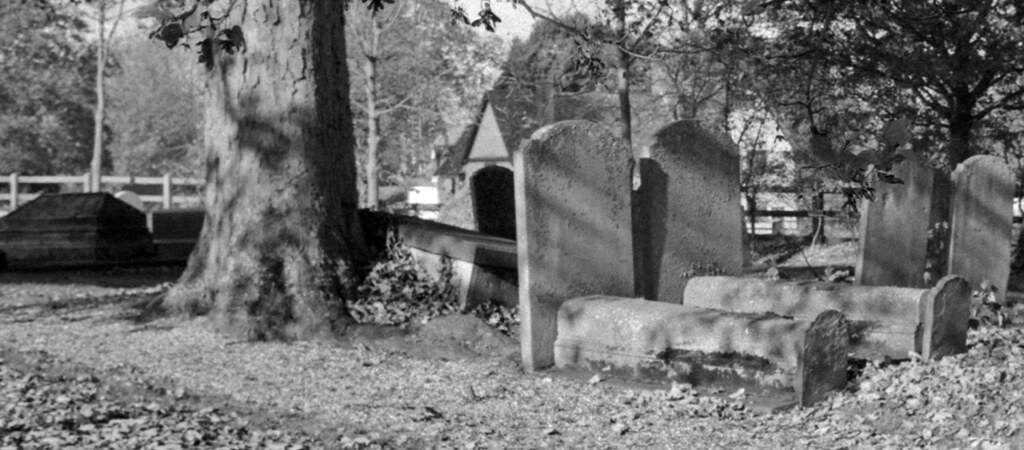
 

I'm sort of struggling to write this.  As a post, it's been burning up my brain for a week or more.  Self-knowledge and honesty are such important concepts to me (even if I'm not necessarily that good at them) and these three quotations about naming cut straight to the heart of it.  That's kind of the trouble, what is there left for me to say?  They aren't explicit, perhaps, but they are so brilliantly put - I don't want to write in my standard clinical argumentative essay style.  I probably will anyway.  Stop and read the quotations again?

Each of the three authors has a clear understanding of what a name is and isn't.  Shakespeare, via the innocent Juliet, points out to us what ought to be obvious but so often isn't or wasn't - that there is more to a person than what label they happen to be wearing.  In Le Guin's Earthsea universe, the secret names of the characters give those who know them power over the one who is known.  This author doesn't invite us to plumb the symbolism as such, these are children's stories. The tone of them though is so philosophical that it's hard to resist.  Her thought resonates very strongly, when you look at it, with that which Winterson expresses a decade and a half later - of the word 'name' being a cipher for something approaching 'the true understanding of the individual'.  Through them all, the progression runs, 'if a name is not the essence of the thing in itself, then what is? Where is concept which defines us, the thing that we understand when think of the name we use to describe it? That is what we really understand when we think of somebody's name, and the better we know that person, the closer to their true 'name' we get.'

It's very exposing to feel that someone knows you completely, right down to the core - which feeds back into the Le Guin concept.  If someone knows your 'name', that defining combination of emotions and thoughts and history that is you, where all your levers are and what to push when, then they have great power over you, 'your life in their keeping' as she says.  Brought out of the magic and into real life, Winterson's thesis is to seek for someone who knows her that completely, in order that they might restore her to herself when she is lost - a person who has the time and energy and ability to find out that kernel of the self and can be trusted with the delicate centre of identity, so that there can be someone else to guard it.

Back in Le Guin's fantasy, there is a point when the central character is suffering great guilt, and in his moment of self doubt another boy tells him his true name and hence cedes the first boy power over him:
             'Thus to Ged who had lost faith in himself, Vetch had given that gift which only a friend can
             give, the proof of unshaken, unshakable trust.'
A willingness to be known is a gift to give as well as an invitation to give back.  It is love, to know and understand one another that deeply, to accept the huge trust, the power and the responsibility, and to reply in kind to show that you recognise it for what it is.  That's the point.

Wednesday, 23 December 2009

What a hug is.


The Hug
It was your birthday, we had drunk and dined
Half of the night with our old friend
Who'd showed us in the end
To a bed I reached in one drunk stride.
Already I lay snug,
And drowsy with the wine dozed on one side.

I dozed, I slept. My sleep broke on a hug,
Suddenly, from behind,
In which the full lengths of our bodies pressed:
Your instep to my heel,
My shoulder-blades against your chest.
It was not sex, but I could feel
The whole strength of your body set,
Or braced, to mine,
And locking me to you
As if we were still twenty-two
When our grand passion had not yet
Become familial.
My quick sleep had deleted all
Of intervening time and place.
I only knew
The stay of your secure firm dry embrace.
Thom Gunn, from The Man With Night Sweats

This is perhaps my favourite full length poem from this collection, which I've quoted before.  It's a beautiful, peaceful image a relationship.  Safe, close, warm, held and loved, yet still surprised and surprising.  I also love the idea of a 'grand passion...become familial'.  He's a very direct poet - there's no beating about the bush or confusion in his imagery.  The poetry comes from such subtle use of words that you barely notice how your reactions are steered.  I particularly like the use of the words 'stay' and 'dry' in the last line, which seem to me to suggest something of death.  The whole seems to conjure up something of Larkin's 1964 poem 'An Arundel Tomb', though that might just be me:

An Arundel Tomb
Side by side, their faces blurred,
The earl and countess lie in stone,
Their proper habits vaguely shown
As jointed armour, stiffened pleat,
And that faint hint of the absurd —
The little dogs under their feet.

Such plainness of the pre-baroque
Hardly involves the eye, until
It meets his left-hand gauntlet, still
Clasped empty in the other; and
One sees, with a sharp tender shock,
His hand withdrawn, holding her hand.

They would not think to lie so long.
Such faithfulness in effigy
Was just a detail friends would see:
A sculptor's sweet commissioned grace
Thrown off in helping to prolong
The Latin names around the base.

They would not guess how early in
Their supine stationary voyage
The air would change to soundless damage,
Turn the old tenantry away;
How soon succeeding eyes begin
To look, not read. Rigidly they

Persisted, linked, through lengths and breadths
Of time. Snow fell, undated. Light
Each summer thronged the glass. A bright
Litter of birdcalls strewed the same
Bone-riddled ground. And up the paths
The endless altered people came,

Washing at their identity.
Now, helpless in the hollow of
An unarmorial age, a trough
Of smoke in slow suspended skeins
Above their scrap of history,
Only an attitude remains:

Time has transfigured them into
Untruth. The stone fidelity
They hardly meant has come to be
Their final blazon, and to prove
Our almost-instinct almost true:
What will survive of us is love.
Philip Larkin, from The Whitsun Weddings (London, 1964)


Monday, 21 December 2009

'The tempter or the tempted, who sins most?'

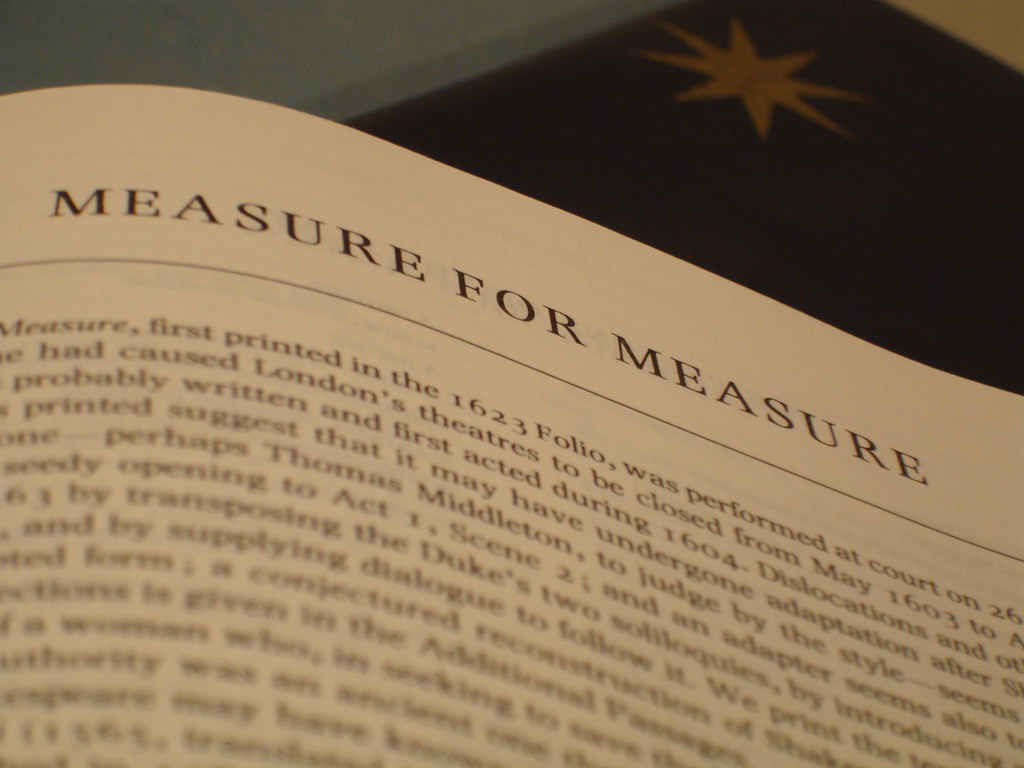
From Measure for Measure, 2.2.169


This quotation occurs just after Isabella has been pleading for her brother's life with Angelo, the Duke's draconian deputy.  It's a very difficult question to answer, either in the context of marriage (M4M is all about marriage, or if you re-write it like we did, it can be all about the acceptance of homosexual or otherwise queer relationships in a conservative society) or more generally. It depends a lot on what your feelings about marriage are in the first place, I suppose. How seriously do we take the 'til death do us part' stuff these days, really? Is the bond of marriage as much of a big deal as that, really? Should two people stay together even beyond the point when the relationship makes either of them happy purely because they are married?*

There's a chunk of me that doesn't feel allowed to talk about this – I've never been married. I've never, finally, made the decision that yes, this person is forever. All I need or want, always. I might have felt that a time or two, but that's not the same as standing up in front of somebody legal and signing to that effect. That's a big, big deal, that declaration. The very fact that I feel like that, despite the way that marriages are contracted and dissolved in secular Western societies, says that it's still an important institution – to use myself as litmus for Everyone, anyway. If you're going to get up there and have all of those people watching you, you owe it to yourself and everyone else, let alone to your partner, to really mean it, aside from any legalities. It demands that you trust the other person enough, too, to be making the same enormous commitment that you are. You both have to know all the way through yourselves that This Is It. It can't be a time that you hide behind yourself and allow the bullish part of yourself to chivvy the undecided and probably more rational part of you to go through with it. The whole thing is about complete and total trust – for oneself and one's own feelings as well as for the fact that the other person is interrogating themselves just as deeply...which is the scary part.

Is that a fanciful ideal, to believe that people should and do really, truly feel to the bottom of themselves and line up every layer of their minds to check that they aren't fooling themselves, and really can and do trust other people to do the same? Personal integrity and everything. Some people probably know instinctively what they're thinking, I'm probably the odd one out there. But I'm sure there are hundreds of people who drift towards marriage because it's The Next Thing and then live happily ever after - but then there are hundreds of people who never live their lives right to their full extent. The people who just skim their own feelings and understanding, who are content with the surface of life. I'm not sure whether it shows that I'm a cynic to believe that there are many of such people or that I'm an optimist to believe more and more that those people might be the minority...at least of the people that I know. Those skimmers might be 'content', but are they ever happy? I've said before that I'll cope with the lows of a life lived as fully as I personally can, without actually imagining extra drama in the name of 'living', to gain the highs at least for a few more years, but that's another story.

But why do relationships where that commitment has been made honestly eventually shatter? Where there hasn't been total honesty with the self and then one another, things are a bit different. I suppose one often feels that one has been honest to in the first place and then finds that one hasn't? But also, how much do people change? If you've been happy with someone for three years is it reasonable to believe that you will always be happy with them? [I'm applying scientific terms to emotions again. I wonder if that's a bad habit or a sane thing to do?] CAN you just outgrow someone, like you might in a short-term relationship of some sort? Why shouldn't you be able to? Is it more that you always outgrow people but then re-learn the loving them part, and that's what keeps a relationship going? Could that be the point in a way of such a tight institution as marriage? I suspect it has to be that.

But it all depends on the sort of the 'outgrowing' I guess. If it's just a question of finding that in your mutual life you have arrived at incompatible points then that is surely where you might re-learn the original loving in the new context. The trouble is that I don't think usually people can see that sort of drifting apart until it's too late. It's perfectly possible for the first realisation that something was wrong before to come from the revelation of somebody's infidelity. The point then is surely not the affair itself but what it means for the original relationship. The person who is 'cheating', to use the most judging synonym out there, might be so horrified by the fact of what they've done that their original relationship will actually be better off...something about realising the value of what you have. But the other side is that one realises what is missing from the prior relationship...which might on some level be a good thing for the individuals involved too. Either way, it ought to lead, admittedly through fire, to the possibility of a better future. Having seen some of that, though, I think that logic glosses far too much of the pain in all of this. Which doesn't invalidate the conclusions, but it does colour them.

[Ok. I still hate the language I'm using in this discussion...but if I don't make it sound clinical, it will sound insincere. As it is, I sound too definite in my wandering attempt to understand some of this, even with the volume of question marks I've used...]

All of which is a long way back around to asking – 'the tempter or the tempted, who sins most?' How much blame can be attached to the 'other (wo)man'? Is it their fault that someone else was tempted? Is it their responsibility to safeguard the relationship of the 'tempted' party? In modern times we only have a generally accepted societal framework for such moral questions, but to take the Shakespearean quotation in context is to require us to address the deeply Christian setting of the period in which it was written. The 'tempter' then is always the Satan and the snake in the Garden, and hence ought inherently to be the evil one; Eve is the 'tempted', and while she is clearly regarded as a sinner throughout the Bible, she is also the mother of the race and the reason for the existence of Christ and so on and thus is an ambiguous figure. With that simplistic rationalisation, we seem invited to make the tempter the greater sinner. However, the snake in the Garden was deliberate in the temptation of Eve; he was all out for her downfall. Shakespeare underlines the ambiguity – clear in his question is the fact that both parties sin and the only query is around which one is more sinful. The question brings us up a little short. Is the 'tempter' really such a Satanic character? Is the 'tempted' really as innocent as Eve was when the snake came to her? How many affairees are really likely to be setting out to break up a home? I'm sure there are people who do go out to sleep with someone married or not, but I find it hard to believe that most people looking for love and happiness (surely 90% of world) would set their sights on something so sure to generate heartbreak and recriminations somewhere along the line. In real life, the ordinary affairee might be guilty of not caring rather than active sin. But a sin by omission is still a sin in most religions. In our society, is it? Well, yes, but I don't think it's such a big thing as it might be to the religious. Perhaps they could be blamed for not stepping back quickly enough, not pro-actively defending the relationship in which they are the intruder. But 'intruder' too suggests action and intention which may well not be there. Is it ever our responsibility to save people from themselves? UK old-style socialist (nanny-state) politics would suggest that sometimes it is The Socially Acceptable Right Thing To Do. But that doesn't reduce the fact that Sometimes Things Happen. Don't They?

It's too circumstantial. Who is the seducer? IS there a seducer? Does ANYTHING Just Happen? How often is there equal blame? Won't it usually be uneven, but be random as to who? Is there a general skew? Is there some sort non-relational standard against which all of these things should be set? The very fact that Shakespeare poses the question in such a way in a deeply religious age again underlines the fact that religion doesn't have an easy and satisfying answer...why should our much more woolly modern consensus-morality be any clearer?

*At no point in this am I thinking about how this applies to couples with children. That's a totally different kettle of fish. It's not just about two independent grown ups then; the obligations have much more to owe to the innocent kids than they do to anyone else.

Wednesday, 7 October 2009

Two weeks.

It's creeping up behind me. Three weeks seems a long time. The three weeks left before I finish at work seem to stretch into eternity. That's partly because I've got MASSES of work to do and the mental piles are tottering around my ears...and mass clearly equates to length.

Two weeks is tomorrow.

I'll be doing something else - sales analysis for a theatre. Working out a glitzy bit of number crunching on a new piece of software. Walking to work. Drifting around the supermarket. Planning a party. And then...

Two weeks.

My birthday is less far away than that. I hate my birthday, it reminds me of all the things I haven't done yet. I discovered yesterday that someone I sat through classes with at uni has not only founded a reasonably well known and certainly very outspoken climate change activists group - but has written a book about it. I am in awe. And support what she's doing, definitely. She keeps inviting me to events on Facebook, though I suspect she doesn't know who I am or where I came from in her life. But I am a little jealous.

Two weeks.

I hate deadlines. At least the ones that are to do with life and not to do with work. With work, they're ok. I like to plan, and generally make sure the decks are cleared down enough that I finish things well in advance to leave time for things to go wrong. Even if that actually isn't a very efficient use of time. But in life? I never have strong enough plans to work out what I should have done when far enough in advance, so when New Year and my birthday go whizzing by I'm always left with a nebulous guilt for Things Not Done. It's too late for me to write a book before my birthday (still an ambition - maybe I will have written one before ONE of my birthdays?), and I think it's probably too late for me to do a ton of the things with Traci I wanted to do before she goes...we don't have time, and what time we have we need to fill with packing and admin.

She goes in two weeks, and we have no idea when she might come home.

I'm going to miss her like crazy.

Monday, 2 February 2009

This is for you. Called: I love you.

Three tiny words. Eight letters or ten characters. Five vowels and five distinct vowel sounds (count them). Three consonants, none of them plosive or percussive or in any other way harsh. One glottal stop, or 'voiceless glottal plosive', according to Wikipedia. Why does so much hang on them? The softness of the phonetics means they're easy on the ear and easy to say, once you get past the awkward glottal at the beginning - which makes them hard to start to say. 'Je t'aime' ('I like you') or j'adore ('I adore you') are not the same. 'T'estimo' (Catalan - 'I esteem you') is even worse. Liking, adoration, esteem, are fine emotions, but they are aspects of love and not the whole. Adoration puts an object on a pedestal; liking does not convey the urgency; esteem is formal and distant. Gaelic makes more effort - there's a whole list.*

- Gráím thú (I love you)
Simple enough, that. Like the English, though, it's imprecise. A cipher for a million things. Shorthand, in the way that a hug or a touch is, for feelings that would take a lifetime to express in words. That would never be complete. That can't be precise or complete, because words don't cover all of the elements in the right ways, all at the same time. Everything that follows is part of this phrase - it has to be all-encompassing, in as many senses as I can think of. But it remains a code.

- Tugaim cion duit (I give you affection)
- Tá cion agam ort (I have affection for you)
- Tá mé ceanúil ort (I have affection for you)

Three ways of saying 'I care', but 'care' is not enough for the whole feeling. 'Having affection' is better than 'adoring' or 'esteeming', though. Better even than 'liking', because one can like many things in a purely cerebral way; it does not demand the involvement of emotions. Affection is human and warm. Close, safe, content. It's curled up on the couch under a blanket watching a film with that person and the cat. It's not about thinking or analysing. It is coming down to find your breakfast laid out for you in the kitchen. It's not about pain. It is safe and easy and content and close. This is love, too, on one day or at one time. Not all the time. It doesn't show the pain or the danger or the exhilaration or the need or the mania, the heights and the depths. It is level, safe. A part, not the whole.

- Tá grá agam duit (I have love for you)
- Táim i ngrá leat (I'm in love with you)

The distinction between loving and being in love is important. If I have ever said 'I love you', I have been certain of meaning the first of these - nobody ever believe otherwise. I love easily, for reasons I am rarely able to fathom until I get some distance. I may not have been certain about the second. I may have believed that I knew what I was talking about, but I may not really have known underneath. Almost, not quite, every time I fall in love, I feel that I have never been in love before. Maybe I just fall harder each time. I certainly understand more, and seem to stretch and grow with each time. So that the last time I expand so much I feel enormous. Great. Empowered. Alive. Loving someone is the extension of affection, going deeper and further, but it ultimately lacks the urgency of being in love. I'm not sure that the need is there in loving, and it is fundamental to being in love. It hurts when you give up something you love, and you miss and you hurt - but you aren't made less in the same way? Being in love is mutual, and you can love someone who doesn't love you back - and if they don't love you in the same way, then you can never be more than yourself, because they do not give totally of themselves. Being in love with someone, makes you more than yourself. I think that could almost be the definition, at least for me. [How much 'romance', in the most pejorative way of inflecting that word, can I betray in myself? Quite a lot, probably. I only like to pretend I'm a cynic, I suspect.] The two become more than the sum of the parts, in the way that two building blocks can interlock and form something entirely different. One brick is a brick; two bricks can be a wall, and if their shapes are right, they need never come apart once they have come together. And it is circular, never ending conversations that have to stop because it's four hours past too late where there isn't a moment's silence and you have gone so many places that you wouldn't be able to visit even with anyone else and you have held one another and talked with touch as well as voices aware of nothing outside the compass of yourselves, but since the whole world is in that space what is left? and it is sex that makes your body shiver with just the thought and it is when you have found out the souls of one another and discovered them fractal and total and it is silence understanding without contact and the reason to get out of bed and the reason to go back and it is finding yourself stripped naked and it being ok and stripping the other to their core in your turn and finding them beautiful and being beautiful because they find you so and this list is trite and partial. It is the whole of these and more, and it changes and it ebbs and it flows, always greater than it would be possible to be alone. And people settle for 'affection', for 'comfortable', for 'suits me', for 'safe' - for an image of happiness that they think they fit, if they fit at all. I have learnt that I want more than that.

- Tá mo chroí istigh ionat (My heart is within you)
- Ádhraím thú (I adore you)

'My heart is within you' is probably reason that this list is in Gaelic and not any other language I could have found. That's the poetry of the Irish right there, written into their idiom. You can think like a poet when that kind of phrase is built into the everyday lexicon. I wish I could pronounce it - maybe I should learn. It says, "The centre of my being is part of you. I do not hold it back - cannot, now. It goes with you. I cannot live without it, but it is in your keeping. I am incomplete without the part of myself that is in you. Stunted. But with you, I am fully alive. More than it was possible to be, away from you." To me, this is 'true' 'romantic' love. What is the phrase from Oranges? 'Romantic love has been diluted into paperback form and has sold thousands and millions of copies. Somewhere it is still in the original, written on tablets of stone.' This is one of those tablets, in an ancient language.

I was going to write about Greek love, too. About 'storge' and 'philia', which encompass friendship and affection; about 'eros', which is total devotion as well as erotic love; and 'agape', which sounds better as 'caritas' in Latin though I suspect it's then slightly different, but which covers an unconditional love often used to describe religious devotion. See here for more. It's a bit Christian (C.S. Lewis), but it's worth reading for the underlying themes, that aren't about religion. I found I'd written them, mostly, though.

Oranges, again:
'The emperor, walking round his theatre, could see them all at once, if he wished.
Round and round he walked, and so learned a very valuable thing:
that no emotion is the final one.'

I only had one RS teacher at school who said anything I remember. He was called Mr Campbell, and someone had weasled him out of retirement to come and teach us. I rarely remember us keeping an RS teacher at school for more than a couple of terms, and he was no different - but the whole school begged him to stay. There were letters and impassioned pleas and all sorts. For a man older than most of our dads, in a school full of spoilt little rich girls in the south east of England. He never taught us anything that seemed to be part of any curriculum, we just sat and debated. He started every lesson with a 'wise saying', many of which I remember. There was 'There are more things in heaven and earth, Horatio,/ Than are dreamt of in your philosophy'**, and the passage that starts at Luke 12 verse 27 'Consider the lilies how they grow: they toil not, they spin not; and yet I say unto you, that Solomon in all his glory was not arrayed like one of these', and there was 'Ye shall know the truth, and the truth shall make you free' (here). There were more, and I still have the exercise book that I copied them down into with the rest of my class, somewhere. They weren't all religious, either. I must dig it out again. He spent a whole lesson teaching us about love and its types. An odd thing for a 60 odd year old man to spend his time discussing with 14 year old school girls, really. I don't think I ever realised that he was using C.S. Lewis as a pattern until I did that search, but he was. I am grateful to him for the time he took to teach me and my schoolmates about things that were more than our exams or our curriculum and for the thought he put into our lessons. I never liked RS unless it was philosophy, and he seems to have been the only person who thought it necessary to try and make us wonder about the world around us and our place and our lives, the entire time we were at school.

*See here for source.
**Hamlet, Act 1, scene 5

Sunday, 18 January 2009

Do I dare?

You

Uninvited, the thought of you stayed too late in my head.
so I went to bed, dreaming you hard, hard, woke with your name,
like tears, soft, salt, on my lips, the sound of its bright syllables
like a charm, like a spell.

Falling in love
is glamorous hell: the crouched, parched heart
like a tiger, ready to kill; a flame’s fierce licks under the skin.
into my life, larger than life, you strolled in.

I hid in my ordinary days, in the long grass of routine,
in my camouflage rooms. You sprawled in my gaze,
staring back from anyone’s face, from the shape of a cloud,
from the pining, earth-struck moon which gapes at me

as I open the bedroom door. The curtains stir. There you are
on the bed, like gift, like a touchable dream.

Tea

I like pouring your tea, lifting
the heavy pot, and tipping it up,
so the fragrant liquid streams in your china cup.

Or when you’re away, or at work,
I like to think of your cupped hands as you sip,
as you sip, of the faint half-smile of your lips.

I like the questions – sugar? – milk? –
and the answers I don’t know by heart, yet,
for I see your soul in your eyes, and I forget.

Jasmine, Gunpowder, Assam, Earl Grey, Ceylon,
I love tea’s names. Which tea would you like? I say
but it’s any tea for you, please, any time of day,

as the women harvest the slopes
for the sweetest leaves, on Mount Wu-Yi,
and I am your lover, smitten, straining your tea.

Carol Ann Duffy, Rapture, 2006 Winner of the T.S. Eliot Prize


The images of new love are brilliant - the idea of enjoying the small things about someone, particularly visible in the second poem, is exciting and real. Of enjoying NOT knowing, knowing that you are going to learn. In the first poem, it is the idea that someone else can walk into your life seemingly unaware, unaffected, while you have to hide from the earthquake of their presence in the ordinary that is most effective. But if it's really love, then the invader and the invaded are the same person. That first poem speaks as an individual - that feels odd. One only has one's own feelings to write about, certainly, but an impression of mutuality is missing from the first poem. Isn't it? Though it is possible to love someone who does not feel the same. Is that really loving? Doesn't love demand some interplay between two people?

I have found a new resource for poetry, having nearly exhausted the books I keep around me. I have found a few things in it over the last few weeks, and inspiration for a few more things. She's a peculiar woman, that one. I'd be intrigued to meet her, though I wonder whether or not I'd actually like her. I get the impression I'd have got on with her younger self but not the person she is now. She has had a hard life, but that only makes her more interesting. I haven't finished with that site yet.

Sunday, 14 December 2008

I have found The Answer. Twice.

The First Answer

Disclaimer: The following should not be read looking for any agenda. There isn't one. Except that I found the following very important, and wanted to share it.

'One day, a lovely woman bought the emperor a revolving circus operated by midgets.
The midgets acted all of the tragedies and many of the comedies. They acted them all at once, and it was fortunate that Tetrahedron had so many faces, otherwise he might have died of fatigue.
They acted them all at once, and the emperor, walking round his theatre, could see them all at once, if he wished.
Round and round he walked, and so learned a very valuable thing:
that no emotion is the final one.'

(...)

'I miss God. I miss the company of someone utterly loyal. I still don't think of God as my betrayer. The servants of God, yes, but servants by their very nature betray. I miss God who was my friend. I don't even know if God exists, but I do know that if God is your emotional role model, very few human relationships will match up to it. I have an idea that one day it might be possible, I thought once it had become possible, and that glimpse has set me wandering, trying to find the balance between earth and sky. If the servants hadn't rushed in and parted us, I might have been disappointed, might have snatched off the white samite to find a bowl of soup. As it is, I can't settle, I want someone who is fierce and will love me until death and know that love is strong as death, and be on my side for ever and ever. I want someone who will destroy me and be destroyed by me. There are many forms of love and affection, some people can spend their whole lives together without knowing each other's names. Naming is a difficult and time-consuming process; it concerns essences, and it means power. But on wild nights who can call you home? Only the one who knows your name. Romantic love has been diluted into paperback form and has sold thousands and millions of copies. Somewhere it is still in the original, written on tablets of stone. I would cross seas and suffer sunstroke and give away all I have, but not for a man, because they want to be the destroyer and never be destroyed. That is why they are unfit for romantic love. There are exceptions and I hope they are happy.

The unknownness of my needs frightens me. I do not know how huge they are, or how high they are, I only know that they are not being met. If you want to find out the circumference of an oil drop, you can use lycopodium powder. That's what I'll find. A tub of lycopodium powder, and I will sprinkle it on to my needs and find out how large they are. Then when I meet someone I can write up the experiment and show them what they have to take on. Except they might have a growth rate I can't measure, or they might mutate, or even disappear. One thing I am certain of, I do not want to be betrayed, but that's quite hard to say, casually, at the beginning of a relationship. It's not a word people use very often, which confuses me, because there are different kinds of infidelity, but betrayal is betrayal wherever you find it. By betrayal, I mean promising to be on your side, then being on somebody else's.'

(...)

'But history is a string full of knots, the best you can do is admire it, and maybe knot it up a bit more. History is a hammock for swinging and a game for playing. A cat's cradle. She said those sorts of feelings were dead, the feelings she had once had for me. There is a certain seductiveness about dead things. You can ill treat, alter and recolour what's dead. It won't complain.'

Oranges Are Not The Only Fruit, Jeanette Winterson (Vintage, 2001, first published in Great Britain by Pandora, 1995)

The above is a book that has been on my 'to read' list for ages, though I'm glad I hadn't read it until now. She wrote it when she was 24 - my age. I wonder if I can make that an excuse for part of the way it resonates for me - there are a great many more reasons, but that is perhaps the most prosaic and the only one I'm prepared to get out in public at the moment. The lesbian elements, as well as many of the religious ones, are by the by for the most part. I think the explicit statement above about men being 'unfit for romantic love' is partisan and generalising, but it is interesting nonetheless, particularly if you substitute 'some people' for 'men', as it were. But this is almost more a philosophy than a novel, written with enormous power and huge skill. Virginia Woolf, 50 years on. I need to read more. There aren't many books that when I reach the last page, I turn back to the beginning and start again - this one I did, and I've nearly read it twice in two days (there have to be some useful things you can do sitting at the back of a cold church in a long concert, between numbers with which you are involved). I will probably need to add more extracts as I find them, reading this time.

I need to find time to write properly again, for myself. I CAN write, I know I can. I've just not found the time to pursue it properly. I want more sonnets, and maybe I'll try and write some pieces of Actual Prose. Short ones, and nothing explicitly narrative - I have no ability with plot - but something between poetry and prose. I have no time. That's the kind of thing you need to do every day to keep any sort of progression, and I'd usually write my diary, given the choice. I don't know. It's late, and I need to show you the other Answer.

The Second Answer

This is so much less serious than the above, but a record needs to be made of it nonetheless. I was in London yesterday, for an ex-Binson Christmas, with turkey, too much food and boozed up carols. (And my homemade mincemeat, with which I was very pleased.) My Secret Santa present (courtesy of Kate) was a rather lovely bag, and a bar of chocolate. Not just ANY bar of chocolate. A bar of 100% cacao from this guy. It was featured on TV earlier this year, and Kate and I had trailed around Selfridges looking for it with no luck. She found me some for Christmas! I was SO excited. I got back at 1am this morning and have since spent 6 hours in Great St Mary's, so had little time to play with it until I got back post-concert this evening. I unwrapped it and just smelled it. Even to my slightly blocked nose, it's amazing. It has an incredible perfume - rich and dark and chocolatey. Of course, it's very bitter as it is, since there's nothing in it but cacao, so if you taste it it's hard to get past that to the flavour beyond. Grate about a half a centimetre off the length of the bar into a mug's worth of milk with a dessertspoon full of runny honey, a (large, if you're me) pinch of cayenne, a small pinch of cinnamon and a grating or two of fresh nutmeg, and you have the most sublime hot chocolate you've ever tasted (the spices are pretty close to Traci's standard additions, but you could do all sorts of things - I intend to go with cardamon next time, perhaps with something floral...orange blossom water, if I had it, or maybe a grating or two of orange zest...or a REALLY good vanilla extract...). Really. I've made hot chocolate many many ways, but this is really something else. And it's now a good half hour after I intended to be in bed, but I have been excited.

ETA: I neglected to factor in the high caffeine content of 100% cacao. Not had much sleep. :-(. I will have to remember this in future...