Showing posts with label recipe. Show all posts

Sunday, 5 August 2012

Pistachio petit-four cake.

I have had a fascination with this cake for some considerable number of months.  I've been wanting to make it and wanting to make it and wanting to make for AGES.  I very much love Deb's Smitten Kitchen  blog - so much so that I pre-ordered her cookbook the day it came out and I'm waiting with bated breath for it to show up.  In the meantime, I'm baking my way through the back numbers - which brought me here.


I was explaining the cake to Will - while we were eating enormous steaks, now I think about it - and bemoaning the fact that it's hard to make for work and anyway was enough of a spectacle that it really needed an event suitable for it.  Whereupon Will invited me to his birthday bash, which involves approaching 20 people in his parents' beautiful house, barbecuing, eating and drinking...  Also plenty of chasing about with two labradoodles, one of whom was clearly designed to be in a cartoon, trying to make friends with the horses and biting nails over the Olympics.  Brilliant.


The cake itself is remarkably easy to make.  That's sort of the thing about baking - you do one step after the other, just like the recipe says, and it all comes right in the end.  You do have to measure, and it is worth doing the little things that seem fussy, like weighing your batter into the tins to make sure they're the same thickness or browning the nuts before you grind them...and when you do that, it all works.  I only had 2 cake pans for a 3 layer cake, so I did a lot of weighing out of ingredients and dividing them so that I could bake in stages.


Producing the cake was overkill.  Totally.  It was enormously excessive and unnecessary, and went down brilliantly.  I will do it again.

Saturday, 28 July 2012

Guacamole.

So normally making guacamole is very simple for me: I put an avocado into one of Tom's hands and a knife in the other, and say something like; 'We're having chill for dinner!' and guacamole happens.  I genuinely didn't know how, until, deserted, I had to figure out how to make it for myself.

Here are most of the ingredients.  Typically, I didn't pull one key element out of the refrigerator but we can have that as a surprise later.


NB that piece of chilli is frozen - they come in great big bags, especially if you buy them at the Indian grocers, and nobody can finish them that fast.  I freeze them and then cut lumps off as required - they defrost enough to be easily to cut in about 2 minutes.

First task is avocado stoning, where you halve the beast, smack a knife into the stone (carefully avoiding cutting off own hand at wrist, or any wayward fingers) and then turn the knife like a clock hand to release the stone.  This works like a dream, though I sometimes find getting the soapy stone off the knife is a bit of an adventure.


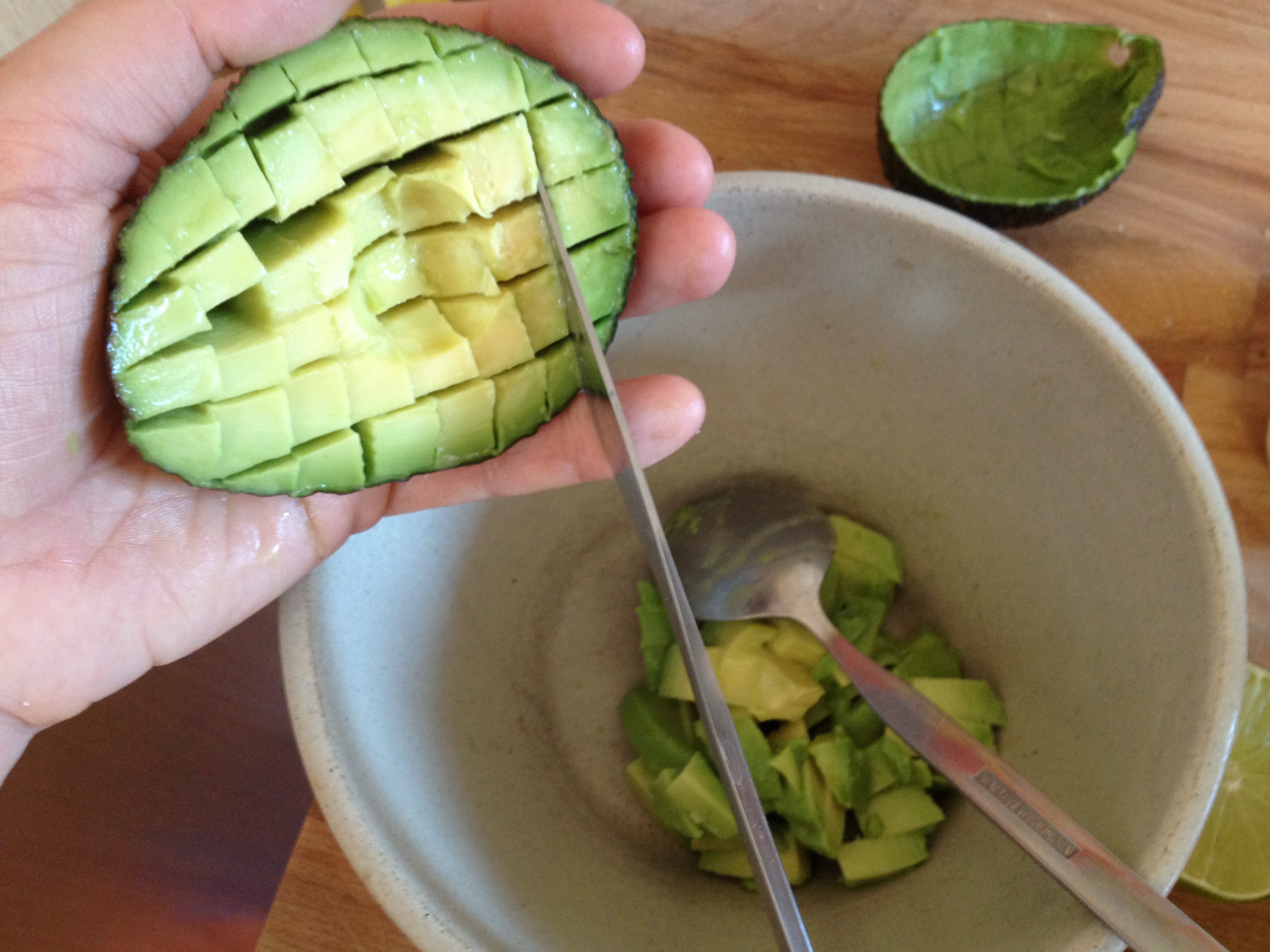
Using a butter knife, dice the avocado flesh and then remove it to a bowl with a spoon.  Voila:

Juice your half lime and sprinkle over some salt. Leave to macerate for 20 minutes or so, while you mince 1 large clove of garlic and about an inch of red chilli.

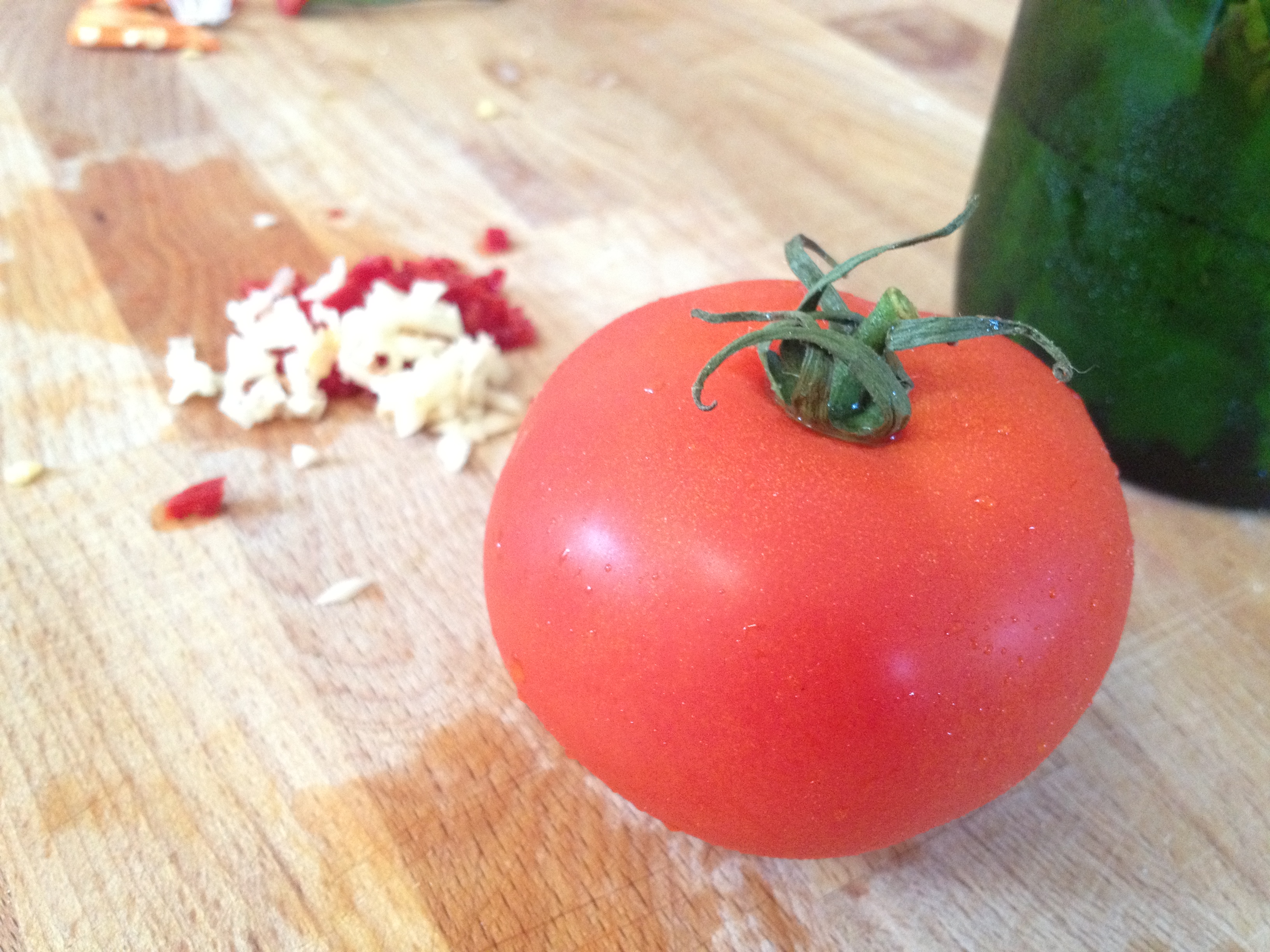
(sneak tomato portrait) 

Cut a medium-large tomato in half and remove the seeds (I usually throw them in the main dish, if it's a saucy one), and then cut the flesh into large dice.  Take the leaves off around 6 big sprigs of coriander/cilantro and chop coarsely.


Pour off any lime juice which hasn't been absorbed into the avocado and mash it a bit with a fork or a spoon, depending on how ripe your avocado was.  Stir in the chilli, garlic and tomato.  Add the coriander/cilantro just before you serve it, and taste to see if it needs more salt.  With chips, chilli, quesadillas, tamales, bread...anything, really.  It doesn't keep so you really should finish it.  Yes.  That's why you should finish it.  Ahem.

Technically, 1 ordinary avocado could probably be said to yield 2 servings.  This has never really been noticeable for me.


Making Guac, the Tom Way

Take one soft avocado.  Cut around the stone and separate the halves.  Smack a large knife into the stone (miss own arm and fingers) and give a slight turn to remove the stone.  Use the butter knife to dice the flesh and then spoon it into a bowl.  Add the juice of half a lime and around half a teaspoon of salt.  Leave to macerate for around 20 minutes.

In the meantime, finely dice half a deseeded chilli and a clove of garlic.  Remove the seeds from half a medium-large tomato and dice the flesh quite chunkily; a finely sliced spring onion is optional.  Coarsely chop the leaves from 6 or so sprigs of coriander/cilantro.

Drain any excess lime juice from the avocado and mash it coarsely.  Stir in everything else.  Eat all at once, with gusto, chips or Mexican dishes.


Er.  This was the day it got to bedtime and I found I'd accidentally made fairy cakes.  True story.  These things happen to me...

Sunday, 30 October 2011

Getting up at 5.30 on your birthday, or How To Make Croissants...


We all know I love to bake.  I would be a whole lot fatter without my work colleagues to help.  There are certain traditional times when everyone brings in something edible into the office: birthdays, and when they come back from holidays.  I add in 'whenever I feel like baking' to that list...and that's often.  So when I get to one of the times when everyone brings things in, I'm on my mettle to produce something a bit more....so I spent 3 days making croissants for my birthday.

It began on Friday night, when I mixed sourdough leaven and yeast poolish (batters made of flour, water and wild or cultured yeast).

Leaven - sourdough batter, made with equal parts water and 00 flour and a spoonful of my sourdough culture. Poolish is
identical, but switch a tiny amount of commercial yeast for the culture. I have no idea why it should be called poolish....
It finished as the sun came up on my birthday.  In fact. this is what before dawn on your birthday looks like if it's mid October and you live in London:

Monday 17th October, about 7.20am.

Croissants are a bit of a faff, even for somebody who really doesn't think that 24 hours is too long to wait for a loaf of bread.  You make something a bit like a baguette dough (so that's very soft and very white)...

Dough bulk rising.

and you roll it out, plonk a slab of butter in the middle and wrap it up like a parcel...

Laminating croissant dough with butter: and roll and fold and roll and fold and roll and fold and...
...and you roll it and fold it twice every half hour, for 3 hours, until, eventually, you're allowed to shape them.

Aren't they cute? I was aiming for mini ones, but they baked up to suitable breakfast size...

It was Sunday evening by this stage - I could probably have got to this point 24 hours earlier but I wanted to make sure I could bake them on Monday morning, because who wants a day old croissant?  I was going out with my friends to have brunch on Sunday, too, so it's a good job the dough is pretty forgiving - you can put it in the freezer and things to slow it down.  Next time I make them though I want to do what they tell me about when I bake them, because I'm hopeful that will just perfect the texture.

On Monday morning, they looked like this:

All glazed up.
And they baked beautifully.  Everybody thought I was mad, but *I* was the one who spent a whole hour on the bus with the heady smell of fresh croissants warm on my lap instead of stinky London morning commuters.


I'm not going to try and write out the recipe, it would take too much explanation.  Tom and I have a new Bible -


It's really excellent, if you're into this kind of thing.  Lots of detail, lots of explanation, lots of wonderful photos.  I think the croissant recipe would probably total about 20 pages, but it's hard to count and certainly not that hard to do.  This is the second time I've made this recipe and they really did come out well.  I am beginning to think I might make a few changes next time, because I'm not getting just the texture I want, but I need more time for that - and a lot of people to eat them...

There are a few more photos here.

Monday, 12 September 2011

What To Do With Monster.

I went on holiday for a month.  It was hot and sunny in the south of France, and damp and English in London.  My garden has become a jungle, and everything is a size bigger than it should be.

 
There are mushrooms three inches across under the birch trees and clearly the homes of gnomes, a bright yellow pumpkin as big as my head which looks like a roc's egg, runner beans 18 inches long and fat with big purple beans, where the snails haven't got them - and under the parasol leaves near the front of the vegetable patch I found Monster.


Monster is a courgette.  Monster weighs 1.5kg, or 3.5lb in old money.  Monster is practically as long as my arm.  My dad told me not to take him on a train because he might get classed as an offensive weapon.  Who could possibly be offended by Monster?!

His eating demanded ceremony and attention.  I didn't think he was going to get cooked at all, my week is so busy.  Today my curry date (third in a week, but all delicious) cancelled a little to my relief.  I will see the friend next week for idli and dosai, and we will be both be relaxed and ready.  All the way home on the bus I pondered.   I googled and thought and risked antagonising the motion sickness and the smelly man with ear hair who sat beside me for a while.


Monster: roasted with lemon and rosemary; stuffed with crispy sausagemeat, chilli and pear.

I knew there was going to be sausage, but it took a Nigel Slater recipe, obviously, to tell me that I wanted it to be *crispy*.  The rest is my idea...

Marrow with crispy sausage and pear
Serves 2 very hungry people, or 3 with a salad
1 large courgette, or several smaller ones, weighing about 1kg in total after trimming.
Rosemary sprigs (about six 2 inch ones)
1 lemon
olive oil
8 butcher's sausages, around 400g
1 hard conference pear
1 tbsp coarsely chopped parsley
1 small red chilli
3 cloves garlic
Sea salt and black pepper

Preheat the oven to 220℃.  Cut the courgette into 3 inch lengths, and then in half vertically.  With a spoon, scrape out the spongy inner flesh (and add to your compost to feed to next year's Monster).  In a large bowl, toss the pieces with a couple of spoonsful of oil, the zest of the lemon, plenty of sea salt and freshly ground black pepper.  Place the pieces skin side up in a heavy roasting tin or casserole dish and tuck rosemary sprigs all around and inside.  Bake for 20 minutes, or until beginning to colour, then flip the pieces over.  It will probably take 40 minutes all told, it's done when a fork goes all the way through easily but don't overdo it.

Meanwhile, chop the chilli and garlic finely.  Strip the sausagemeat out of the skins.  Heat a spoonful of oil in a cast iron pan until shimmering and crumble the meat into it - you may need two pans, or to do this in batches.  If you crowd the pan the meat will steam and not go crispy.  Try not to disturb it too much until it has begun to caramelise.  Get it nice and brown, adding the garlic and chilli for the final 5 minutes.  As it fries, chop the pear into quarters, core and slice each quarter into pieces half a centimetre thick.  Remove the meat to a dish and keep warm.  In the same pan, fry the pear until it takes a little colour, then add the juice of half the lemon and let it evaporate.  Add plenty of salt and pepper, and return the sausage to the pan to combine.  Stir in the parsley.  Taste for seasoning.

When the marrow is cooked, discard the rosemary and serve with the meat.

Friday, 9 July 2010

Melon Seed Horchata


I have been tidying my house today.  It's been a bit of a mammoth undertaking.  The bathrooms still need scrubbing and the kitchen floor needs doing and there's laundry all over the living room, but it's better than it was.  I don't feel like I'm living in such a pit.  Of course, there are still some exploding sacks of clothes belonging to a brother and his girlfriend stuffed into a corner and more bedding than can be shaken at with a stick on one of the beds, but it's tidier.  I even re-filed my cookery books and sorted out the wheat of elderly bank statements from the chaff of envelopes.  I haven't hoovered; I HAVE made horchata.  Not the rice based cinnamon flavoured stuff I had in San Francisco, which was delicious, but something identifiably from the same family.  I bought a melon yesterday.  I'm currently very very poor, due to a small amount of miscalculation and the impulse purchase of a corset, so any fruit I buy has to be vetted carefully and on offer before I shell out, and the eating of it has to be planned such that I eat it when it's perfect not wasting anything.

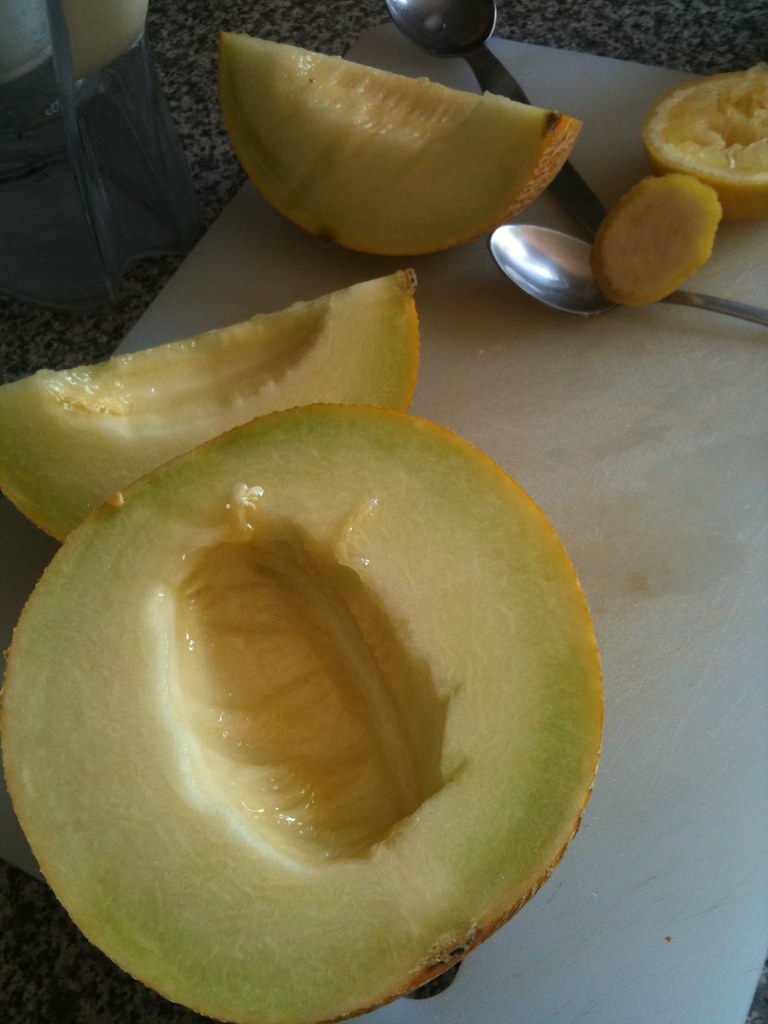
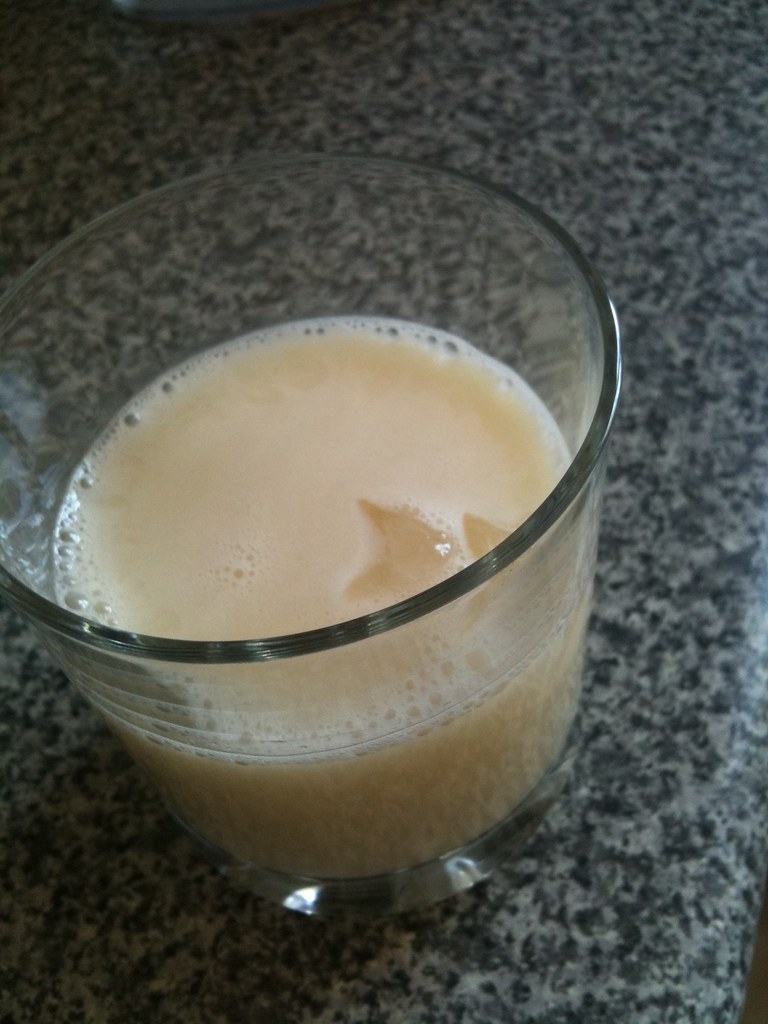
I've been wanting to play some more with my new cookery book ever since I got back; something about the amazing weather in south east England at the moment.   And I had a melon.  At the back of the book is a very simple recipe for melon seed horchata, that neatly takes in my need for a cool drink, my adoration of melons and my reluctance to waste the smallest part of a beautifully ripe piece of fruit.  All you do is lift out the seeds and pulp from the middle as you would ordinarily, but for each cup of fruit add an equal volume of water, 1½ tablespoons of sugar and 1½ teaspoons of lime juice.  You then blend the mixture until it's as fine as can reasonably achieved in a home machine and leave the lot to muddle in the fridge for half an hour.  Then you strain it (ideally through muslin), add ice and enjoy.  If you really wanted to, I suspect it would be fantastic with a shot of tequila.  It has a great texture, a little like coconut milk in its smoothness but with a wonderful aroma of melon.


One or two things: my one ordinary sized galia melon made 1 cup of horchata, which isn't much.  Use more melons, or possibly freeze the pulp until you have enough for a sensible amount.  It also had a slightly bitter aftertaste.  I'm debating what is likely to have caused this and have several thoughts, the most likely being that it sat longer than half an hour in the fridge and various tannin-type things might have leached out of the seeds.  I also didn't use the melon variety specified by the recipe, which was cantaloupe.  The stripy orange fleshed melons, iconic to me of holidays in France when I was a child, are by far my favourite variety (though I love all of them), but it's very hard to get decent ones in England.  I bought one in San Francisco, seduced by the unbelievable scent as I walked past them.  The ones in Tescos yesterday smelled of cardboard.  Even carried carefully home and placed gently on the windowsill for a few days, they would never emit that amazing Mediterranean perfume.  So.  I didn't buy one.  I bought the only galia I could find that smelled of flowers, and left it in the sun all day.  It is a pretty good piece of fruit.  I am not sure whether the seeds are likely to be much different between the two varieties, but it's certainly possible that one will produce a slightly less bitter drink than the other.  I shall be hoarding melon seeds for as long as they're on offer, and trying out different varieties - everything with the pale yellow, thin skinned seeds has got to be worth a go, but I think that it's probably not worth bothering with watermelon.  Better to puree the flesh in that case and drink that (definitely with lime and tequila, in that case...).

Saturday, 10 April 2010

Mussels and Scones: a Cornish spring

...so I got distracted.  Sometime I might tell you about him.  I have actually been writing a blog post, but it's very long, currently imageless, and about my confusion over Ireland and Irish history.  I'll finish it at some point and post it for everyone to skip.  In the mean time, spring leapt up and came crashing into consciousness.  Easter. Sunshine. BOOM.  Amazing.  I went to Cornwall for a week to walk the dogs and eat yellow food (Simnel cake and ice cream lemon meringue pie) and watch Jeeves and Wooster and get drenched to the skin without freezing and paddle in the sea to the perturbation of the canines and commune with the llamas and get adored and attacked by turns by the cats and have all my family around for approximately four hours and eat too much chocolate and generally get excited about the turning of the English seasons.  It was great.


Something I've been meaning to do for ages has been to pick mussels off the beach and cook them myself.  The Cornish coast is ideal for this - it's a rocky shore, but there are are some quite deep beaches which means that there are rocks exposed only for half an hour or so at low tide and also the water is relatively warm.  I think it's those two things which lead to the wild mussels down there being nearly as big as the farmed ones which are under water all the time.  I didn't pick anything that was much smaller than my thumb, and that was easy to do.


There are a couple of beaches I've had my eyes on for a year or two actually, to pick mussels from, but circumstances like the tide, the weather and not having a bag with me have hindered me a bit.  This time, however, I finally got around to it on Holywell beach.  The dogs were bemused as to why we were spending 20 minutes standing around by some rocks when there were a whole load of interesting bits of seaweed on the tideline, not to mention bunnies in the dunes.  Rocky noticed me pulling things off the rocks.  I think he thought that they must be like blackberries, which he loves and picks for himself whenever he can.  He tried to pull off a few for himself but decided that they were better to roll in than to eat.  Kiri used to eat barnacles off rocks, it's true, but never managed mussels...

Mussels are easy to cook.  There are schools of thought about whether you need to soak them in salted water with flour or oatmeal overnight before you eat them or not.  I did soak them, more because I didn't want to eat them until the next day than anything else, and they were pretty grit free so I have nothing much to add to the lore on that.  I ended up with a mixing bowl full of molluscs - I guess something in the region of 6 or 7 pints or two ish kilos, but that's just a guess.  Enough to make a good sized starter for five, anyway.  The only time consuming part of the whole process is cleaning them.  You have to go through the bowl and pull of the 'beards' or 'byssus' by which they attach themselves to the rock and scrape off the barnacles (which introduce grit,), and throw away any that don't close when tapped.  I guess that took me 40 minutes or so.


I then chopped about 8 shallots and a couple of cloves of garlic and softened them in olive oil.  I added a wine glass full of white wine, a bay leaf, some black pepper and the clean mussels.  I clapped the lid on and left it for five minutes, by which point all the shells had opened.  I transferred the mussels into hot bowls and stirred some double cream (optional) and a large handful of chopped parsley into the juices.  After heating through, I poured this over each portion of shellfish and served the lot with hot french bread.  It's possibly my favourite dish to eat ever.


My next ambition with mussels is to cook them actually ON the beach - picking them and then barbecuing them until they open, and then dipping the meat into garlic and parsley butter.  Heaven.  My next wild caught shellfish plan revolves around trying to catch some crayfish in the old mill stream that runs across my parents' garden...

I had an American in Cornwall.  I needed to illustrate what a cream tea is, which meant I made scones to serve with strawberry jam and clotted cream.


I firmly believe that there is little point in scones beyond vast quantities of strawberry jam and clotted cream.  If you can't get good versions of both, don't bother.  Handily, the West Country is brilliant at both.  The scone recipe I used came out of the 'The Dairy Cookbook', which is older than I am and only still has covers because the bookcase holds all the parts of it together.


It has recipes for all the old fashioned things (provided they contain dairy) that one actually needs now and again and which new books rarely contain.  I think you can probably read the recipe in the (rather dark, sorry) photograph, but I edit it very slightly:

350g self-raising flour (or plain flour with 2.5 tsp of baking powder)
1 tsp salt
2 tsp baking powder
2 tbsp caster sugar, plus extra for sprinkling
75g butter
175 ml milk, plus extra as needed and for brushing

Jam and (clotted) cream to serve

Preheat the oven to 230°C, with two or three large baking sheet inside.  Sift together the flour, sugar, salt and baking powder several times to ensure they are well combined.  Rub in the butter until the mixture looks like fine breadcrumbs, and then add the milk a little at a time until a smooth dough is achieved.  Knead lightly (scones are in theory better the less you handle the dough) until smooth, adding more milk if required.


Roll out the dough to around 1.5 cm thick and cut rounds about 5 centimetres across.  Brush each with a little milk and sprinkle lightly with sugar to give a crunchy sweet top to each scone.  Transfer them to the hot baking sheets and bake for 10-12 minutes until well browned.  Cool on racks and eat while still warm, with jam and cream.

Monday, 1 March 2010

Playing with cake.

David Lebovitz writes my favourite food blog of the internet.  There are competitors, it's true, but I love David's style, his pictures, his character and his beautiful recipes.  He's a guy from San Francisco living in Paris, which makes for amusements all by itself.  When I was there the other week I explored a few places more or less entirely on his recommendation.  I was also haunted by the exciting sort of feeling that I might run into the guy - Paris and its food has become so tightly linked to him and his writing in my mind.  (Actually, he was away while I was there, but still...)  He has worked as a professional chef, and now seems to make a living from writing books and blog posts.  When I am busy or on holiday and my feed reader goes berserk and tells me I have 800+ unread items to go through, his posts are some of the few that I make sure I read before hitting the 'mark all as read' button.  [I keep meaning to send him some suet and a proper recipe for mincemeat next Advent, rather than the Delia one he tried which makes no sense. ]

I haven't made a great many of his recipes, it has to be said, mostly because I don't make dessert that often and that is his speciality.  However, when I AM looking for something sweet, it's definitely a go to sort of place.  I trust his recipes to work, unlike quite a lot of the internet.  I recently adapted this recipe to christen my ice cream maker, and it was divine (all I did was switch the milk chocolate for dark and leave out the pepper, nice though it sounded, because I wanted something to go with ginger-chilli caramel sauce and pepper was an unnecessary extra...).  I have plans about using this macaron recipe on the next batch of ice cream's left over egg whites.  Determined to crack macarons.


 One thing I'd had my eye on for ages though was just a simple recipe for chocolate yogurt snack cakes.  That doesn't even link to his site, but to someone else's (also a great blog, by the way, but it doesn't suit me quite the way David's does).  It comes from a book of his which I've just purchased.  I've made them twice now, the first straight up and the second time adding a soft centre.  I found them a little dry, that was the thing.  They're good as a base, and they have a great crumbly texture, but they didn't come out as moist as I want in a muffin - which could well be explained by my use of low fat yoghurt.  I also had two open jars of Nutella (or store own brand variant) in my cupboard, product of living in a house that nobody actually lives in for more than a month or two at a time at the moment.  So...I froze teaspoons full of Nutella on a baking sheet lined with greaseproof the night before I wanted to bake.  I followed the recipe and made the batter.  I half filled the papers, poked in a chocolate-hazelnut ice cube and covered the it over with more batter and baked as directed.

 
(Was still having camera issues at this point. Not sure why everything I took that day was out of focus...)

They came out brilliantly, particularly when still warm with a spoonful of crème fraîche.  Now I need to find other things I can use to make soft centres for muffins.  I could make an ordinary ganache with chocolate and cream and flavour it all kinds of ways, then freeze and bake like this, but I want to work out a way of doing it with something like lemon curd.  No idea how that might work though - either the freezing or the cooking of lemon curd.  It's sort of a delicate concoction.  But if I could figure that out, there's a whole world of fruit fillings out there, too.  Jam is too sweet I think, at least for me.  Apple puree is pretty easy.  Hmm...

Cooking for the jet-lagged.

I actually thought really hard about this.  You kind of have to, if people are going to do you the honour of travelling 4,349 miles (7,000 km, 7,654,240 yards, 275,552,640 inches, 699,903,706 cm) to stay with you.  What would I want to eat when I'd been on a plane for all that time?  Nothing complicated.  Nothing unfamiliar.  Something sustaining but not heavy.  Real Food, to counteract fake plastic plane food.

Chicken Stew, with Homemade Bacon, Leeks and Mushrooms...

 
(Every picture I took of this meal turned out to be out of focus, hence they're all going to be tiny...)
I love stew.  I've said this before.  This might not be a quick meal to prepare, but it's not complex.  It's amazing what happens when you just leave something in the oven for a while.  

For about 6 people, or 3 with masses of leftovers
1 of those packets of thighs and drumsticks that have four or so of each - free range, obviously.  Or 1 whole free range chicken, jointed, if feeling energetic. Bone in is important, but frankly any sort of chicken portion would be fine
250g bacon lardons
3 large leeks
450g mushrooms (any field sort - chestnut or mini portabellos would be extravagant)
500ml good chicken stock, either home-made or using an organic cube
3 or 4 bushy sprigs of thyme
50g butter
Olive oil, black pepper


Prep the veg.  Cut the darkest green parts off the tops of the leeks and about half a centimetre off the root end.  Slice them in half lengthwise and fan each half out under the tap to clean it.  Slide the  leaves back together and slice crosswise into centimetre slices.  Cut the mushrooms into quarters unless very small or very large.


In a large heavy casserole, melt the butter with a splash of olive oil to keep it from burning.  Gently fry the leeks without colouring for around 20 minutes until soft.  In the meantime, in another pan over high heat, brown the chicken with a little olive oil in batches.  Remove to a plate.  Turn the heat down and without cleaning the pan fry the bacon until coloured on all sides and the fat is beginning to run.  Remove to a plate.  Fry the mushrooms in the fat that ran out of the two meats.


By now, the leeks will have softened.  Turn the oven on to 150℃. Combine as best you can the chicken, bacon, and mushrooms with the leeks in the large casserole.  Tuck in the thyme sprigs and add a generous grind of black pepper.  Don't add salt at this stage, unless you know that the bacon you're using isn't that salty - my homemade had plenty for the whole dish.  Pour over the stock and top up with boiling water (and maybe a glass of white wine) until the meat is virtually covered.  Bring the lot to the boil and then put it in the oven for around an hour.  Test to see if the meat is falling off the chicken bones, it might need another half an hour.

....with mustard mashed potatoes to soak up the juice

Mustard mash is my favourite sort.  I loved mashed potato when I was a kid, it was my favourite sort.  It even beat roast.  Still does.  One of those other things I learned to make when I was very young, along with custard.  Sunday lunchtime in my mum's kitchen aged around 8.

For 6 or thereabouts
6 large baking potatoes, peeled and diced
1 fat clove of garlic, peeled
As much crème fraîche as you can fit on a dessert spoon (optional, you could use greek yogurt or just leave it out)
50g butter
Milk
Salt
Freshly ground black pepper
2 tsp grainy mustard - I have some that's JUST grains, no mustard liquidy stuff, which is very mild

Put the potatoes and garlic in cold water with a pinch of salt and bring to the boil.  Cook until soft right through.  Drain and mash with the butter.  Add the crème fraîche and stir, and as much milk as required to bring it to a smooth consistency.  Season to taste with mustard, salt and pepper.

I could eat mashed potato and the juice from the stew together forever.

Wednesday, 27 January 2010

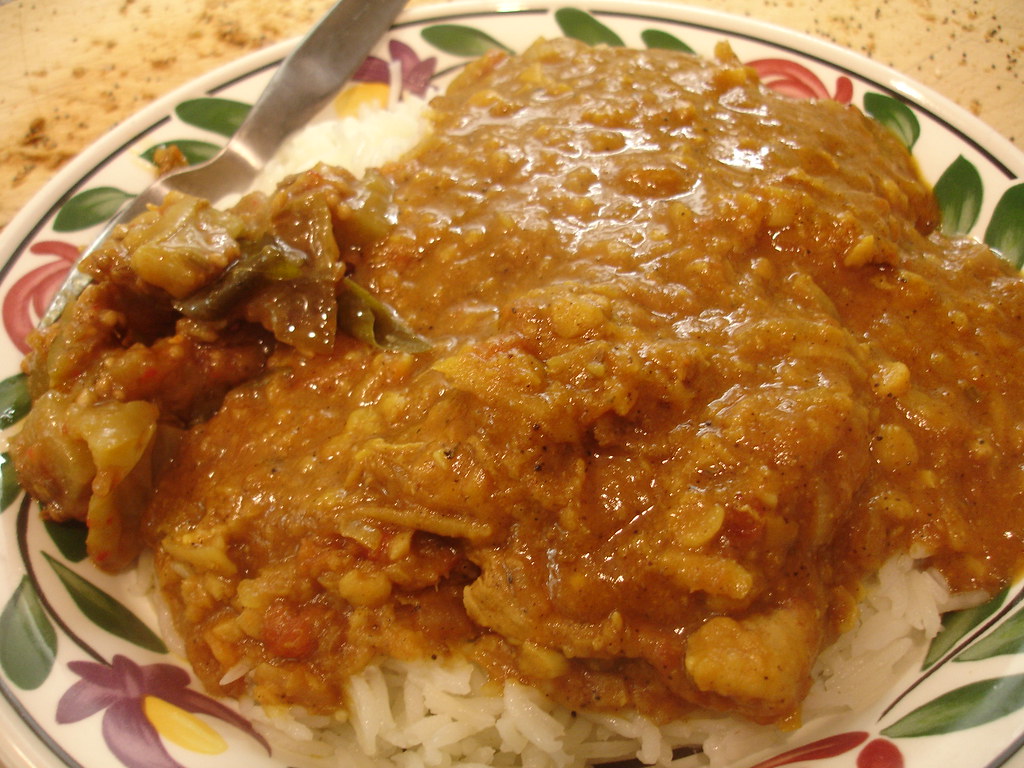
Chicken Curry


(It's hard to photograph curry looking appetising.)

Ok.  This time I have nobody to blame my recipe backlog on.  It's just built up.  I was sort of waiting for the bacon to be cured before writing about it, and then I made this the other day and only found time today...  But!  This is the best chicken curry I ever made, and I made it more or less by accident.

A few weeks ago, I wanted a stir fry.  Just...did.  I was also feeling extravagant, which meant that my stir fry needed meat in.  Chicken breasts are depressingly easy to cook into dry blandness, and frankly are expensive.  I buy chicken thighs, or thighs and drumsticks, which seem to be given away for pennies even if they're organic.  They won't be dry when you cook them, and you have bones for making stock and thereby making the money go further.  I buy them bone in.  It's a faff to de-bone them, especially the drumsticks.  But it's so worth it.  You need 20 minutes to do a pack of 4 thighs and 4 legs, and a sharp small knife and something to listen to you while you do it.  Also, not to care that much about what it's going to look like.  Learning the anatomy of a chicken leg will take one attempt.  Mind out for the sharp pin bone that's sometimes in the drumstick, it's easy to break it and leave it in the meat.


 (Today is *caption* day. See that little dried chilli in there? I grew it. From a seed. And then I dried it myself. It makes me very proud.)
But...what you get is bones.  I'm actually more interested in the bones than the meat.  Stock freak.  It takes an evening to make stock.  About 5 minutes prep if you have the bones ready, then 4 hours of simmering while you do something else.  For an ordinary western-type stock, you'd need to have bones, celery, onion, carrot, peppercorns (no salt) and bay in there.  This stock, when I made it, was going to be a noodle soup, so the ingredients you see above are an onion stuck with 4 cloves, a star anise, a dried lime (optional, but I like them - don't use a fresh lime the pith makes it too bitter), a two cubic inch piece of root ginger peeled and coarsely sliced, and a couple of dried chillies.  I covered it with water and simmered as slow as possible.  The house smelled wonderful.  Then, I drained it and reduced it (boiled until smaller) so that it would fit in a container in the freezer.


(stock)

Now, the intention was going to be to make that stock into noodle soup - a mixture of stir fried mushrooms, pak choi and spring onion combined with noodles cooked in the stock, all seasoned with soy sauce, lime juice, sesame oil and sweet chilli sauce.  Clean easy dinner.  BUT.  I was going through the freezer the other day and found a tub of cooked off chana dal (yellow split peas), the remaining boned out chicken pieces and the stock.  In my head, it all became curry.

The chana dal is easy, by the way.  Buy a packet (world food aisle, or wherever the pulses are. World food aisle will be cheaper...), follow instructions (soak overnight, boil).  I could have boiled some red lentils instead while I was cooking the other bits - they don't need soaking and cook in half an hour or so.  They would have been nearly as good, but the stew would have been less thick.  I just happened to have some on hand.

Ok.  So.  This recipe is long and complicated.  Except it wasn't.  I had the components for it on hand from other cooking I'd done in the past.  Which is the reason that I always cook off the entire packet of anything that needs soaking when I have the time, or boil up my chicken bones for stock on an evening I'm in, and freeze them in batches.  It's not putting extra time into a specific recipe, it's just making use of the time I have, I guess.  But.  I will try and repeat this dish in the future and I won't have those things in my freezer.  Then, I'll use an (organic) chicken stock cube and boil up my red lentils as and when I need to cook.  I'm sure it'll still be fine.  If I can remember what I did this time around, anyway.  In reading the H-FW book, I discovered a recipe for a tikka marinade, which is the point of that stage.  Pieces of chicken coated in salt, pepper and garam masala and then fried would also be fine, I'm sure, to cut another step out.

Chicken Tikka Dansak, sort of
Ingredients
For the chicken tikka marinade, with a nod to H F-W:
½ a teaspoon salt
1 tbsp yoghurt
½ tbsp lemon/lime juice
1 tbsp garam masala
1 tsp ground coriander
1 tsp mixed spice
1 tsp ground fenugreek
A golf ball sized piece of root ginger, coarsely grated (I also keep ginger ready grated in ice cube trays in the freezer...anal? Moi?)
2 large garlic cloves, crushed/chopped
1 hot green chilli, finely sliced (also in the freezer - who the h*ll can use all of one of those bags of hot little chillies they sell in the supermarkets before they go off?!)
1 tbsp flavourless oil

For the curry:
The meat from 3 large free range chicken thighs, skin on - around 300g, cut into large pieces (about 4 per thigh)
2 large onions, sliced into thin half moons
4 large cloves of garlic, crushed/chopped
2 cubic inches or thereabouts of fresh ginger, peeled and coarsely grated
1 tsp cumin seeds
1 tsp ground fenugreek
1 tsp turmeric
½ tsp ground star anise, or half a one
6 green cardamon pods, crushed enough to break them open
1 tbsp garam masala
2 small hot green chillies, stalks removed and cut into three or so large pieces each
1 tin chopped tomatoes
250g (dry weight) chana dal or yellow split peas, cooked to the consistency of mashed potato (see the back of the packet), or the same weight of red lentils cooked in unsalted water until completely soft and as thick as possible without burning them (don't add too much water to start with and keep topping up until they're done)
1 litre good quality organic or home-made chicken stock, ideally with the Eastern spices as described above
Salt, freshly ground black pepper
Around a teaspoonful of sugar
Juice of 2 limes
3 tbsp flavourless oil


Combine the marinade ingredients and rub well into the chicken pieces.  Marinade pieces overnight or not less than 5 hours.  Makes the fridge smell good.  When you start the sauce, preheat the oven to 230℃.

Make the sauce.   Heat the oil in a very large pan and add the cumin seeds.  Fry for a few seconds and then add the onion and a pinch of salt and stir well.  When the onions are translucent, add the ginger (reserving one teaspoonful), garlic and chillies.  Fry again for a minute and stir in the dry spices and whole ones, and a grind of black pepper.  Stir to combine.  It shouldn't look dry at this point, if it does add some more oil or it will burn.  Stir in the chopped tomatoes and bring to the boil.  Simmer for around 15 minutes, tasting after 10.  Add half the sugar to bring out the flavour of the tomatoes, and taste to see if the flavour is strong enough - it might want more garam masala.  This sauce is going to thin down considerably with other ingredients, so it needs to be strong at this point.  Set aside.

Spread the chicken pieces onto a baking sheet and roast in the preheated oven for 5 minutes at 230℃ and then 15 minutes at 200℃.

While the chicken is in the oven, bring the tomato sauce back to the boil and stir in the cooked pulses.  Add any left over marinade from the chicken.  When it is simmering, add in the stock until a sauce consistency is reached - you might not need it all.  If you add too much, boil until it reduces and thickens, stirring to stop it burning.  Taste - the pulses will mean it wants more salt, sugar and most of the lime juice (reserve half a lime for the end).  If it's not spicy enough, add some cayenne pepper.  Simmer for 5 more minutes, and then add in the cooked chicken tikka and any scrapings from the tray.  Simmer for 5 more minutes and then stir in the reserved lime juice and ginger.  If you discover it's too spicy, stir in some yoghurt or some cream and heat very gently (don't boil).

Serve with rice.  I ate this with Carl last night, and I decided I was so pleased with it that it merited a trip to the curry house around the corner to buy it some nan and some onion bhajis, too...


BACON (and the store cupboard quick supper of choice)


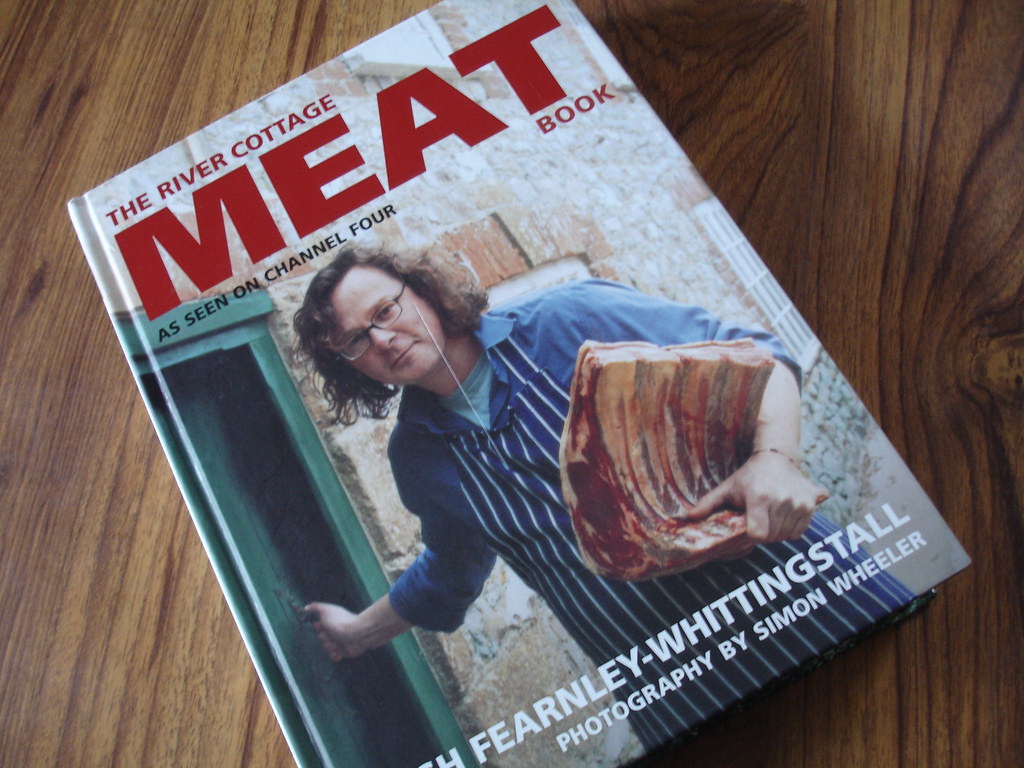
I was given this book for my birthday 3 months ago by my friend Martin, with whom I lived for about half of last year.  He's the most foodie of any of my friends, including those who work in kitchens.  We like Martin, he's ace.  He'd been given a copy himself the Christmas before and had noted quite how much I read it and decided I should have my own copy.  Ace.  It's already had more use (in terms of actual following of recipes as opposed to reading over breakfast for ideas) than many other books I've owned for years.

Hugh Fearnley-Whittingstall is an odd chap, but his is a life I'd like to lead.  Yes, he's a TV cook, which isn't the interesting bit.  He has a farm in Devon where he produces rare breed high welfare meat.  He gives the impression of being more keen amateur than professional chef - an enthusiast.  He did training with Rose Gray and Ruth Rogers of the River Cafe, who were also responsible for Jamie Oliver.  I'd love to eat at their restaurant, they appear to be the grandparents of the modern British food movement.  His food is hearty and exuberant and emphasises all the things that I think are fundamental to the way we eat: it should taste good, it should be respectful of ingredients particularly if any of those ingredients came from an animal, it should show an awareness of tradition but not be bound by it.  This book expounds his 'nose to tail' eating philosophy as well as underlining the importance of understanding meat and meat production in order to make best use of what is a precious resource - which we have the privilege and not the right to eat.  ...having said that, I'm still not keen on most offal.  One day, I will own a cat and a dog and they will eat the offal of the animal and I will eat the rest, and everyone will be happy.  Ish.  It's not like I wouldn't be feeding the pets anyway...  I need to learn to like offal.

 
(finished product)

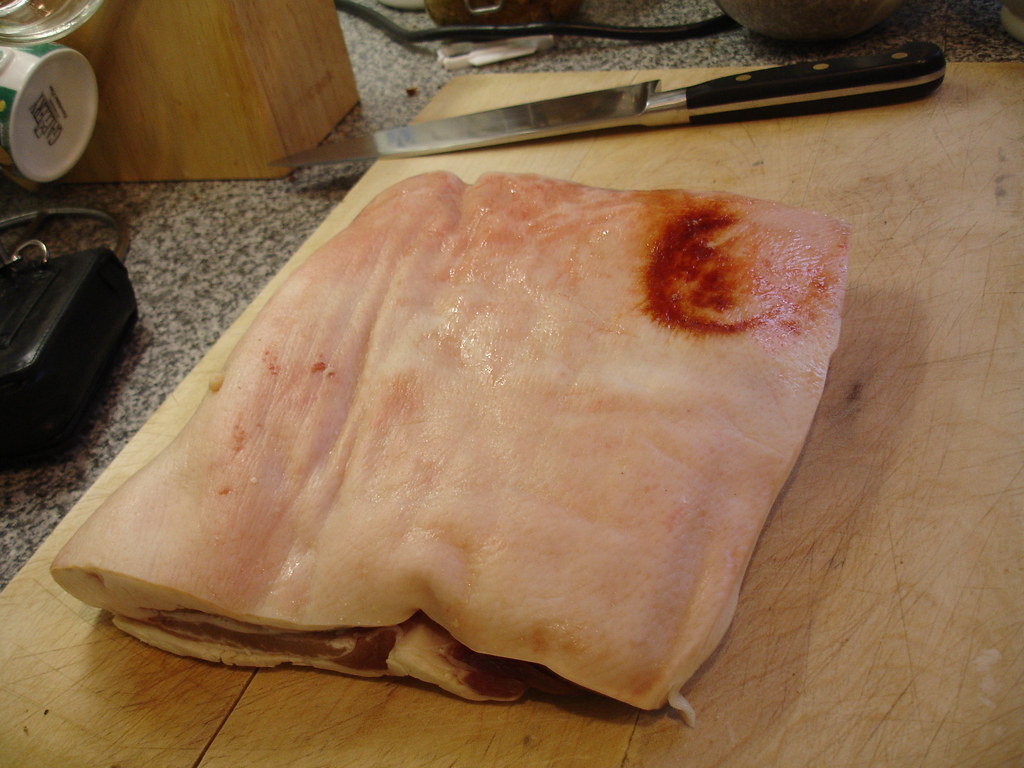
I had a go at making bacon from this a year or so ago, with a good piece of free range pork belly I picked up at the Cambridge Sunday Farmer's Market.  It was a reasonably successful essay and taught me a few things for this time around - for a start, buy a decent sized piece of belly.  A kilo, at least.  The tiny piece I used before was clearly an end, very thin, which meant that I actually needed to cure it for far less time than I did.  H F-W in the book suggests buying a whole belly, weighing in at, at a guess 5 odd kilos.  No.  I don't need that much bacon.  I don't have ROOM for so much bacon.  I guess that's a problem with the book, really.  It assumes you need to feed 20 people at a time and have outbuildings with chest freezers and smokers and space to hang hams and pheasants.  I live in a flat in the centre of town.  My parents have most of those things, but even down there I wouldn't want to hang anything that needed somewhere dry in the llama/STUFF shed.  Not because of the llamas, but because it's so DAMP in that valley.  Anyway.  Everything is scaleable, and it is useful on occasion to know how to spit roast a pig over a wood fire in order to feed 90 people.  (This is quite high up my List Of Things To Do Someday - possibly in the ADC yard next summer.)  I bought a piece of pork belly from this butcher in a village not far from here.  When my mum first stopped eating factory farmed meat getting on for 15 years or so ago now, this company was about the only place selling higher welfare stuff and the two local shops (there are outlets all over the country now) were weekly pilgrimage spots.  They still guarantee meat of higher welfare than practically anywhere else.  It's not cheap, mind!  Pork belly is a cheap cut always, but my 1.3kg came in at £15...  But pork is second only to chicken in the levels of abuse meted out to the animals, and therefore I'm prepared to try that much harder and pay that much more to get it.  Plus, you never need a great deal of bacon in any dish to make it 'bacon-y', so this should last me some time.


(naked belly, as it came)
  
The actual process of making bacon is very simple indeed.  It takes little prep time and no special equipment or unusual ingredients.  It is true that we're only talking about what might properly be called 'salt pork' here - I prefer it smoked myself, particularly for adding to things.  However, I haven't got a cold smoker or anywhere to light a fire and hang the meat for 24 hours.  One day...  So.  You have your piece of belly.  Now, the cure.  Essentially, this is 2 parts coarse salt to 1 part dark brown sugar with some flavourings.  The book recommends a couple of bay leaves handful of juniper berries but I'd run out of the latter so opted instead for 5 or 6 cloves and a few blades of star anise, aniseed always being a good flavour with pork.  I used 100g of salt and 50g of dark brown sugar at first but I had to make up another batch with 50g of salt and 25g of sugar and some more of the flavourings after a few days. I ground up the spices and the bay leaves with a bit of the salt in a pestle and mortar and mixed it all together.  It was sitting on the side in my kitchen for the days I was curing the pork and kept getting added to other things because it smelled fantastic.

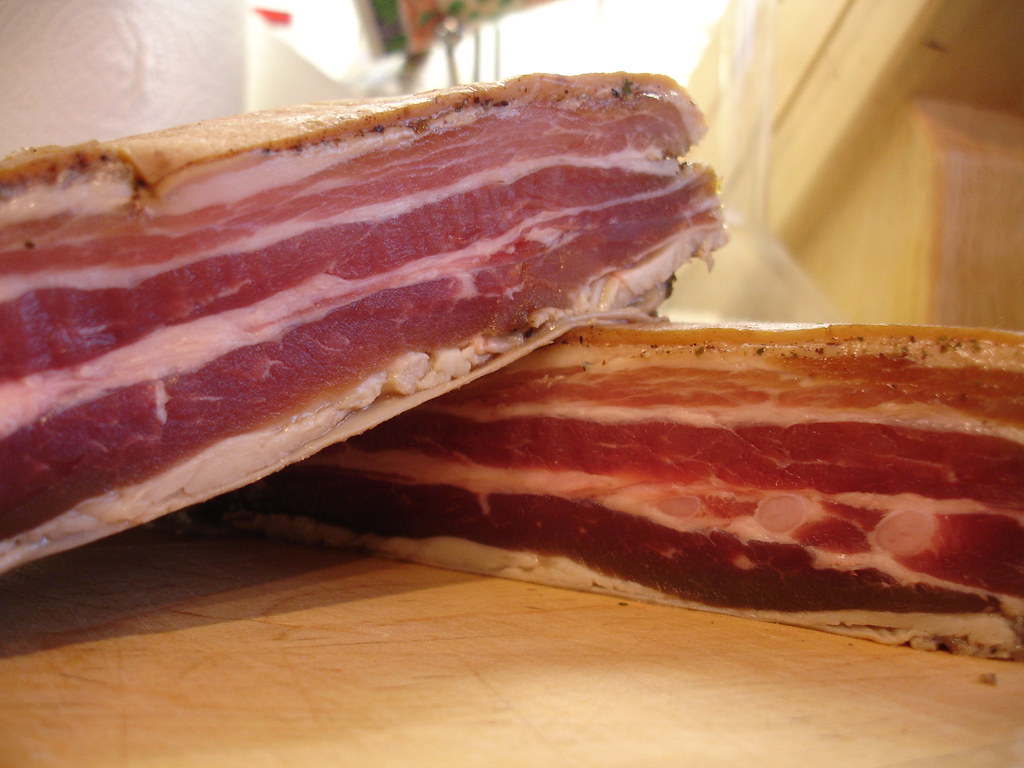
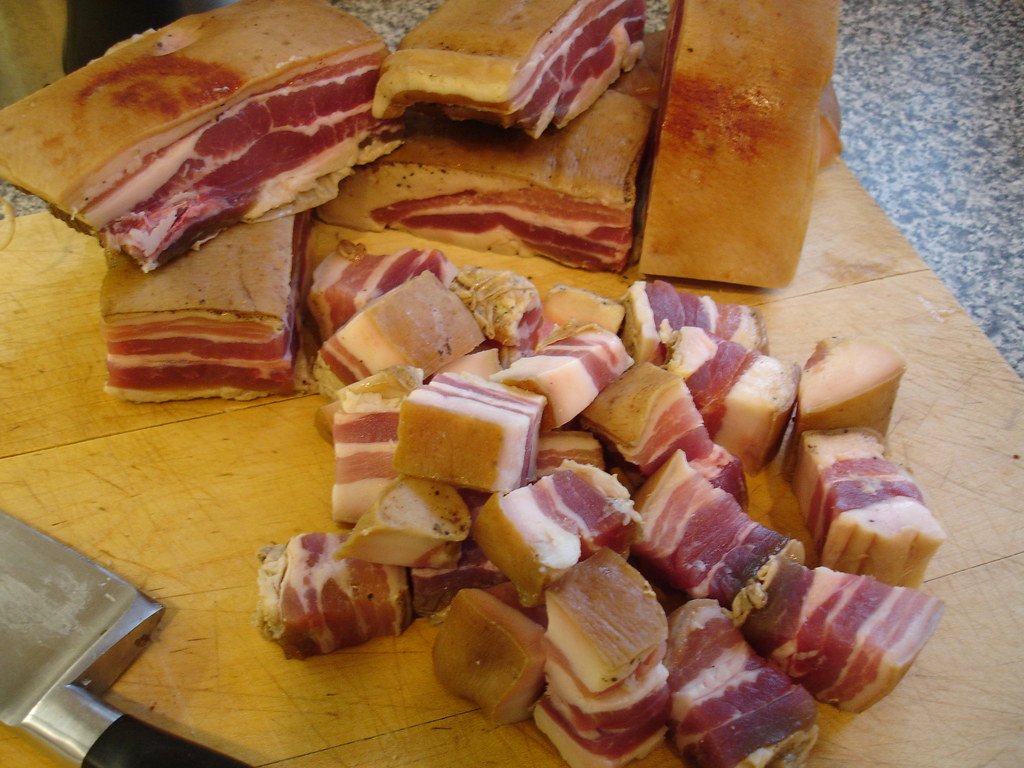
All you do is take handfuls of the cure and rub it into all sides of the meat.  Stick it in the fridge, covered with paper or loosely with clingfilm (not sealed, that's how you grow bugs...).  Walk away.  Come back tomorrow, drain of the liquid drawn off by the salt, rub in more cure.  Go away.  Repeat for about 5 days total.  You can go on longer, which will increase the keeping quality, but it will become only fit for stews and not for frying up.  THAT is it.  How easy is that?  And what you get at the end is this:

(large pieces here for freezing, little bits are quite large lardons for a stew I'm planning for when Charissa! and! Tedd! get! here! on! Friday!.  Chicken, leek, mushroom, bacon, since you ask.  If I'm not too excited by visitors to take photos, I will blog that too...)

A few notes:
  • H F-W suggests adding a pinch of saltpetre (potassium nitrate) to the cure.  This is what keeps the bacon pink when you cook it, instead of turning grey the way pork normally does.  However - saltpetre is a controlled substance because it's one of the ingredients of gunpowder.  My mum has a salt beef recipe I adore that has saltpetre in and which she hasn't made for ages in part because getting hold of this is hard.  However - the average butcher can source it.  She suggested smiling nicely and they might give you a tiny amount if they're reasonably sure you're not going to blow anyone up.  I don't think it's worth the hassle. 
  • When I first made this, I left the belly meat-side down, skin-side up in the cure.  This meant that the skin dried out and was actually impossible to cut let alone eat or use once the meat was cured.  This time, I scored the skin into rectangles (the size in the last photo) just in case, and made sure I put it skin-side down so that it sat in the liquid drawn out.  The scoring probably helped the cure to penetrate as well, and anyway the skin wasn't so hard this time.  So.  Skin-side down.
  • The little pieces I fried up just now to taste from my 6ish day cure were quite salty but no more so than the most salty commercial cures.  Edible, certainly.  The aniseed edge came through nicely.  Next time, I think I'll try smoked paprika and fennel seed along with the bay in the cure.  I like the aniseed note, and I'm hoping that the smoked paprika will add an edge of smokiness that I'm longing for in my bacon...
As for what to DO with home-made bacon.  Well.  I have ambitions around chicken casserole and baked beans, but the way I most usually eat bacon is as part of the immediate I-need-food-now meal below:

Pasta, Pesto, Peas, Preserved Pork Product (...by which I mean bacon. Or salami. Or chorizo. What it says, really. All work great)

Ingredients
Erm.  These are above, really.  There isn't much more to it.  But...for one person I use:
75-100g pasta
A small mug of frozen peas
1 rasher of bacon, about 35g at a guess? Or an inch of sausage. As much as you like is fine, but I hoard my meat products and use them sparingly...
A large teaspoonful of green pesto. Or red. Or even just a clove of garlic chopped small and some olive oil. (If just garlic, fry it for a few seconds (no more) with the bacon.)
Black pepper
Oil for frying

Boil the pasta in salted water, adding the peas for the last few minutes before it's ready.
Meanwhile, shred the pork into tiny pieces.  I'm virtually always doing this from something I've taken straight from the freezer (I freeze bacon in single rashers, or use a large knife and brute force and hack pieces off the frozen together lump...), which means I can get pieces a few millimetres square - just so long as they're quite small so that every forkful of pasta will have a bit of bacon in it.  Fry in a small amount of olive oil until the fat runs and it goes brown and crispy.
Drain the pasta and peas and return them to the pan.  Scrape in the bacon bits and any fat in the pan.  Stir in pesto.  Grind over pepper.  Eat as fast as you can because you have to be somewhere else, being grateful that proper supper took you all of 10 minutes to make.  Don't forget to soak the pan with the pesto in it, that stuff's a pain to wash up...

Wednesday, 13 January 2010

URGENT BERRY SPONGE & CUSTARD


OR:
What To Do When Your Dad's Here For Dinner.

My dad turns up at this flat every couple of weeks.  This is fine.  It's his flat.  I just use it while I'm waiting for the next job.  But I feed him.  Which is also fine, because I like to cook.  Sometimes he takes me for a curry, but I do try and cook because curry every two weeks would be bad for me.

But I tend to forget that he eats lots.  Also fine.  But I have to remember that he eats twice what I eat, and that therefore I need to create food accordingly.  I'm not always very good at this.  When I opened the fridge at four o'clock this afternoon and looked at the quantity of chilli I was planning to use to feed us, along with the couple of bits of cornbread I didn't already freeze and thought about how much rice I could decently serve as well - I realised I was short about a third of a meal.  Hence the emergency berry sponge.


The only useful thing I remember learning in school food tech lessons was one throwaway remark by a teacher, who said that sponge cake was equal weights of eggs, flour, butter and sugar, plus a pinch of salt and some raising agent (1rounded tsp to every 100g of plain flour, or just use self-raising).  I hardly ever look at another recipe now, if I just want sponge.  Oh I tweak it - the equal quantities version always works out a little dry, so I add whatever dairy I have on hand until it's a little looser.  Ideally it would be cream, but usually it's some sort of yoghurt.  That's quite a good one, because the acid helps the raising agent and cakes rise more.  Sometimes I've added fruit purees to it (as for an apple crumble cake, or raspberry cupcakes), often I sub some of the flour for cocoa to make chocolate cake.  It's a great base, and it works even if it's not perfect.  It has the enormous benefit of being easily memorable, so that you never need to look anything up.

My freezer virtually always has frozen berries in it.  I love them.  I defrost a few with a spoonful of sugar and add a dollop of yoghurt and often call it lunch, or a sauce for something else, or a way of getting vitamins.  They're handy.  They aren't necessary for this recipe - jam would frankly have done.  Or golden syrup and pineapple rings.  Or apple sauce.  Or pears.  Or nothing at all.


Berry Sponge Pudding
Ingredients
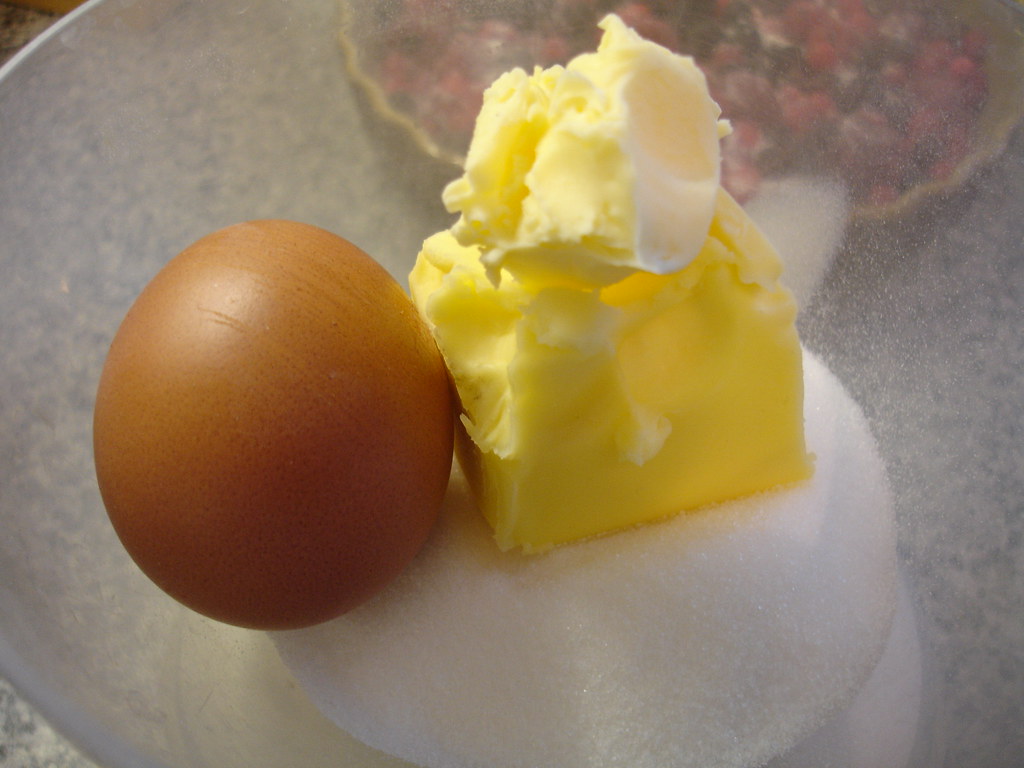
1 medium free range/organic egg
50g butter
50g caster sugar
50g self-raising flour
½ tsp baking powder
Pinch salt
A spoonful of low-fat yoghurt to loosen
Enough frozen mixed berries to cover the bottom of whatever dish you are using (my flan dish above is about 20cm across, and I probably used 200g of berries)
Vanilla or regular sugar to sprinkle over - around 3 tbsp


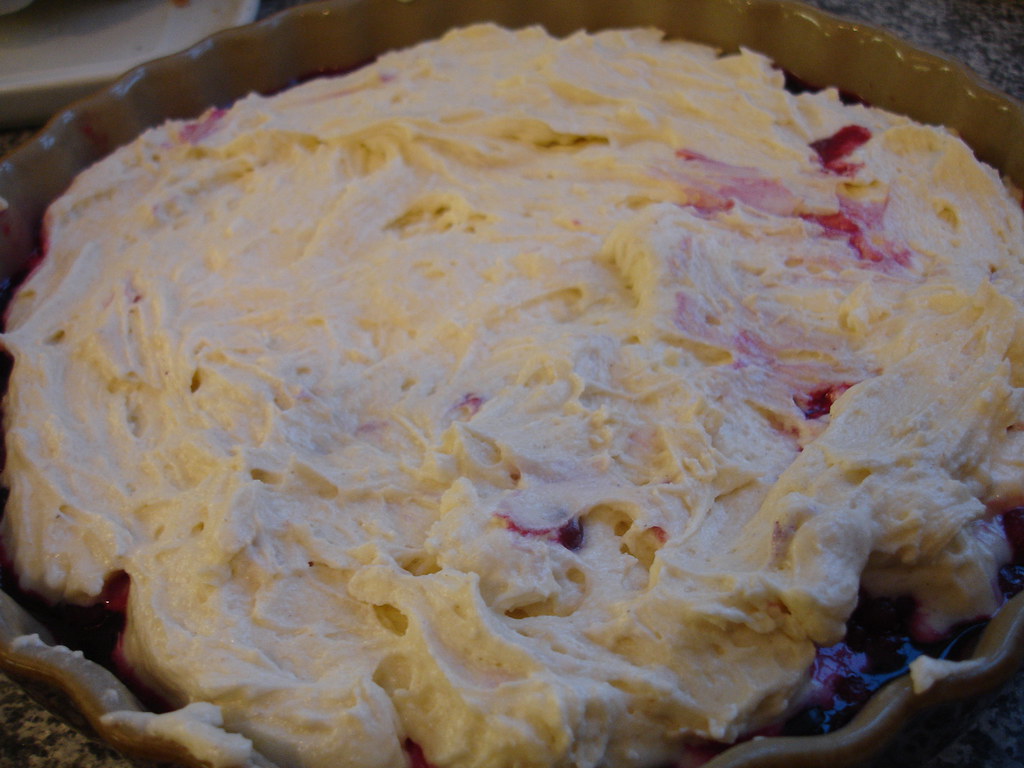
Preheat the oven to 200℃.  Put the berries in the dish and sprinkle with sugar.  Microwave on high for 2 minutes, just to defrost them a bit.  Cream together the butter and sugar until pale and fluffy.  Beat in the egg, then sift in the flour, baking powder and salt.  Beat in the yoghurt if it needs it, just so it isn't so stiff.  Carefully blob the cake mix on top of the berries - it won't be neat, and you can't just dump it all in and spread it out.  Don't worry about the edges, it'll spread out.  Bake in a preheated oven until golden brown and a skewer inserted comes out clean - around 15 minutes.

And because I was making this for my dad, I had to make custard.  Daddy likes custard.  Which meant I had to go and buy cornflour, so I could have come up with a better dessert altogether.  Ah well.  The following is my mother's custard recipe, which isn't nearly as rich as most of the ones on the web, but which means you can indulge without worrying too much.  It's the first thing I ever learnt to cook, I used to eat it on its own.


Real Custard
Ingredients
½ a pint milk (I actually used *1%* for this)
1 egg
1 tsp cornflour
1 dessertspoonful sugar
Drop of vanilla essence (optional)

In a small pan, bring most of the milk to a gentle simmer - just bubbles around the edge.  Keep back about a spoonful of the milk and dissolve the cornflour in it.  When it's smooth, whisk in the egg and sugar until smooth again.  When the milk is hot, carefully pour it into the egg mixture, whisking as you go, then pour the lot back into the pan, still whisking.  Carefully heat until it's close to the boil again and has thickened a bit - it should just coat the back of a spoon.