I took a couple of days off this week. I had been going to take the week off and Traci and I were going to go away, but she's headed off to France to see an old friend before she has to leave Europe sometime next month. I could have cancelled all of the leave, but I was dying for a break and anyway had a lot of things to do - like take vast quantities of stuff to charity shops and start the long and drawn out process of shipping my books somewhere they'll be safe while I bum around the globe for 6 or 8 months. Yesterday, I decided that a holiday was a holiday and I was going to do something with it that I wanted to do and damn everyone else and all my chores. I took some books down to St Albans and then took the train from there to St Pancras and the tube from there to Leicester Square.
And I went to the National Portrait Gallery. I like the NPG. It's not too big, unlike the National Gallery next door, and it's easier to get your head around a more focused form of art than the enormous and wide ranging collections you find in the bigger London galleries. A portrait is a portrait. These days, a lot of them are photographic and I like that. Even the ones that aren't are quite accessible. Also, you get the double interest of the technical and artistic brilliance of the picture itself combined with an interest in the subject. It's about biography as well as art.
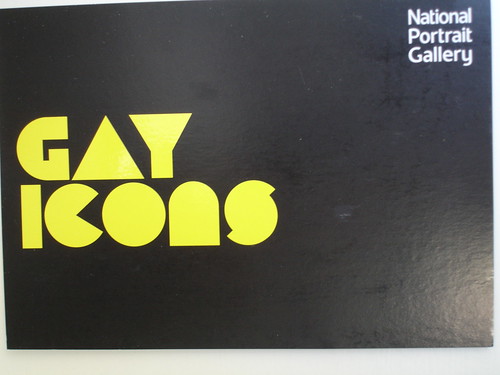
I wandered around the Gay Icons exhibition which I've read a few reviews of. It was put together by a panel of ten selectors, all prominent public gay figures, asked to select six people from the last 150 years, who may or may not themselves be gay, whom they regard as inspirational. I hadn't heard of a lot of the people quoted, though I had heard of most of the selectors. There were few restrictions placed on the selectors, which meant a nicely diverse range of figures quoted. Lots of artists of one sort or another - from porn stars to drag queens to poets and composers, sports people, martyrs like Alan Turing and Harvey Milk, activists like Peter Tatchell who work for gay rights and others who have worked for other causes - Nelson Mandela for example, and various feminists, anti-slavery campaigners and racial equality advocates. The downtrodden and discriminated against everywhere united in the commonality of struggle, I guess.
But the one story that touched me above all others was that of Sojourner Truth, one of Jackie Kay's choices. She was a former slave who worked for the abolition of the practice. The following speech is attributed to her, given at the Women's Convention in Akron, Ohio on the 29th of May, 1851.
"Dat man ober dar say dat womin needs to be helped into carriages, and lifted ober ditches, and to hab de best place everywhar. Nobody eber helps me into carriages, or ober mud-puddles, or gibs me any best place! And ain't I a woman? Look at me! Look at my arm! I have ploughed, and planted, and gathered into barns, and no man could head me! And ain't I a woman? I could work as much and eat as much as a man - when I could get it - and bear de lash as well! And ain't I a woman? I have borne thirteen chilern, and seen 'em mos' all sold off to slavery, and when I cried out with my mother's grief, none but Jesus heard me! And ain't I a woman?"
This is an extract of the version recorded by Frances Gage (see article here) and is almost certainly not historically accurate - but isn't it fantastic? No matter how she said it and what she said, isn't it incredible that a former black female slave in mid-nineteenth century America should have been able to get up and make such a speech? She must have been a formidable lady. She'd have been in her late 50s by this point, having been freed around 25 years previously. Most slaves didn't live that long. To have gone through so much with so little - and to have stood up before men and women of both colours and spoken like that. We who live today have so much to be grateful for. Not that there aren't things to struggle for still - in the West, gay partnership rights across Europe and America, healthcare reform in the US, freedom of speech and rights for women everywhere top a very long list for me - but how far we have come.
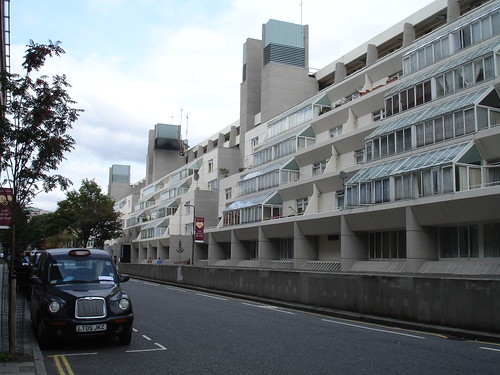
This last picture is the Brunswick Centre. I was wandering back to Kings Cross through Bloomsbury, turned a corner, and there it was.



 Posts
Posts


