Showing posts with label art. Show all posts

Thursday, 25 February 2010

Why do people take pictures?


I've been on holiday.  It's been amazing.  There have been adventures across Europe with people of at least 4 nationalities.  I have made a lot of bread and muffins and stew.  There has been history and music and charades and poetry and culture.

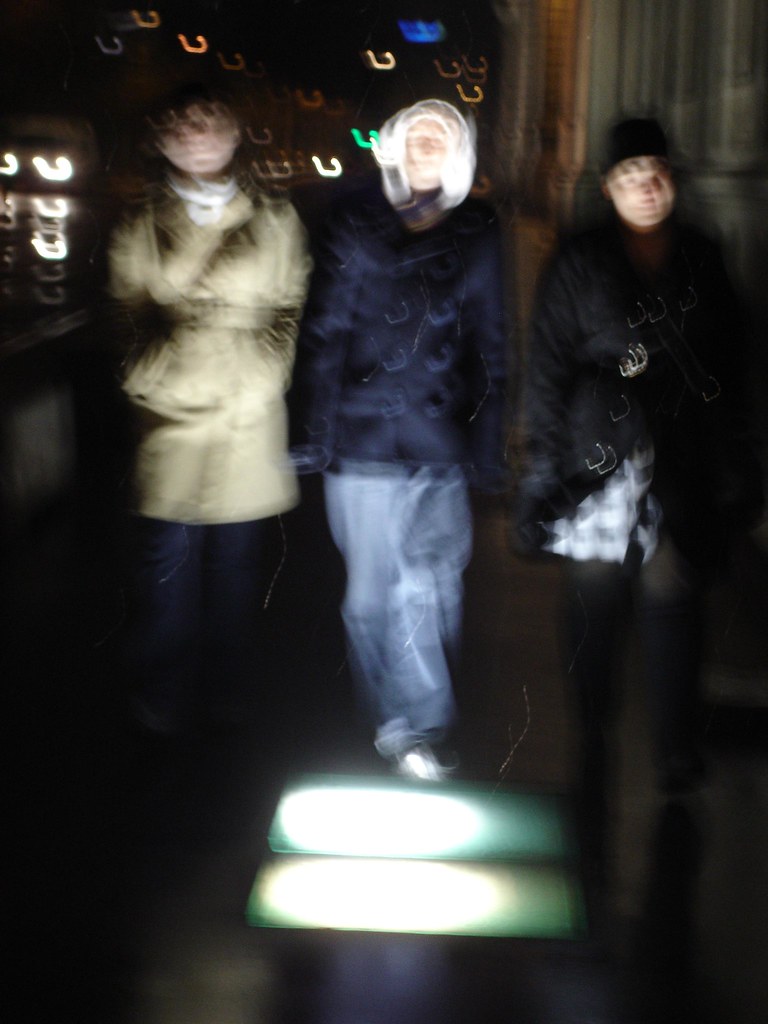
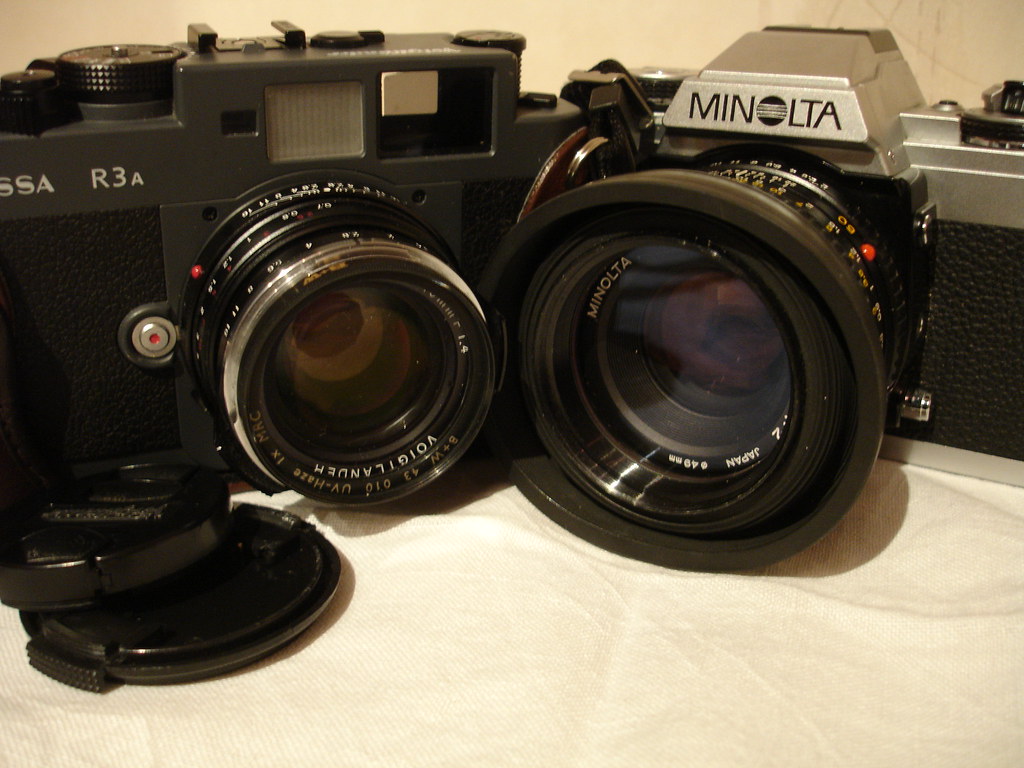
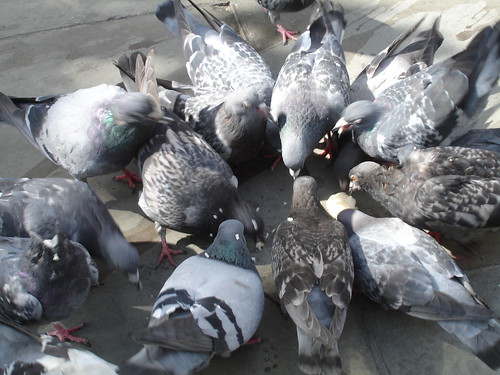
The film camera I had been wanting to use to record it all started sulking on day three.  I was sad.  Instead, I fell back on my trusty little digital that I've been using for ages, my iPhone, and a Holga (not developed yet).  I was disappointed not to be able to take some nice black and whites, but there were compensations - like the shot above.  I was pleased with it.  It's not in focus. You can't see anyone's face. Bits are over-exposed.  But I think those are the things that make it more interesting.  You have to work at it.  The colours and the shapes are pretty.  It has movement.  Admittedly, a lot of this was chance and I had to take a few shots to get one I liked.


I guess people take pictures for different reasons.  *I* take pictures for different reasons.  If I'm posting a recipe, I take pictures of the dish for illustration or direction - recording-type purposes.  If I'm taking pictures when I'm out, I want more than just a record of what I saw - unless what I saw was worth it all by itself.  I want a capture of a moment or a place or a time or a mood.  I want thought not just a picture.


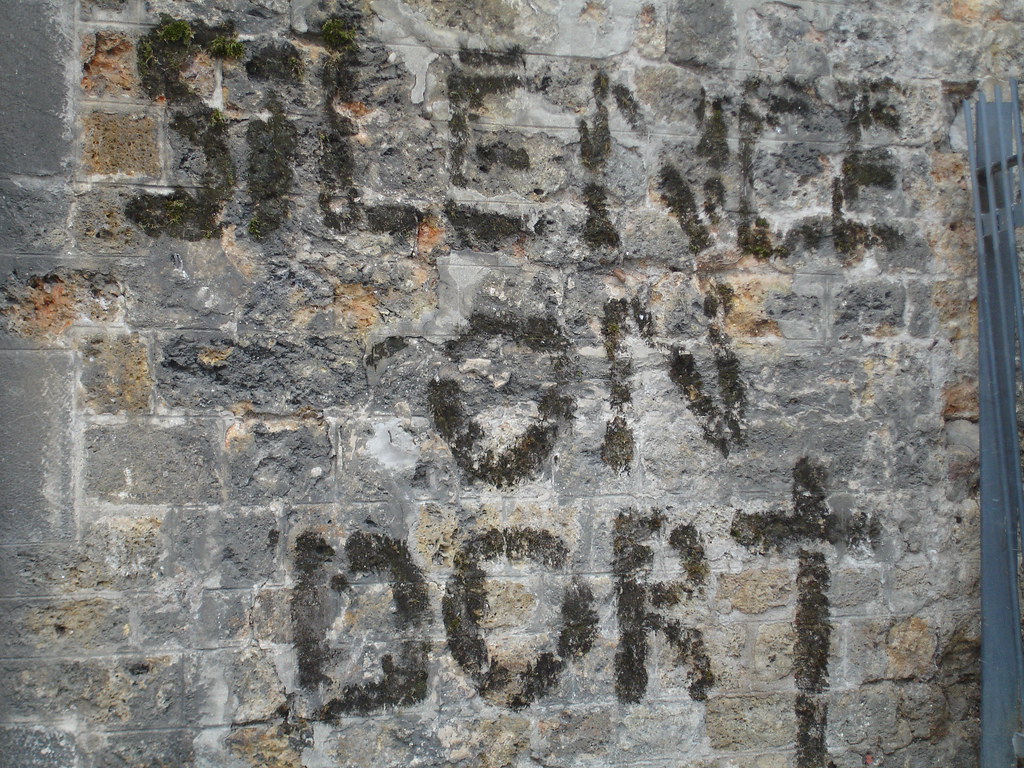
This piece of graffiti was on the wall beside one of the gates to the Père Lachaise Cemetery in Paris and was one of my favourites of the whole trip (it means 'Silence! We're asleep!', or thereabouts).  I guess the shot is a record, but I thought it was an interesting enough subject in itself to justify my taking a picture of it.  It really needs some trimming to remove the fence on the right, which is a distraction, but I don't think it really detracts from the interest of the subject. 

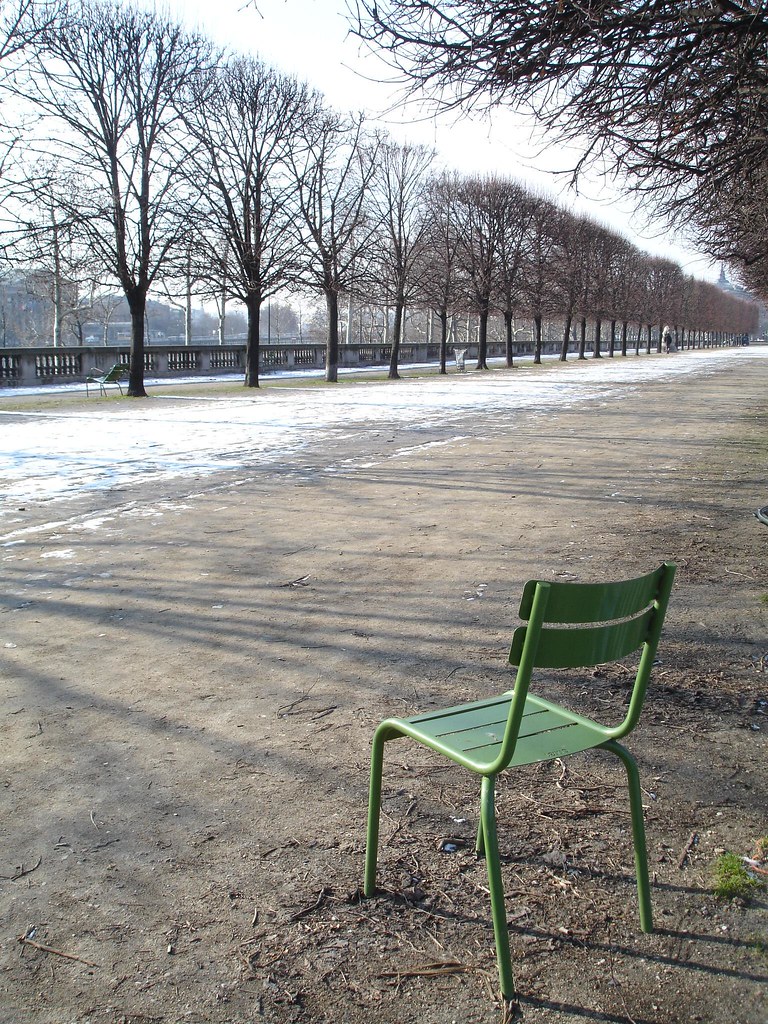
The second shot, of a road in Pompeii, is a bridge between 'record' and 'arty', I guess.  It is a record of me being in Pompeii, but I was also trying to find a way of capturing some of the essence of the day - the light, the fact that I was standing on the same road that people had used 2000 years ago before the looming mountain blew her top, the emptiness of the place and the scale of the tragedy.  Taking pictures of every piece of coloured fresco left behind on the walls wouldn't have had any of that.  Besides, most of such things are fenced off and badly lit - photographers taking pictures for postcards can get in closer and light things properly and take far better shots than I can of those things and their work is on the internet.  I could take the picture anyway - when I'm using a digital camera, it's not like taking pictures costs me anything - but what would it achieve?  Would I ever look at it again?  Unlikely.  Would anyone else? Maybe I'd show something particularly exciting to other people, to give them a flavour of what I've seen and pass on my enthusiasm, but they aren't going to want to see 50 shots of bits of ruin.  I'd be bored - why would any of my friends be any different?

Every tourist has a digital camera.  That's a given.  A really hefty proportion of them have digital SLRs.  I'm sure a lot of them do think about what they are pushing the shutter for and why, but the vast majority of pictures I saw being taken weren't ones I would have wanted to see afterwards.  The instinctive 'see something famous or ancient or beautiful; quick push a button and move on' I find faintly offensive - especially when the subject genuinely IS ancient or beautiful.  Where is the reverence?  Where is the appreciation?  In Pompeii especially, you're looking at somewhere thousands of people died.  That's a big deal.  I went to the Musèe D'Orsay while I was in Paris.  It contains some of the greatest masterpieces of European art of the last 200 years.  It's a fantastic experience, even crammed as it was the day I was there.  At every picture, there was a bundle of tourists taking pictures.  Clickclickclick.  WHY?  What purpose does it serve?  How is your little photo, with its bad angle and reflection and other people around you, remotely doing justice to this work?


Don't get a better camera.  Take better pictures.  Ones that make the world more interesting or add something, not ones that reduce it.  Enhance.  Appreciate.  An aim for life...

Tuesday, 22 December 2009

Taking pictures.


I love taking pictures. Partly, I like the recording nature of it – I've always been one for salting away experiences to come back to later. That's not a small part of the reason I've always had diaries and blogs and things; ever since I was about 12 I've written pretty regularly about things that were happening to me. That Wordsworth quotation I've talked about before from the Preface to the Lyrical Ballads, about poetry being 'the overflow of powerful feeling remembered in tranquillity is relevant, I think – something about re-living, re-interpreting, making peace and learning might be some explanation as to why, along with a nebulous feeling that there might be some kind of quiz at the end and I ought to take notes. It's kind of strange to go back and read what was bothering me when I was 16. There are events in that year's diary that were clearly central to my existence that I cannot recall at all now – arguments with friends and places I went and things I did. Which just goes to show how little grown ups really remember about what it was like to be a teenager at school and the effect that inter-friend rows or worries about grades or whether that boy liked you or what your friends thought about what you were wearing had on your life. You learn to deal and your dramas gain context but such things are never actually easy - when you're that young it's so much more powerful for being new. That was the year I had been given a day by day journal, and I did write in it every day. Highlights* include my GCSEs and losing my virginity. I've just been given another daily journal for Christmas, so we'll see whether I can manage to keep it again. The way I write has changed a lot though. I have this for anything contemplative and my journals tend to be angsty and aggressively personal, for working out the things that bother me. We shall see.

Photos are part of the record-keeping, the knowing what the world looked like and felt like at a particular time in my history, our history. If they can be beautiful to look at too, that's an advantage. They can't be lie. Even Photoshop can't really lie, you can always tell. That expression on that person's face is really there. He really did spill a pint over her just when you pressed the shutter.

I'm not qualified to discuss graphic art. Mostly, I don't get it. Oh, I have some understanding I think about perspective and spacing and light and colour and even composition when I'm thinking hard so that I take pictures that are usually conventional and can sometimes be nice or maybe even engaging to look at if I get a good one, but I don't understand the context of it all. Of where pictures might fit in the timeline of other pictures, of what the journey is in history – where from, where to and why. Why people pay such large sums of money for things very often eludes me. Why is that black canvas with red squares on it worth so much, when you get right down to it? Is it exclusivity – the fact that you have something that everybody wants? I look at pictures for a mood or a story, in much the same way that I might read a poem but much less hard. If I saw something perfect for the purpose, I would buy something to hang on the wall – but that would be to reduce something that might contain a great deal of social comment to a mere ornament...wouldn't it? Maybe not. It would depend how I looked at it – whether or not it just became a thing. But I probably wouldn't buy something truly disturbing to hang on my wall. I may well buy a copy of a book I found disturbing – that would be a reason to buy it. There's more of the argument about the function of art in there but I need to do more reading before I talk about it again.

There seems to be an obsession in photography with the capture of the moment. Which makes sense – the two biggest things it has going for it as an art-form are accuracy and speed. The best pictures I've seen seem to be where that aim is most clearly realised. Sometimes that means a picture where you can look at something for a long time that you can only see for a split second in the world, or a picture that shows you something you wouldn't think to look at because your eyes pass over it, or a shot that makes you re-evaluate something (object, person, concept, anything) that you know well because it's taken in a strange light or at a strange angle or out of context of out of focus - just a little twisted away from your own view of things. Much like the best literature, I guess. Those pictures have stories. They are the ones you're still thinking about a week later. This is why I object to overly posed, or at least badly posed, photos – it's not a moment that you get in a posed photo, unless it's done brilliantly. Which it can be. Just...it isn't usually, even by people who should know what they're doing.

Graham and I went round the Taylor Wessing Photographic Portrait Prize Exhibition at the NPG yesterday. The shot that won was of a teenage swimmer preparing for the Olympics. It was a great photo – it was. The girl was there dressed in a swimming costume, not looking like a model and looking very seriously straight out at us. She was sharp in focus and the background was nicely blurred. Everything was blue. She had a plastic foot. Graham was suggesting cynically that this was why that portrait had won. It was engaging as a shot, I guess. I can remember the expression on the girl's face even now, and I can't have been looking at it for more than a minute or so. But t the time I wasn't grabbed at all, for all I stood looking at it trying to understand how it was 'better' than the shots around it for a while. Sitting here now, I can feel more in the picture than I did then, though I now might be imagining it – they didn't have a postcard for me to buy. Out of context, I can see that there is a story in the determination of a teenage girl training to be the best in the world. The foot is irrelevant in that context. I'm also haunted by a shot of a boyish girl with scars all over her arms and a portrait of a large and starched black woman sitting on a bench outside a house with two identically dressed little girls either side of her who are both laughing and crying. The first one affected me partly for the very naked portrayal of self-harm, which gave the picture a story that wasn't a subtle one – I'm wondering if that was partly why it didn't win, it was about the subject rather than the photograph, if that follows. The second – maybe too much risk of sensationalism or something patronising? It wasn't either of those things. I'm just struck, like Graham was, by how politically correct the winner was in the face of the rest, many of which drew the eye and the mind much more immediately.

There were other quite dark shots that show the more unpleasant things that humans are, and there was one that we thought was hilarious – of the head and torso of a very happy model, wearing nothing except a belt and a Native American head-dress. Little in the way of thought to the last but it was fun. I think the technically 'good' pictures that don't arrest your thought might as well be illustrations – which isn't necessarily to belittle them, just to ask, yet again, what makes it art? I take illustrations, usually – often deliberately ('I need a picture of this cabbage in order to write about it'; 'I want always to remember that this is how my dog plays on the beach'; 'this walk on this coastline has been beautiful and the light is beautiful and I want to remember it'). Graham takes pictures that talk a bit more, unless for similar reasons he wants an illustration. There is no reason why one shouldn't do both or either both in the same shot. In different contexts, the same picture could be both. That's the thing about a great portrait, I guess – you might have taken this picture of Granny, but it might also speak beyond that surface. There might be a captured expression, or a way of sitting, or a mood, that says something greater about her or about age or about England or about anything else. I want to see the pictures that draw thoughts on the walls.

It's a free exhibition and well worth a glance if you have an hour to spare on Charing Cross Road.

*There should be an 'ironic' html tag.

Saturday, 12 December 2009

Books.


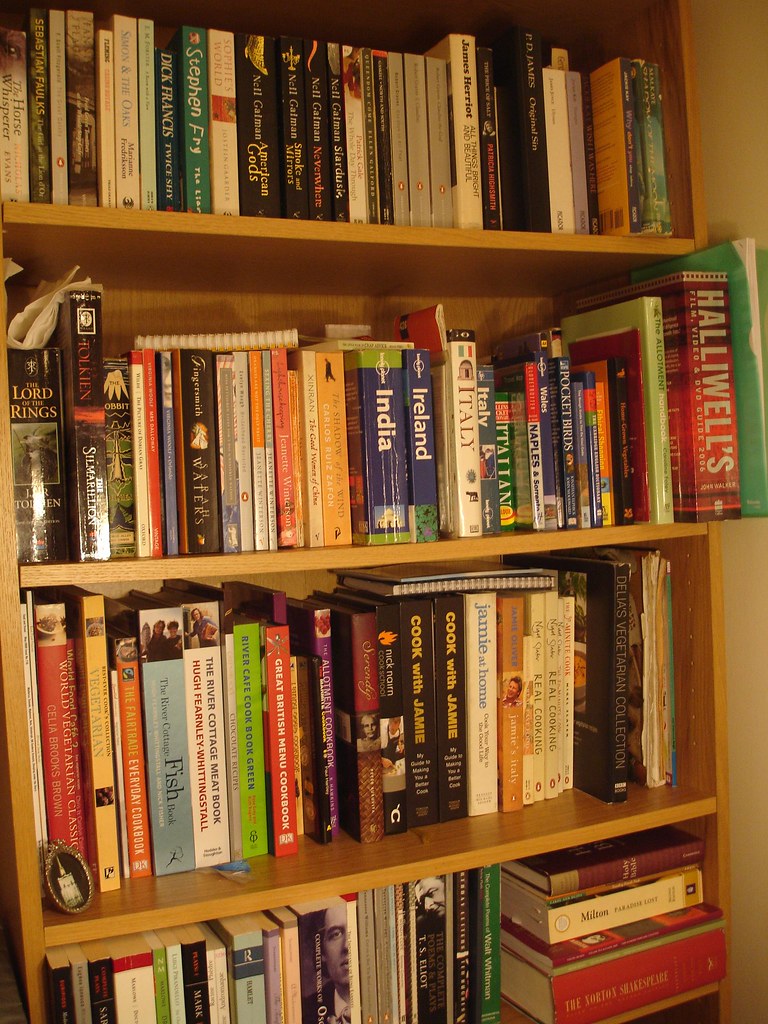
I adore books.  Today, I finally got around to sorting the ones in this flat out.  It's a strange place, this, because it contains stuff belonging to all members of my family which, with the exception of myself, they aren't currently using.  It's things they haven't got rid of but only need intermittently or not at all.  There's a lot of un-thrown-away rubbish, or things left here like a very elderly pair of slippers belonging to my dad or the largest pans we own as a family, 'because I need something when I'm there'.  When I got here, there were 6 loaves of bread in the freezer some of which have been there for months and months (becoming breadcrumbs by degrees).  And around the same number of 2-pint containers of milk, half used and frozen 'for next time'.  I have forbidden anyone buying either of those staples until the freezer is under control...


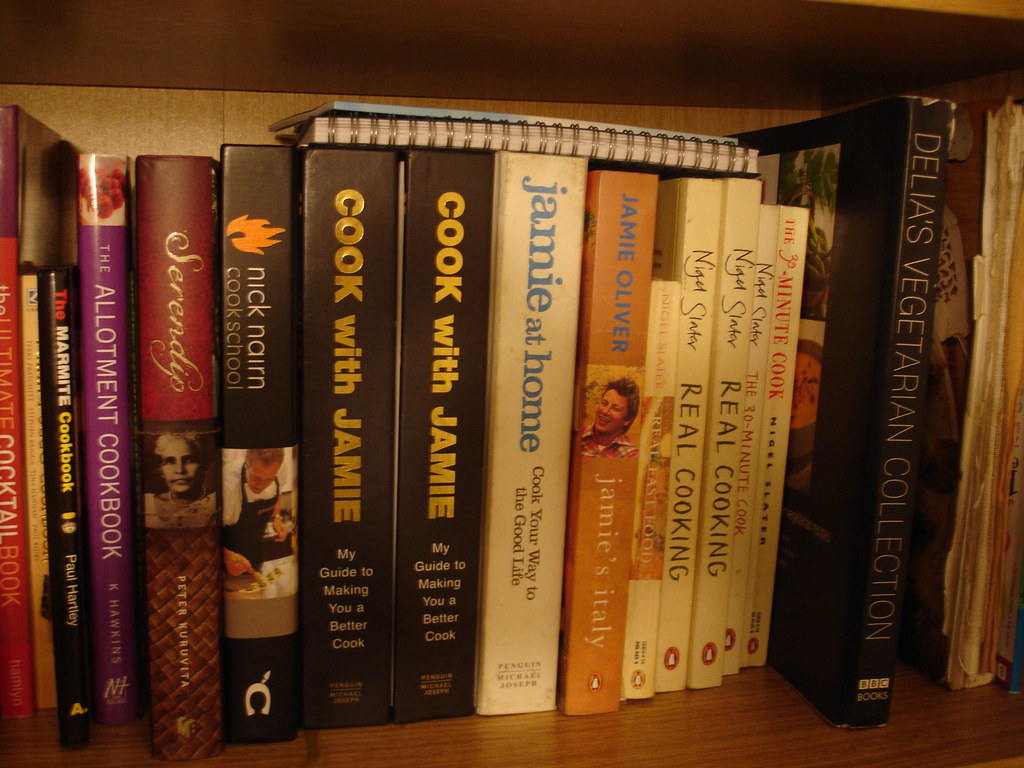
The books aren't that different.  I found a heap of Dorothy L Sayers, Agatha Christie and P. D. James that belong to my mum and her crime obsession.  I organised the cookery books that belong mostly to my next brother and me to discover quite how many duplicates we have between us.  He's living in college at the moment so all his cooking stuff is here.  Still.

There isn't really excuse for the following, though.

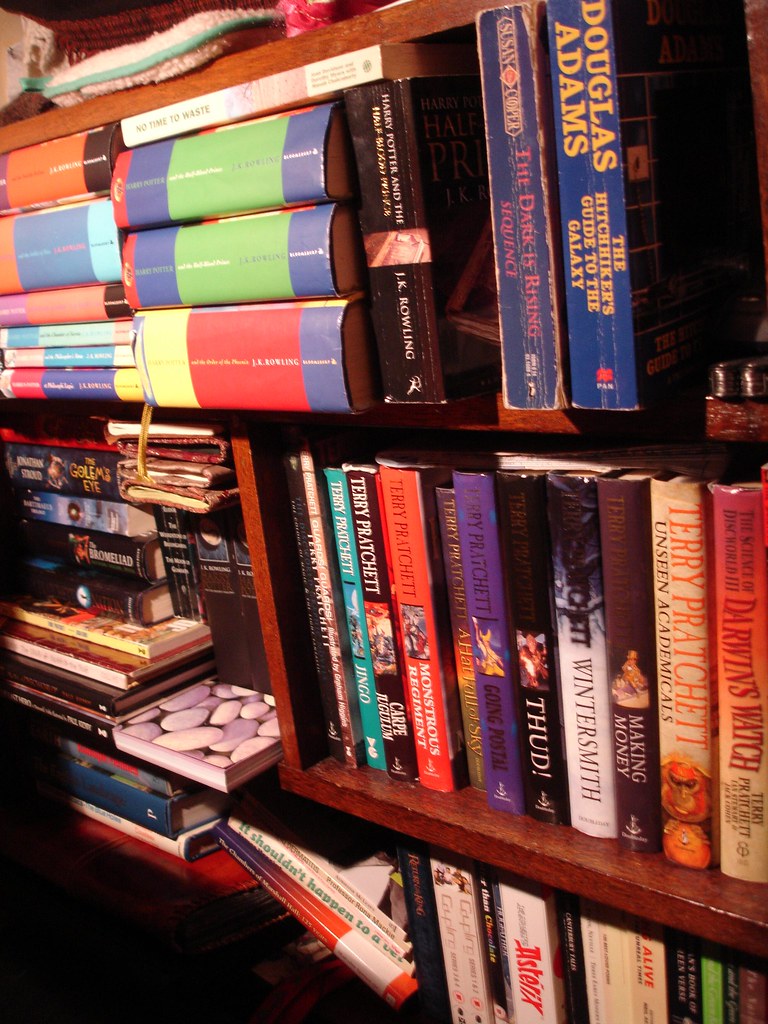
That's *three* copies of The Riddle of the Sands by Erskine Childers, first published in 1903.  It's a relatively little-read early spy novel written at a period that was (rightfully) fearful of German imperial ambitions westward over the North Sea.  It's actually a wonderful read, if you like an action story.  That is no reason to have copies from re-issues in, respectively, each of 1955, 1978 and 1998.  And I first met it as an audiobook, too, which means we have it FOUR times.  I suspect the older two belong to my dad and my mum, and the newest one is mine.  Still.  Not really an excuse.  For Harry Potter we have three copies of each of the last two novels.  That's one for each child, though I suppose that makes sense - we were all living in different counties when those two were published.  I also have the first book in Latin, but that's beside the point.

The duplication is hindering my ability to file things.  I always have this problem.  I suppose I have around two thirds of my books here, and the rest on shelves in Cornwall.  Down there, where I have room for them, they're orderly - divided by genre and then alphabetised.  Here, I've done my best.  Adult fiction is downstairs, along with maps and travel, reference, drama, biography, interesting non-fiction ('coffee table') and most poetry.  Up here beside me is the complete Discworld, 'young adult' fiction (that's the aforementioned Harry Potter*, Philip Pullman, Jonathan Stroud and a few other things - there isn't much space after Terry Pratchett), the irrelevant non-fiction and poetry anthologies.  The main issue is that every single shelf is double-stacked, which means that A-E is behind F-K, etc, and hard to get to and hard to re-shelve.  I haven't labelled things.  I'm debating it.  My family might upset things if they don't notice.  I understand librarians and their constant air of irritation.  It's taken me all day to do this and I hate the thought of it being disturbed.  But I suspect that labelling things might be taken amiss, too...they aren't quite all mine.


I adore books.  It's why I did a degree in English.  I love them for escapism, I love them for learning, I love them for poetry and music and understanding and knowledge and information and discussion and ideas and new thoughts and hope and different moods and people and places to reflect back to myself.  I get totally and utterly lost in stories, I always have.  It's what makes me unbelievably irritating to watch films with - I jump, and gasp and mutter and have to resist shouting encouragement or warnings or advice to on-screen characters even in crowded cinemas.  I usually fail when sitting on a sofa.  That world onscreen is real.  And I feel bereft when I finish a book, or a film, almost without exception.  Putting one down in the middle used to be a very rare occurrence indeed, until my education led to more discerning tastes.  Even now though, I'll probably read the book I've got and then not bother with anything else the author has written unless influenced by some trusted friend.  Once a book is started I feel an obligation to it to finish it.  It's a thing as a whole and never in parts - what comes after modifies what happened to begin with; you can rarely say with any authority that you don't like a book when you've only read half of it, you didn't look at the whole thing.  That irritating foible of style might turn out to be magically transformed later in the tale into something of purpose.  The only exception to this rule is something like a poetry or short story anthology, put together by an independent editor or team.  Any set put together by a single author ought to hold together as a whole, like an album does.  The best of them create something greater than the sum of their parts.  I've never had that feeling about a multi-author collection, there's just too much disparity of style and preoccupation.

I do read several things at once, though, because what I read needs to reflect my mood or I will fidget and not do whatever doesn't fit justice.  I tend to have a volume of poetry, something new to me - probably loosely-defined as 'literature' - and something familiar (still might be some sort of classic or modern classic) or otherwise simpler on the go all at once and will flit between them.  That's often influenced by which is lightest.  I read a lot of poetry collections on trains because they're so little.  I actually don't get on with bookshops and browsing them, it isn't how I read.  I follow threads, looking for influences on favourite authors or books I've heard reviewed or discussed or which come from the same family as something else I love.  I have never been at a loose end for something to read next, not since I first picked up a book.  I have a very well tended Amazon wishlist, which represents fairly accurately preoccupations of the moment, though with a bias towards to trashy because I let myself buy less of it - the 'worthy' stuff gets bought more often.

I virtually never read books created for 'art' that were originally published in a foreign language (non-fiction or criticism is different).  Translation is a difficult and valuable skill, granted, but to my mind it will always muddy whatever the original text said.  Some might argue that translated works should be regarded as something in their own right, and maybe they should, but I don't want my closeness to a text mediated by somebody else.  There was a point that I kept making over and over in one paper of my degree, and I can't now find the reference - about the fact that no reader can truly approach a text in total isolation as advocated by the enormously influential New Critics of the early C20th.  How you understand a given word in a given position is always governed by where you have seen that word, that phrase, a similar word, a rhyming phrase, the same idea, a contrary idea, used in what you have read before - which is influenced by your historical moment, your employment, your gender, your education, your class, what you're listening to...right down to what the weather outside is doing and maybe even what colour pants you put on this morning.**  A translation means that someone else's unique position in time is already influencing how the text can be interpreted, and so one individual's unified creation becomes clouded.  At some stage, maybe I'll learn enough of a foreign language to read well in it, but it hasn't happened yet.  It requires total immersion, I think, to get to the point where your mind feels the connections between things instinctively.  Mind you, there are advantages to being an outsider - I, reading American novels for example, will understand them very differently to someone from that nationality, and it is from such oppositions that the most interesting ideas come from, I guess.  What I read won't be what you read, and from what we each comprehend from a text will a more full and more interesting reading, conversation, philosophy come***.  That is a strong reason for the existence of criticism, for me****.  To do with the exchange of ideas is central in really good criticism and the reason that I read essays on texts I'm interested in, still - even if I'm not writing essays any more.


All of which is a way of justifying the enormously large collection of books I have and will continue to have.  They comfort me and connect me to the world around me and I think they're great.

More about the function of art, from me. I meant it when I said I was keen.

*I keep thinking 'that is the type of thing I'd usually find a reference link for'.  But it's Harry Potter.  No.
**I think this possibly wanders around the edges of Derridan Deconstructionism, should anyone be remotely interested.  Lots of fairly nihilist Post-Structuralist Post-Modernist philosophy about the instability and eventual futility of human endeavour.  Fascinating, but a little dark.
***Edward Said definitely discusses the idea that the Critic should always be in opposition to society in order to be of any use.  Which kind of makes sense.  References...  I *think* this will be in The World, The Text, and the Critic but I couldn't swear to it...
****There's a very great deal to say about the function of criticism - which really means the function and influence of art and literature...the discussion of the POINT of reading.  Academics have been studying it for centuries, which always seems a little uncomfortable to me.  All those discussions could boil down to a justification for their existence, on one level.  In modern times (as opposed to the Greeks), the conversation comes into its own in the Victorian period with Matthew Arnold's seminal essay 'The Function of Criticism at the Present Time' (1864), particularly 'the idea of a disinterested endeavour to learn and propagate the best that is known and thought in the world, and thus to establish a current of fresh and true ideas.'  I find it absolutely fascinating and wrote my dissertation on the function of art and whether or not it is or even remotely should be regarded as philosophy.  I'm aware that other people wouldn't find it quite so interesting, though...

Saturday, 12 September 2009

Ain't I a woman?


I took a couple of days off this week. I had been going to take the week off and Traci and I were going to go away, but she's headed off to France to see an old friend before she has to leave Europe sometime next month. I could have cancelled all of the leave, but I was dying for a break and anyway had a lot of things to do - like take vast quantities of stuff to charity shops and start the long and drawn out process of shipping my books somewhere they'll be safe while I bum around the globe for 6 or 8 months. Yesterday, I decided that a holiday was a holiday and I was going to do something with it that I wanted to do and damn everyone else and all my chores. I took some books down to St Albans and then took the train from there to St Pancras and the tube from there to Leicester Square.

And I went to the National Portrait Gallery. I like the NPG. It's not too big, unlike the National Gallery next door, and it's easier to get your head around a more focused form of art than the enormous and wide ranging collections you find in the bigger London galleries. A portrait is a portrait. These days, a lot of them are photographic and I like that. Even the ones that aren't are quite accessible. Also, you get the double interest of the technical and artistic brilliance of the picture itself combined with an interest in the subject. It's about biography as well as art.

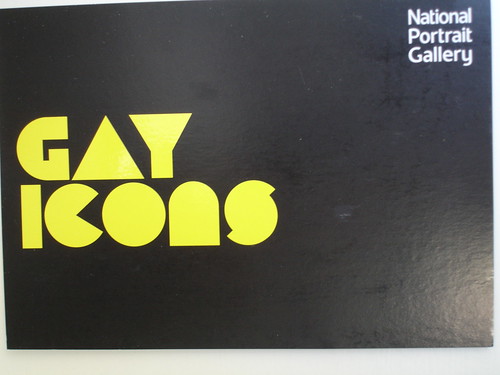
I wandered around the Gay Icons exhibition which I've read a few reviews of. It was put together by a panel of ten selectors, all prominent public gay figures, asked to select six people from the last 150 years, who may or may not themselves be gay, whom they regard as inspirational. I hadn't heard of a lot of the people quoted, though I had heard of most of the selectors. There were few restrictions placed on the selectors, which meant a nicely diverse range of figures quoted. Lots of artists of one sort or another - from porn stars to drag queens to poets and composers, sports people, martyrs like Alan Turing and Harvey Milk, activists like Peter Tatchell who work for gay rights and others who have worked for other causes - Nelson Mandela for example, and various feminists, anti-slavery campaigners and racial equality advocates. The downtrodden and discriminated against everywhere united in the commonality of struggle, I guess.


But the one story that touched me above all others was that of Sojourner Truth, one of Jackie Kay's choices. She was a former slave who worked for the abolition of the practice. The following speech is attributed to her, given at the Women's Convention in Akron, Ohio on the 29th of May, 1851.

"Dat man ober dar say dat womin needs to be helped into carriages, and lifted ober ditches, and to hab de best place everywhar. Nobody eber helps me into carriages, or ober mud-puddles, or gibs me any best place! And ain't I a woman? Look at me! Look at my arm! I have ploughed, and planted, and gathered into barns, and no man could head me! And ain't I a woman? I could work as much and eat as much as a man - when I could get it - and bear de lash as well! And ain't I a woman? I have borne thirteen chilern, and seen 'em mos' all sold off to slavery, and when I cried out with my mother's grief, none but Jesus heard me! And ain't I a woman?"

This is an extract of the version recorded by Frances Gage (see article here) and is almost certainly not historically accurate - but isn't it fantastic? No matter how she said it and what she said, isn't it incredible that a former black female slave in mid-nineteenth century America should have been able to get up and make such a speech? She must have been a formidable lady. She'd have been in her late 50s by this point, having been freed around 25 years previously. Most slaves didn't live that long. To have gone through so much with so little - and to have stood up before men and women of both colours and spoken like that. We who live today have so much to be grateful for. Not that there aren't things to struggle for still - in the West, gay partnership rights across Europe and America, healthcare reform in the US, freedom of speech and rights for women everywhere top a very long list for me - but how far we have come.


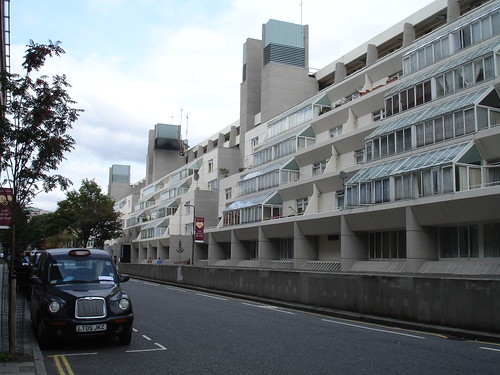
This last picture is the Brunswick Centre. I was wandering back to Kings Cross through Bloomsbury, turned a corner, and there it was.

Tuesday, 4 August 2009

Of the Terrible Doubt of Appearances

Been a while since a poetry post. I clearly miss my degree too much. Enjoy the pretty poem if the analysis is too self-indulgent!

Of the Terrible Doubt of Appearances

Of the terrible doubt of appearances,
Of the uncertainty after all, that we may be deluded,
That may-be reliance and hope are but speculations after all,
That may-be identity beyond the grave is a beautiful fable only,
May-be the things I perceive, the animals, plants, men, hills, shining and flowing waters,
The skies of day and night, colors, densities, forms, may-be these are (as doubtless they are) only apparitions, and the real something has yet to be known,
(How often they dart out of themselves as if to confound me and mock me!
How often I think neither I know, nor any man knows, aught of them,)
May-be seeming to me what they are (as doubtless they indeed but seem) as from my present point of view, and might prove (as of course they would) nought of what they appear, or nought anyhow, from entirely changed points of view;
To me these and the like of these are curiosly answer'd by my lovers, my dear friends,
When he whom I love travels with me or sits a long while holding me by the hand,
When the subtle air, the impalpable, the sense that words and reason hold not, surround us and pervade us,
Then I am charged with untold and untellable wisdom, I am silent, I require nothing further,
I cannot answer the question of appearances or that of identity beyond the grave,
But I walk or sit indifferent, I am satisfied,
He ahold of my hand has completely satisfied me.

Walt Whitman, from Calamus (1860)


Apparently,
this is J. K. Rowling's favourite poem. That article says it's in Leaves of Grass but my collection clearly says Calamus so I went with that. And well she might pick it as a favourite. I don't know much Whitman and bookmarked this to read after someone mentioned it on Twitter. If someone mentions something as a favourite then I'm usually curious to see why, especially when it's not something I know a great deal about. Whitman was too American to feature on my course at university and I haven't really found a good way in yet.

This poem is fantastic. If you just read it for sense, you get the fact that the speaker finds the world confusing, but that it's all ok when he has a friend, a lover, with him. So far, so good. I'm not sure that it's the sort of thing the British Romantics were much into, though it's hard to say. The style is so different from that of, say, Tennyson who was writing at the same time, or of Wordsworth who was a little earlier. I don't recall this sense of vulnerability in Tennyson or Wordsworth, or even this much positivity for much of the time. Admittedly, I found both of them too wet and self-conscious and frankly emo to persuade myself to study them too long so I will freely accept correction on that subject. I love that last line though. When I first read it, I thought 'wedding poem' because of that fantastic sentiment there, though it would have to be perfectly read to convey the sense of it to anyone just listening and not following it along on paper. All the huge questions of existence are resolved by the presence of another and by the fact that they are there with you. What better summing up of a true relationship can there be? It's wedding season at Great St Mary's again, and I shall await someone choosing something other than 1 Corinthians 13 probably in vain...

Wikipedia suggests that Whitman might be regarded as the father of blank verse - look at the line length in the poem and the lack of strong rhythmic, rhyming or even strong structural devices. It's real blank verse in that sense, but far from prose because of the conscious syntax and even type-setting. The hyphenation of 'may-be' all the way through apart from the first instance seems unlikely to be a mere whimsy of the period or of the later editor. Again, I haven't studied Whitman or American writing of this period, so it's possibly that 'may-be' was habitually hyphenated, but even if it was I like that it forces you to take more time over the phrase - both when reading to oneself or out loud. 'Maybe' is synonymous with 'might' in modern parlance. The way we use and understand the word today doesn't emphasise the permissive element in the word 'may'. Today's use seems to allow us to sit back and let things happen. The quick way that we throw the word about means that we never stop to savour the fact that there are several outcomes to something. This construction is more conscious of the fact that something may be or may not be. Whitman achieves what I have there with six words and italics in two words an a hyphen, and then intensifies the uncertainty by repeating it through the poem. Suddenly, it is more important to us that things have more than one possible outcome and that the speaker and we as readers are more uncomfortable about that. This level of confusion and concern is important because it heightens the relief we feel with the speaker when we discover that love and friendship are the things required for peace.

But the construction of uncertainty doesn't end with 'may-be' - he uses the phrase in conjunction with 'doubtless', 'may-be these are (as doubtless they are) only apparitions'. What are we supposed to make of that? Are they apparitions? The juxtaposition of the certainty and the uncertainty only makes our understanding even more slippery. And their are other things, like beginning the poem in the middle of a sentence that is never complete. In fact, all four of the first four lines are dependent clauses without an independent to stand with. They are all missing bits, and we are wrong-footed from the outset. The first nine lines proper of the poem are long run-ons, with interruptions in parentheses. They are hard to follow and one has to read them several times in order to unravel which clauses might go with which. The word 'nought' appears where one might expect 'naught' - the two words are similar but they don't mean the same. How does one resolve it? I went to read the poem in other locations to check that they were printed right. 'Nought' is a number; 'naught' is nothing. We don't normally draw a line between the two that says they are the same thing. ARE they the same thing? It opens more questions.

The second part of the poem is clear. The clauses are easily resolved into sentences albeit still long and complex ones that make sense and follow through, in contrast to the first part. There are no interruptions and no 'may-bes'. Clarity exists in the structure as well as in the sense of the words. It is as though the presence of the friend resolves the potentially complex syntax as well as the 'big questions'. It is all this that makes this poetry not blank verse. The emotional journey of the poem is greatly intensified by the poet's manipulation of our ability to comprehend it. I love it. It's so clever and so well done, and the sentiment is a beautiful one - for all it's a fairly twee resolution of the 'existential angst' theme that so much poetry relies on.

Sunday, 19 July 2009

I have a thing about postcards.

Or rather, just cards in general. I still have nearly every birthday card I've ever been given, though I think they're in Cornwall somewhere. I started running out of space, so unless they were particularly important I began tearing the pictures apart from the backs and recycling the backs. I have some great ones. The postcard thing is slightly different, because it's about images I've chosen for myself. It still have the odd separated birthday card in it, or cards people have sent me and even the odd flyer or leaflet if it had a particularly good image. I have one photo taken by Graham, that fits in seamlessly. I have an ambition of one day wallpapering them all to a suitable wall, but in the meantime, I use the wardrobes.


It probably doesn't look like it, but they're quite carefully arranged. The idea isn't to have areas that are all the same colour or that are too busy. New cards often mean rearranging what's already there so that the newcomer fits. The too busy is a big factor in how I choose images to go in. It's much more effective to have a very simple image on each card, because it gets too hard to see otherwise.


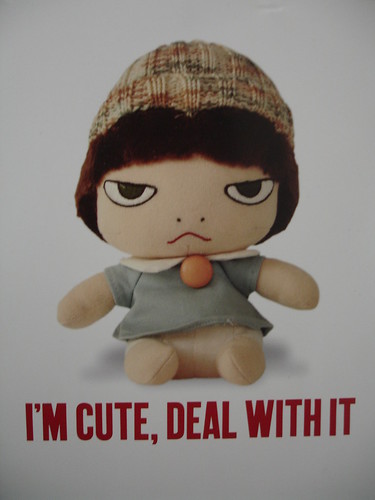
This one is pretty simple - just one object to catch your eye in a sea of more detailed images. It's a flyer from The Baltic Centre in Gateshead. I went to a conference there a year ago, and spent a good hour or two in their shop - they had a Yoshitomo Nara exhibition on, so it was pretty cool. I love the doll - the cynicism and the cartoon aspect of it.


Can't get more simple than that, and it goes quite well with this one:


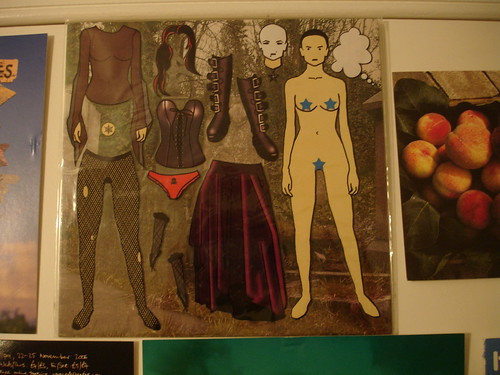
My favourite (at least at the moment...) is this one:

I found it in a tiny art gallery come shop called Frank in Whitstable. I bought about 5 cards in there and found I'd spent about £20. I have forbidden myself even looking at that site properly because I KNOW I'll spend more money.

My postcards range from the abstract (thank you Charissa!) to the silly, from adverts to Darwin and from The Wildlife Photographer of the Year to Joan Collins. I love buying them. It's surprising how much money you can spend on postcards. I don't intend to get into that antiques game, I just find it a nice way of remembering great images.

I pick them up in art galleries, from racks of flyers, from quirky bookshops and gift shops. People SEND me them sometimes...that's exciting. Interesting images from all periods, cultures and places. I remember pretty much where they all came from too. They're an extension of my own photography, part of the same thing. An easy way of having a record of a beautiful thing or place, but also a window into a different time and place. How ELSE could I have a picture of Joan Collins rehearsing dance routines from Seven Thieves alongside pineapples growing at Heligan?

...So. Pretty pictures. If you see one that you think I'd like, post it! And I'll send something back. Then EVERYONE can have quirky collections of of pictures to cover their wardrobes with...

Friday, 13 February 2009

Braindump.

I haven't read or written much poetry in the last few weeks (I did buy Rapture, and I have a stack of books to read that I want to read and that people have lent me - I WILL get to them all!). I feel I have been living it. The heights and the depths and the sheer exhilaration. Oscar Wilde's 'life as art'. Here it is. I found it. It's not always beautiful, it might be challenging, it might disturb - might upset, might make one want to hide. It always has the power to move. It connects - people, places, things, time. I'm scared of it. Scared of not being able to hide in 'illustration' or 'entertainment' or pictures and words that aren't 'art', that I can pretend were art and keep my inner self untouched. That still isn't living, though it can be. There are doors there still to open, in understanding of how we can be together and how we fit into the world. Too far too fast and the doors stick. Time. Understanding. Sleep. These things will make it better. I'm excited by it. Part of it. Surfing the crest of the wave. Coasting down a mountain on a bike still just about under my control. It's a buzz. Incredible thrill.

I love you.

Monday, 12 January 2009

Life as art. Control of existence. The thrill of the individual.

'One should either be a work of art, or wear a work of art.'
Oscar Wilde, 'Phrases and Philosophies for the use of the Young', first published in Chameleon in December 1894

'What is abnormal in Life stands in normal relations to Art. It is the only thing in Life that stands in normal relations to Art.'
Oscar Wilde, 'A few Maxims for the instruction of the Over-Educated', first published in the Saturday Review in November, 1894

'To live is the rarest thing in the world. Most people exist, that is all.'

'It will be a marvellous thing - the true personality of man - when we see it. It will grow naturally and simply, flowerlike, or as a tree grows. It will not be at discord. It will never argue or dispute. It will not prove things. It will know everything. And yet it will not busy itself about knowledge. It will have wisdom. Its value will not be measured by material things. It will have nothing. And yet it will have everything, and whatever one takes from it, it will still have, so rich will it be. It will not be always meddling with others, it will help all, as a beautiful things helps us by being what it is. The personality of a man will be very wonderful. It will be as wonderful as the personality of a child.'

'The message of Christ to man was simply 'Be thyself.' That is the secret of Christ.'

'There is no one type for man. There are as many perfections as there are imperfect men.'

'Man has sought to live intensely, fully, perfectly. When he can do so without exercising restraint on others, or suffering it ever, and his activities are all pleasurable to him, he will be saner, healthier, more civilised, more himself.'
Oscar Wilde, 'The Soul of Man under Socialism', first published in the Fortnightly Review in 1891

'I made art a philosophy, and philosophy an art. I altered the minds of men and the colours of things; there was nothing I said or did that did not make people wonder: I took the drama, the most objective form known to art, and made it as personal a mode of expression as the lyric or the sonnet, at the same time that I widened its range and enriched its characterisation; drama, novel, poem in rhyme, poem in prose, subtle or fantastic dialogue, whatever I touched I made beautiful in a new mode of beauty: to truth itself I gave what is false no less that what is true as its rightful province, and showed that the false and the true are merely forms of intellectual existence. I treated Art as the supreme reality, and life as a mere mode of fiction: I awoke the imagination of my century so that it created myth and legend around me: I summed up all systems in a phrase and all existence in an epigram.'

'At every single moment of one's life one is what one is going to be no less than what one has been.'

'It is tragic how few people ever 'possess their souls' before they die. 'Nothing is more rare in any man,' says Emerson, 'than an act of his own.' It is quite true. Most people are other people. Their thoughts are someone else's opinions, their life a mimicry, their passions a quotation.'

'...every moment should be beautiful, that the soul should always be ready for the coming of the Bridegroom, always waiting for the voice of the Lover.' (NB the references here are to the The Song of Songs)

Oscar Wilde, 'De Profundis', the letter written from Reading Gaol to Lord Alfred Douglas in the spring of 1897

'Preventing oneself from dying is not living.'

'Nothing is really beautiful unless it is useless; everything useful is ugly, for it expresses a need, and the needs of man are ignoble and disgusting.'

'I am among those to whom the superfluous is necessary.'

Théophile Gautier, from the preface to Mademoiselle de Maupin, published in Paris in 1835

Invictus

Out of the night that covers me,
Black as the Pit from pole to pole,
I thank whatever gods may be
For my unconquerable soul.

In the fell clutch of circumstance
I have not winced nor cried aloud.
Under the bludgeonings of chance
My head is bloody, but unbowed.

Beyond this place of wrath and tears
Looms but the Horror of the shade,
And yet the menace of the years
Finds, and shall find, me unafraid.

It matters not how strait the gate,
How charged with punishments the scroll,
I am the master of my fate:
I am the captain of my soul.
William Ernest Henley, 1849–1903

I'm tired today. I suspect some people will read the Wilde quotations especially as displaying a great arrogance in the man, which they do, out of context. But he was a great artist and an incredible man. What's the difficulty with him realising that? He was in enormous pain of the soul when he was writing 'De Profundis', and died not a great deal later. These quotations are, to me, about the relationship between living, truth and art. Ways I would like to be able to be, I suppose.

Here is the opposite, to the optimism of 'Invictus' above. We've moved on by more than half a century, and I suspect the pride and might and strength that was Britain in the late C19 has given way to post-war, post-colonial modernist and post-modern loneliness. I almost feel like writing a piece of comparative practical criticism, there's so much that could be taken from the two of them. If I ever have to set an essay for an English student of any sort...

Both poems express the isolation of humanity, but 'Invictus' imbues the solitary state of man with a proud dignity, whereas in Gunn's poem the 'individual' is resolute, guarding and wary. Both figures are soldiers, and imagery of war is present in both. The soldier of 'Invictus', though, is stalwart, proud, almost optimistic in the face of the enemy. Gunn's soldier is a guard; suspicious, alert - surrounded by mercenaries whose motives and intentions are not to be trusted. The figure is cut off and waiting for things to happen. He seeks, but does not find. 'Invictus' is much more engaged with his world - things happen to him. He is a victim of chance and circumstance, and suffers the buffets of time. But whatever menace the years bring, this man is certain of himself and his mastery of that. Despite the undoubted influence of chance, he himself has control. Gunn's speaker is not certain of himself, he tells us that he 'must/ Find out the limitation/ Of mind and universe.' He does not even suggest why, just that he does not know. There is no mastery here. This is the point at which the dates of the two poems can most clearly be felt; post-Freud and psychoanalysis, the self has become a frail thing. Before the 'discovery' of the subconscious, a man could be certain of his own mind. He need not be scared of it. Undoubtedly, many people in the C19th did feel scared of their own demons, but it was a much more nebulous and less universal thing than it became with the modernists.

The two endings are interesting, partly for their similarity. The epigrammatic two lines at the end of 'Invictus' must be some of the most oft-quoted in all English poetry. Their triumphant air in the face of the adversity of life is uplifting. But it is unrealistic. We know that we are not masters of our fates or captains steering the unknowable course of the soul. The Gunn ending is far more enigmatic but far more realistic, it seems to me. We are born into an unknowing, unformed, vaguely sinister existence - a fog, perhaps a barren wasteland or the possibility of a wasted existence - walk without assistance and alone through all the might-bes and the might-have-beens - all the hypotheses. The final line could be read bitterly, decrying the fate which cuts us off from the world with moats and sentries and darkness, or it, too, could have an element of triumph about it. By the end, the poem has moved past the point where the speaker is 'condemned' to individuality. It is recognised that no problem must be faced until it has occurred. Therefore, with eyes open, despite the fog, which echoes the darkness that Henley recognises in the other poem, we walk through our lives for ourselves - individual, in control, with nobody else responsible for our path. The thought is comforting and terrifying, and the two pieces catch the nuances.

Human Condition

Now it is fog. I walk
Contained within my coat;
No castle more cut off
By reason of its moat:
Only the sentry's cough,
The mercenaries' talk.

The street lamps, visible,
Drop no light on the ground,
But press beams painfully
In a yard of fog around.
I am condemned to be
An individual.

In the established border
There balances a mere
Pinpoint of consciousness.
I stay, or start from, here:
No fog makes more or less
The neighbouring disorder.

Particular, I must
Find out the limitation
Of mind and universe.
To pick thought and sensation
And turn to my own use
Disordered hate or lust.

I seek, to break, my span.
I am my one touchstone.
This is a test more hard
Than any ever known.
And thus I keep my guard
On that which makes me man.

Much is unknowable.
No problem shall be faced
Until the problem is;
I, born to fog, to waste,
Walk through hypothesis,
An individual.
Thom Gunn, something like the 1950s (I WISH I could find better references for this poem, I'd love to read the rest of whatever collection it's in)

Wednesday, 24 December 2008

Adrienne Rich and the Social Function of Art

I was curious about Adrienne Rich after I posted the poem 'November 1968' the other day, and had a look on Wikipedia today, while I was avoiding the statistics textbook that is my work downtime activity. You can read the wiki article for yourself – it's not long. She sounds an intriguing woman, though a bit unbending and extreme for my (English?) tastes. I will reserve judgement until I find some more of her poetry. But I found that she had rejected the American 'National Medal for the Arts' in 1997 on the grounds that 'the very meaning of art...is incompatible with the cynical politics of [the Clinton] administration'. A bit more trawling led me to an article called 'Why I refused the National Medal for the Arts', which she published in the Los Angeles Times Book Section on 3rd August of that year. A lot of the politics she expresses in the article I can't comment on, because they are of their time and place, and I don't know enough about either. She does, however, make a number of assertions for and about art that I'm better equipped to think about.

Parts of the article act as a manifesto for Art, with a capital letter, in the modern world:

'And what about art? Mistrusted, adored, pietized, condemned, dismissed as entertainment, auctioned at Sotheby's, purchased by investment-seeking celebrities, it dies into the “art object” of a thousand museum basements. It's also reborn hourly in prisons, women's shelters, small-town garages, community college workshops, halfway house - wherever someone picks up a pencil, a wood-burning tool, a copy of “The Tempest”, a tag-sale camera, a whittling knife, a stick of charcoal, a pawnshop horn, a video of “Citizen Kane”, whatever lets you know again that this deeply instictual (sic) yet self-conscious expressive language, this regenerative process, could help you save your life. “If there were no poetry on any day in the world,” the poet Muriel Rukeyser wrote, “poetry would be invented that day. For there would be an intolerable hunger.” In an essay on the Caribbean poet Aime Cesaire, Clayton Eshleman names this hunger as “the desire, the need, for a more profound and ensouled world.” There is a continuing dynamic between art repressed and art reborn, between the relentless marketing of the superficial and the “spectral and vivid reality that employs all means” (Rukseyer again) to reach through armoring, resistances, resignation, to recall us to desire.'

This is a subscription to a view of art as higher truth that seems to place it as a sort of substitute for religion. That's a connection other people have made – there is a distinct thread in modern literary theory that addresses the idea of the critic as priest. I'll dig up the reference when I'm next in the relevant loft with that set of files. Art has very often been used to interpret religion, and it might be argued that all that has happened is that art has become the thing in itself, with its own priest-critics doling it out to the masses. I have no problem with that necessarily. Rich herself, however, in the list of adjectives at the start of the quotation, suggests that 'pietising' art will reduce it to the dead 'art object'. So what is art? It is created out of the reaching for a 'more profound and ensouled world', but it is not to be understood or venerated merely as the means to such an end? In the text of Rich's letter to the National Endowment for the Arts published at the end of the article, she states, 'I believe in art's social presence – as breaker of official silences, as voice for those whose voices are disregarded, and as a human birthright.' The idea of 'belief', in this form, is more usually associated with religious faith, and it is almost a godly position in which she places art. It is anthropomorphised into something powerful and active in the lives of the disadvantaged. The idea that art might be the right of all humanity links also with the idea of God as accessible to all. I can't help but feel this claims a great deal for art – it is a product of humanity, rather than something external as any deitic figure is. For myself, I need there to be greater distinction here. It IS still a symptom of the consciousness of society, and its interpretation a tool for social change. Oscar Wilde's useless art is not useless, only useless to those who want to see a concrete result. There are distinctions between use, function and purpose. The preface to The Picture of Dorian Gray, I think, attempts to look at a few of these definitions, but in a typically Wildean coded way, requiring the reader to interrogate the words and their response. That's my dissertation. Let me know if you're interested.

Later in the article, art is 'our most powerful means of access to our own and another's experience and imaginative life.' It is part of the connection between people, then, a means of affirming membership with a group and sharing history and so on. This I thoroughly agree with, but it begs questions about inclusion and participation – does every human being need to connect with art in some form in order to be a true part of civilisation? Does a lack of artistic interest or sensibility inherently prevent integration? It is here that Rich makes one of her most interesting connections, which suggests that art serves a democratic function:

'In continually rediscovering and recovering the humanity of human beings, art is crucial to the democratic vision. A government tending further and further away from the search of democracy will see less and less “use” in encouraging artists.'

Rich, like Wilde, dismisses any overt 'use' for art, but she does imply here that a truly democratic government will find art a worthwhile thing to support. The connections that are created through art have a direct effect on the workings of democracy – as a result of nurturing mutual understanding. This I think is part of what Wilde is trying to get at in insisting that art is useless; he, like Rich, sees that there art has a function, but that it has no tangible use. A sympathetic, and Rich would claim democratic, government will understand its function and support artistic endeavour; a government more focused on commercial gain will believe that it has no 'use'. Here, then, is a purpose for art for those of us that demand it.

There is more to this, though. Rich asks the Marxist question at one stage 'What is social wealth?', implying that the answer might well be 'art'. So is art the symptom of a 'wealthy' society? Or perhaps 'healthy' is an implied synonym here. Several times through the article she draws a link between art and adversity – she points out that 'there is a continuing dynamic between art repressed and art reborn', and later she states that she is writing about 'the inseparability of art from acute social crisis'. So no, art isn't the symptom of a truly 'healthy' society, since in an ideal (and indeed Marxist, as I understand it) society, all would be equal and a great many sources of adversity would be removed. A truly healthy society, then, would have no need of art? Human suffering in one form or another is without doubt a constant, but the concepts of 'repression' and 'social crisis' do not refer to mundane pain or even natural disasters, or any other form of ill except that perpetrated by one person upon another. So, is art impossible in a society where all are equal? I appreciate that such a state of affairs is unlikely to ever come to pass, so perhaps I am worrying needlessly, but it is surely an indictment of art that it can only be produced by suffering and can only accrete as a pearl around the dirt of civilisation. Is art produced in an excess of joy less valuable? I'm sure Rich would agree that art can be produced in such a way, and that such art can indeed be valuable. Beautiful music written to be shared in moments of true happiness is art. I take that on faith. Perhaps there is an argument that says that the art of joy is produced by those who have gone through suffering and thereby know the difference. That's an argument trotted out as a reason that an all-powerful God put suffering in the world. It reduces joy, sadness, art and God though, to suggest that good things only have power in balance with bad things. Or does it? Perhaps we should take a more Buddhist position, that all things have their opposite, and accept that the ideal is a balanced path. But on Rich's reasoning, the middle way would never produce great art. The Wordsworthian 'spontaneous overflow of powerful feelings...remembered in tranquillity' would never come to pass, because the excess would not exist in the first place.

So, art serves an educational purpose, adding to the store of society's shared experience and hence allowing us to act as a cohesive whole. But at the same time, art is produced of repression within society, acting as the opposition pole to the establishment by giving a voice 'to those whose voices are disregarded'. This is Edward Said's position (in Culture and Imperialism...? Will have to check.). But I can't help feeling a little like Oscar Wilde again when he says, 'We can forgive a man making a useful thing so long as he does not admire it. The only excuse for making a useless thing is that one admire it intensely. All art is quite useless.' Limiting art to being made for a purpose is exactly that - a limit. Art can be used for many purposes, but ultimately it must amount to more than these – it must amount to uselessness. It must be able to fulfil all of these positions, and sit easily in none of them. Art requires a complexity that allows it to transcend anybody's agenda. Excerpts can be used in illustration, but there must be internal conflict. It must slip away from facile interpretation. Any such must be recognised as a reduction. And anything that is not a well of questions is not art. At least for me. At least today.